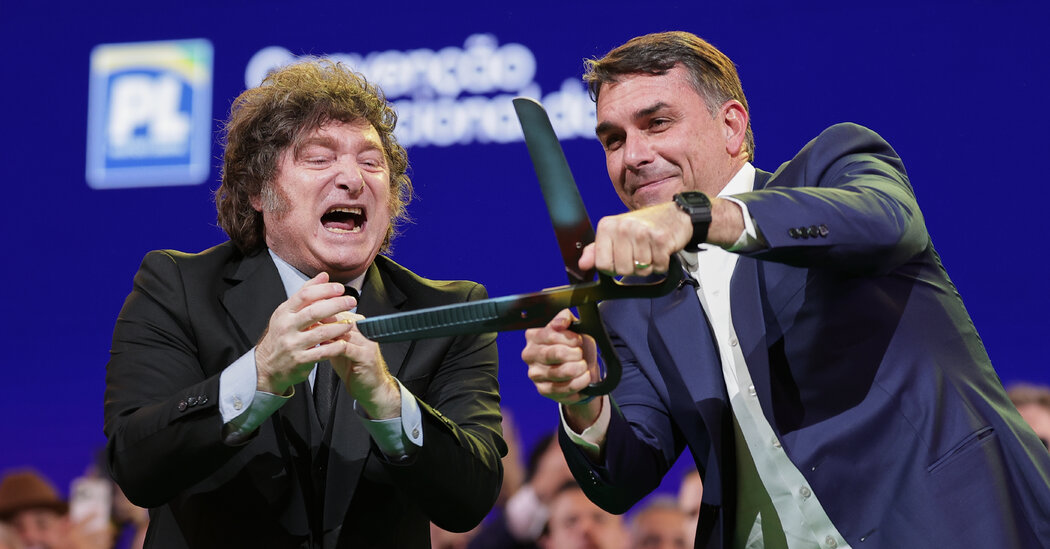
Dancing, beating his chest and hugging Flávio Bolsonaro, the right-wing candidate seeking to become Brazil’s next leader, President Javier Milei of Argentina launched a tirade against Brazil’s current president, calling him a “thief” and “socialist trash.” Milei was looking to help Bolsonaro, who is running against President Luiz Inácio Lula da Silva in the October elections, but that brazen display of camaraderie in São Paulo had consequences. After last month’s event, Brazil recalled its ambassador to Argentina, creating the most serious division in decades between South America’s two largest economies. The episode was just the latest example of the personal alliances and international endorsements that are reshaping Latin American politics, as right-wing candidates win elections across the region. By sharing hardline policy proposals, campaign mascots, and videos of themselves together, they are sending a message of right-wing unity. And, relying heavily on President Trump’s playbook, they are openly intervening in their neighbors’ elections. The rise of right-wing leaders comes as many Latin American voters are frustrated by rising crime and insecurity, and by what they see as the failure of left-wing leaders to address these and other issues, including the economy and immigration. The union of like-minded leaders is nothing new on either the right or the left, as in the long alliance between Venezuela and Cuba. But this new generation of conservative leaders (many of them newcomers to politics) is promoting a new, brazen, often social media-driven version of this dynamic. “There were always political preferences, but they remained veiled,” said José Alfredo Graça Lima, a veteran diplomat and vice president of the Brazilian Center for International Relations. “Now they are explicit.” At the center of the right-wing alliance is Washington, which is seeking to lead by strengthening ties with conservative leaders, including through the Shield of the Americas, a new security alliance against drug traffickers and organized crime. Aligning with the Trump administration can bring rewards, such as bailouts and accelerated military or disaster aid. However, analysts warn that this alignment-first diplomacy also carries potential risks. The break with Lula, for example, could affect Argentina’s relationship with Brazil, its main trading partner, as Milei tries to stabilize his country’s economy. And firm adherence to Trump’s policies, experts say, could mean more instability as the United States attacks ships it says carry traffickers and pressures countries to allow military strikes on land. In Chile, the right-wing candidates who won the last elections differed in important ways and some won by very narrow margins, but they espoused a common message. Many pledged to address the rise in violent crime and achieve economic recovery, pressing issues in the daily lives of many voters. They also adopted strident ideological language. The newly elected Colombian president, Abelardo De La Espriella, has promised to “gut” the left, and Milei has said he wants to defeat the “cancer of socialism.” Whether in opposition to criminals, immigration, or “woke” ideology – “wokism” or “woke culture” – right-wing leaders draw on a shared set of symbols and terms, often echoing Trump and the American right. They also invoke each other, in tactics like adopting the national soccer jersey as campaign clothing, or images like a giant pair of scissors, a nod to Milei’s chainsaw, his symbol of government cuts. Some have promised to build “megaprisons” in the style of El Salvador, whose president, Nayib Bukele, is among the region’s most popular leaders. With the help of social media, they are also finding novel ways to influence each other’s elections. On the eve of Colombia’s first round of elections in May, De La Espriella posted online a video call with Ecuador’s conservative president, who said he would lift tariffs on Colombian products in light of the candidate’s positions. The move was quickly denounced by Colombian officials as electoral interference, but it showed voters that De La Espriella had powerful friends. Updated August 21, 2026, 10:49 pm ET Experts say foreign support has been normalized by Trump, who has supported both candidates. —including De La Espriella and the new president of Honduras—and took credit for their victories. “I love it when I endorse and people win,” Trump said at the inaugural Americas Shield summit in Florida. “Is there any way I can get paid for that?” Experts say the Americas Shield and its military arm could limit its own effectiveness by excluding Latin America’s largest countries, Mexico and Brazil, which are governed by left-wing leaders. What is certain is that the inaugural summit, held at Trump’s Doral resort in March, served as an excellent networking opportunity. De La Espriella, then a defense attorney virtually unknown in international political circles, arrived hoping to rub shoulders and had coffee nearby with Bernie Moreno, a Colombian-born senator from Ohio. He soon drew the attention of U.S. officials to De La Espriella’s far-reaching campaign, including that of Trump, Moreno said in an interview. Lula vs. Milei It is unclear whether this new iteration of partisan diplomacy is merely political theater; Cross-border cooperation between left and right governments on issues such as trade and crime has not stopped, experts say. But at least for Milei, it’s having an impact. In addition to recalling its ambassador, Brazil asked the Argentine ambassador to leave Brasilia, degrading the countries’ diplomatic relations. Experts and diplomats warned that Brazil could intensify its retaliation, which could affect trade relations. A deteriorating relationship with Brazil, warned Mónica de Bolle, a senior fellow at the Peterson Institute for International Economics, could harm Argentina’s ability to pay off its billions in debts to the International Monetary Fund. “Milei’s behavior is not only detrimental to bilateral relations,” he wrote in an analysis this month, “but is also potentially economically destructive.” Lula is not the only leader Milei has distanced himself from. During his term as president he has visited Spain six times but has never met with its prime minister, the leftist Pedro Sánchez. Instead, he criticized Sánchez’s wife, sparking a diplomatic incident in which Spain recalled its ambassador. “There is no benefit for Argentina in picking fights with all these leaders,” said Benjamín Gedan, senior researcher and director of the Latin America program at the Stimson Center, a research center in Washington. “It’s just out of the narrow interest of their brand and their ideology.” Milei did not respond to a request for comment. But his supporters say that aligning fully with Trump has brought enormous advantages, chiefly access to a $20 billion financial lifeline from the U.S. Treasury. They also defended a shift in leftist governments that cultivated ties with Venezuela and Cuba. “Milei made a clear political decision,” Diego Santilli, Milei’s chief of staff, said Thursday, “to return Argentina to the ranks of Western democracies.” However, diplomats say aligning with the Trump administration could also have costs, isolating Argentina on the international stage. Withdrew Argentina from the World Health Organization, a decision that health experts criticized during a recent hantavirus outbreak. Beyond Argentina, voter support for right-wing leaders could falter if they succumb to pressure from the Trump administration, for example by allowing military operations on their territory, said Michael Shifter, a senior researcher at the Inter-American Dialogue, a Washington-based group. He warned that such measures could end up increasing instability and sowing doubts about whose interests leaders serve. — Washington or the voters. De La Espriella has already begun to confront those questions. This month, Secretary of Defense Pete Hegseth announced that the new president would allow joint military operations, causing an uproar across Colombia’s political spectrum, especially since such a major step could be announced by an American. De La Espriella also faced criticism when, after a magnitude 7.4 earthquake, his administration selected only four countries from which it would receive search and rescue teams: the United States, Israel, Ecuador and El Salvador. The move, which Colombian officials maintained was ideologically neutral, nonetheless raised questions from leaders, including Mexico’s president. “In a tragedy, political ideologies mean nothing,” said Héctor Méndez, a well-known Mexican rescue worker. Mexican rescuers went to work in the city of Cali anyway, through an agreement with the mayor. But De La Espriella singled out his Salvadoran ally for praise. “May God bless El Salvador and always strengthen the ties that unite our nations,” De La Espriella wrote in X. “A fraternal hug, president.” Daniel Politi and Patricia Mazzei contributed reporting.