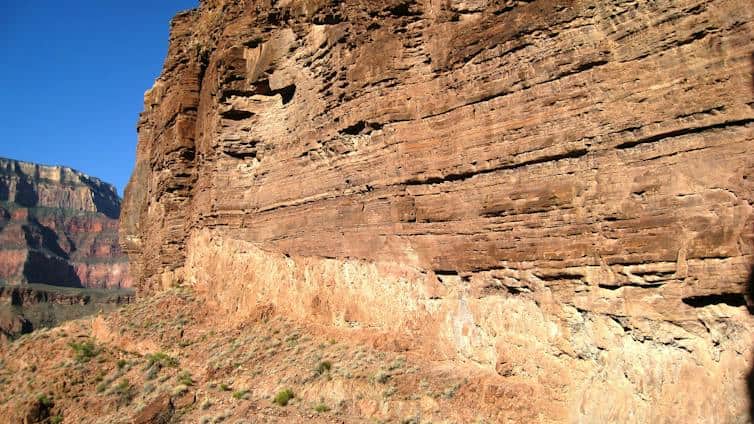
Imagine opening a history book and finding several chapters torn out. This is what geologists examining rock records from Earth’s past discovered on several continents in the 1870s. They called it the Great Unconformity. While rock layers often accumulate in a constant sequence from oldest to youngest, in many places in the world there is a range of hundreds of millions of years. For 150 years, no one has known what deleted those missing chapters. In new research published today in Nature, we finally provide an explanation: processes deep within the Earth lifted some continents far above the sea, where their surfaces were eroded by the grinding movement of enormous ice sheets. The Great Unconformity Rock layers are often stacked in chronological order, with the oldest at the bottom and the youngest at the top. However, in some places, such as the Grand Canyon in North America, you can touch rock layers of two different ages, hundreds of millions of years apart. A flat layer of sedimentary rock, about 540 million years old or younger, rests directly on a crystalline “base” up to two billion years old. The Great Unconformity can be seen in the United States’ Grand Canyon, where ordered layers of sediment lie directly on top of much older solid rock. Brewbooks/Flickr, CC BY-SA Somewhere in between, a considerable portion (up to a quarter) of Earth’s history has simply disappeared. Important things happened at that time. The sedimentary layers of the younger side of the Great Unconformity appear at the same time as an enormous diversification of life forms on Earth. This is the so-called Cambrian explosion, which began about 540 million years ago. Scientists have speculated that entire continents were eroded during the Great Unconformity, which may have altered the chemical balance of seawater and allowed animal life to flourish. ×Thank you! One more thing… Please check your inbox and confirm your subscription. The enigma of the missing rock Geologists have found evidence of the Great Unconformity throughout North America and parts of northern China, as well as beneath younger rocks in northern Europe. However, its origin remains an enigma. Some scientists have argued that it was caused by the erosion of huge ice sheets during the Snowball Earth period, between 720 and 635 million years ago. Others have pointed to the reorganization of continental blocks, mountain-building processes, heat-induced movements within the Earth, volcanic activity or global sea level change. Testing these hypotheses has been challenging because the main evidence consists of missing rock. As a result, we need to work from what we already know to fill in the gaps. How hot rocks can move continents We theorized that the creation of the Great Unconformity could have been influenced by heat-driven movement in Earth’s mantle. The mantle is a 2,900-kilometer-thick layer of hot, solid rock that moves slowly over tens to hundreds of millions of years. The hot mantle rises from the depths and the cold mantle sinks, pushing and pulling on the surface above. This enormous, slow movement can raise or lower the surface by hundreds of meters. The continents lie on top of the mantle and their movement pushes them up and down. We used the Australian Gadi supercomputer to model how mantle movement had affected the continents over the past billion years. Our results consistently showed that mantle convection caused the ancient continental blocks Laurentia (which now makes up much of North America), Baltica (parts of northern Europe), and northern China to rise from about 1 billion years ago to 540 million years ago. Over the past 540 million years, they have been dragged down. https://www.youtube.com/embed/a5W_WnPgqww?wmode=transparent&start=0 The ancient continental blocks Laurentia, Baltica and North China were pushed up by the mantle between 920 and 420 million years ago and then sank. Credit: Santosh Dhungana. This movement of ups and downs is the ideal scenario for the formation and preservation of the Great Discord. When these continental blocks were uplifted, we see that the lower crystalline layer was on the surface and the upper sediment layers were eroded. Then, as the blocks sank, new layers of sediment began to form, which are preserved in the rock to this day. In the Neoproterozoic era (before 540 million years ago), some continents were pushed up by the mantle and experienced massive erosion. In more recent Phanerozoic times, they sank again and new layers of sediment began to form. Santosh Dhungana, CC BY-ND Uplifted continents cleared by ice Importantly, the uplift predicted by our models coincided with the Snowball Earth period. During this period, huge sheets of ice scraped the surface of the continents for tens of millions of years. Glaciers and ice sheets are more effective than rivers at eroding continents, even on gentle slopes. The ice sheets would have slowly slid downhill across the elevated continents, eroding everything in their path. Unlike Laurentia, Baltica and northern China, we found that Australia and South America experienced only two cycles of uplift and subsidence since 900 million years ago. This scenario is not conducive to the formation and preservation of the Great Unconformity and, in fact, we see little evidence of it on these continents. Our research suggests that missing pages in Earth’s geological archive may be due to slow mantle convection that gently lifted entire continents and then caused them to sink over hundreds of millions of years. In that sense, the Great Unconformity is the fingerprint of deep Earth processes. Forces far below our feet have left planetary-scale marks on the geological record and shaped the environment in which complex life first evolved. Santosh Dhungana, PhD Candidate, Environmental Futures, Faculty of Science, University of Wollongong and Nicolas Flament, Associate Professor and Future ARC Fellow, Environmental Futures, Faculty of Science, University of Wollongong. This article is republished from The Conversation under a Creative Commons license. Read the original article.