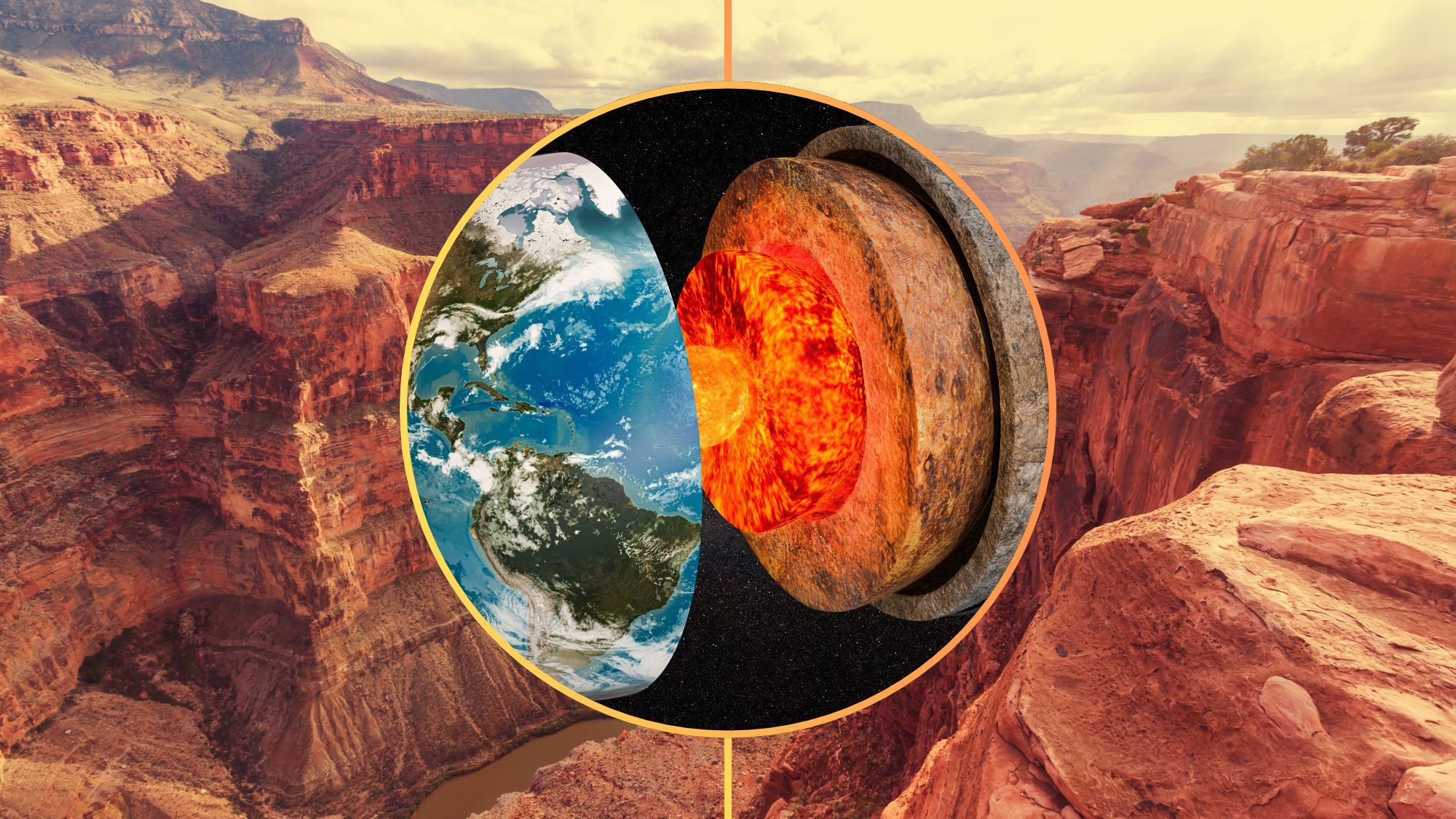
Follow us Add us as a preferred source on Google Newsletter Subscribe to our newsletter More than a billion years of Earth’s history have apparently disappeared. Across the planet, ancient rock formations contain colossal gaps in the geological record, leaving scientists baffled about what happened to the missing chapters of our planet’s past. Now, researchers believe they may have found an explanation, and the answer lies deep within the Earth. Normally, layers of sediment build up over time, eventually forming sedimentary rocks that preserve clues to our planet’s past. Older layers generally lie beneath younger ones, allowing geologists to reconstruct ancient environments and understand how the Earth has changed over billions of years. But the geological record is not always so orderly. You may like In the Grand Canyon, layers of rock separated by hundreds of millions of years sit directly on top of each other, revealing a huge gap in Earth’s geological record. (Image credit: Marcia Straub via Getty Images) One of the most striking examples is found in the Grand Canyon, where rocks separated by hundreds of millions of years sit directly on top of each other, as if some force or phenomenon removed the layers that geologists would expect to see in between. This huge gap in Earth’s geological timeline is part of the phenomenon known as the Great Unconformity. It’s not just about the Grand Canyon. Similar gaps have been identified in Europe, Australia, Africa and Asia. Depending on the location, the missing interval ranges from about 200 million years to more than a billion years. “Imagine a book where a large section in the middle has been torn out,” the study’s lead author, Santosh Dhungana, said in a statement. “The Great Unconformity is that gap in Earth’s history, with the narrative jumping from the early chapters directly to a much later part of history. Our research suggests that these pages were not lost by chance.” The Great Unconformity shown here shows 550 million-year-old Tapeats sandstone resting on 1.7 billion-year-old Vishnu shale, in Blacktail Canyon along the Colorado River in Grand Canyon National Park, Arizona. (Image credit: William Dummitt via Getty Images) What erased the geological record? In a new study published in the journal Nature, Dhungana and study co-author Nicolas Flament investigated whether activity deep beneath the Earth’s surface was to blame. What to read next Using computer models, they explored how the slow circulation of hot rock within Earth’s mantle may have affected the continents for hundreds of millions of years. The results suggest that three large ancient continental regions – Laurentia (modern North America), the Baltic (northern Europe) and northern China – were gradually pushed upward during the Neoproterozoic Era, roughly between 1 billion and 540 million years ago. This would have left vast areas of land exposed to weathering and erosion for long periods, allowing water, wind and other processes. But removing the rock is only part of the puzzle. They also needed to explain why the gaps are still visible today. Their models suggest that the same regions subsequently began to subside as sea levels rose relative to land, sediments accumulating on older, eroded surfaces, creating the sharp divide between ancient and younger rocks that we can still see today and northern China, suggesting that movements deep within the Earth’s mantle may have played an important role in shaping the geological record we see today.