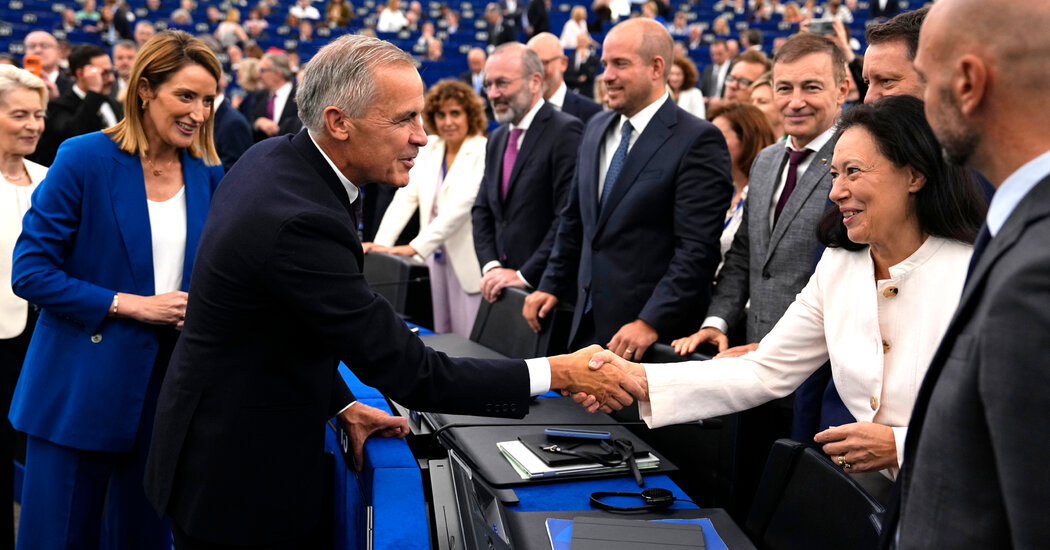
The European Union’s invitation to Canada on Wednesday to become an “associate member” of the bloc shows how determined America’s traditional allies are to seek a more stable future by moving closer together, a move that President Trump said could be perceived as “a hostile act.” As if to confirm the deep concerns that brought them together, Trump threatened retaliation. about Europe, which is a possibility,” she told reporters in North Carolina before a rally. Hours earlier, Ursula von der Leyen, president of the European Commission, told the European Parliament in Strasbourg, France: “We must urgently reimagine our partnerships.” A beaming Prime Minister of Canada, Mark Carney, was sitting next to her. While details on what this relationship might look like remain scarce, Von der Leyen pointed to some potential areas of cooperation, including partnerships in manufacturing, technology, defence, energy policy and economic security. This would not be “a partnership against anyone,” he insisted, “if it were not for our common strength.” Carney’s office also said Wednesday that Canada had formally applied to join the Joint Expeditionary Force, a British-led military coalition of 10 members of the North Atlantic Treaty Organization, seven of which are also part of the European Union. “Behind this there is a desire to protect against what for both partners is an increasingly tense relationship with the United States,” said Ian Lesser, a distinguished fellow at the Brussels-based German Marshall Fund. “But it is not just that it is tense,” he added. “It is the most important geoeconomic and geopolitical relationship for both Europe and Canada.” Carney, the invitation is timely and symbolically important. He has decided to confront Trump, who has imposed tariffs on Canada and periodically threatens its sovereignty. Carney has been pushing for Canada to gain greater access to the European Union (its territory, its market, its funds and programs) without becoming a full member of the bloc. He has found an enthusiastic partner in Von der Leyen, who has described Canada as a reliable source for Europe’s energy and critical raw materials needs, as well as a firm ally that shares NATO membership, support. to Ukraine and a commitment to the rule of law. Von der Leyen does not represent the 27 countries of the European Union, but sets the bloc’s agenda and directs its powerful bureaucracy. The union appears to make sense amid global turbulence and a changing role for the United States. Between them, the European Union’s 27 members have more than 490 million citizens and include four of the world’s 10 largest economies. dense and deep legal and procedural rules, built over decades by a group of nations that ceded sovereignty to each other and to an unelected executive branch in Brussels. Inserting a country an ocean away deeper into this network is not a simple matter. The label that the European Union wants to confer on Canada, “associate member,” is not an existing type of association, which means that it is not clear what actions Canada would have to take to obtain it or to be granted it. “It has no legal basis,” Mujtaba said. Rahman, managing director for Europe at the Eurasia Group “It’s more of a symbolism and a signal,” Von der Leyen was taking a risk by using the term, which had been floating around for weeks before her speech, and caused consternation in several member states, according to European officials. It is considered vague, disconnected from legal frameworks and potentially antagonistic towards countries that already have detailed legal agreements with the European Union. These range from candidate countries such as Albania to close partners such as Britain, Switzerland and the European Union. Norway Those countries have deep trade ties with the bloc and, in the case of Switzerland and Norway, have free movement to and from other European nations. Some Canadian officials don’t seem to like the term either, since being a member of the European Union means losing some of its sovereignty, which is the opposite of what Carney has promised to do. The Conservative opposition leader seized on the term and argued that if Canada was never going to be the 51st state of the United States, it should also not become the 28th member state of the Union. European Union. “There is a lot of good will, but once you start to look a little closer, you also find that many Europeans don’t really know Canada very well, and perhaps they are not fully embracing Canada’s own sensitivities towards sovereignty,” Mr. Lesser said. Hours after Ms. von der Leyen spoke on Wednesday, Canada’s incoming ambassador to the European Union said labels did not matter, but suggested that Canada preferred “alliance for the future” to describe the emerging new link with the European Union. European Union. That phrase also appeared in Ms. von der Leyen’s speech. “I think we are still a long way from reaching what we think is the best way to describe it,” said Jonathan Wilkinson. Three European diplomats said the title “associate member” may not stick. Two officials on both sides are working to find tangible progress that they hope to announce at a summit between the European Union and Canada in Montreal. Canada, aware of the talks, said officials were striving to achieve that goal, but that the work had been slow and difficult, in part because it is highly technical. How difficult it can be to get the European Union to agree on something has been demonstrated frequently over the years. For example, talks on a trade agreement with Mercosur, the South American bloc, lasted a quarter of a century. Canada has its own experience with these EU rigidities, and it has some of its own. with the bloc, in practice for a decade, yet to be ratified by 10 of the 27 member states, for various reasons. Canada already participates in a handful of EU projects, including Horizon, a technology and innovation research effort, and SAFE, a defense industrial program. It had to pay $100 million to participate in Horizon, and other EU programs will likely require Canada to contribute to a budget. Another immediate benefit for Canada from closer ties with Europe. may be to obtain financing from the European Investment Bank. The major development bank, owned by EU member states and with more than $630 billion in assets, is eager and ready to invest in Canadian projects, particularly in critical raw materials, and its leader heads to Ottawa on Sunday to advance talks with the Canadian government. The bank is ready to start work in Canada, a European official with knowledge of the preparations said, but it needed Ottawa to approve certain administrative formalities, such as allowing EU diplomats. work there. Some of the ideas being discussed ahead of the October summit show the ambitious scope of the Canada-EU summit. For example, officials said, Carney wants the bloc to work with Canada to build cloud computing and payments systems that offer an alternative to those in the United States in a bid to secure sovereignty. Discussions have also been underway on a digital trade deal, which could deepen cooperation on cybersecurity and regulatory cooperation. energy, including the monitoring, reporting and assessment system used by the bloc to track methane emissions from ships powered by liquefied natural gas, as well as gas imports entering the European Union market. This is a necessity if Canada is to export gas to the European Union and be able to study at European universities. Because these policy areas depend on complex and politically fraught immigration rules, it could be difficult to make significant progress. Furthermore, any agreement that improves Canadians’ access to Europe would require reciprocity, meaning it would grant equal access to Canada to 450 million Europeans. Some European diplomats have suggested that Erasmus, Europe’s popular student exchange program, could be an easier starting point for collaboration.