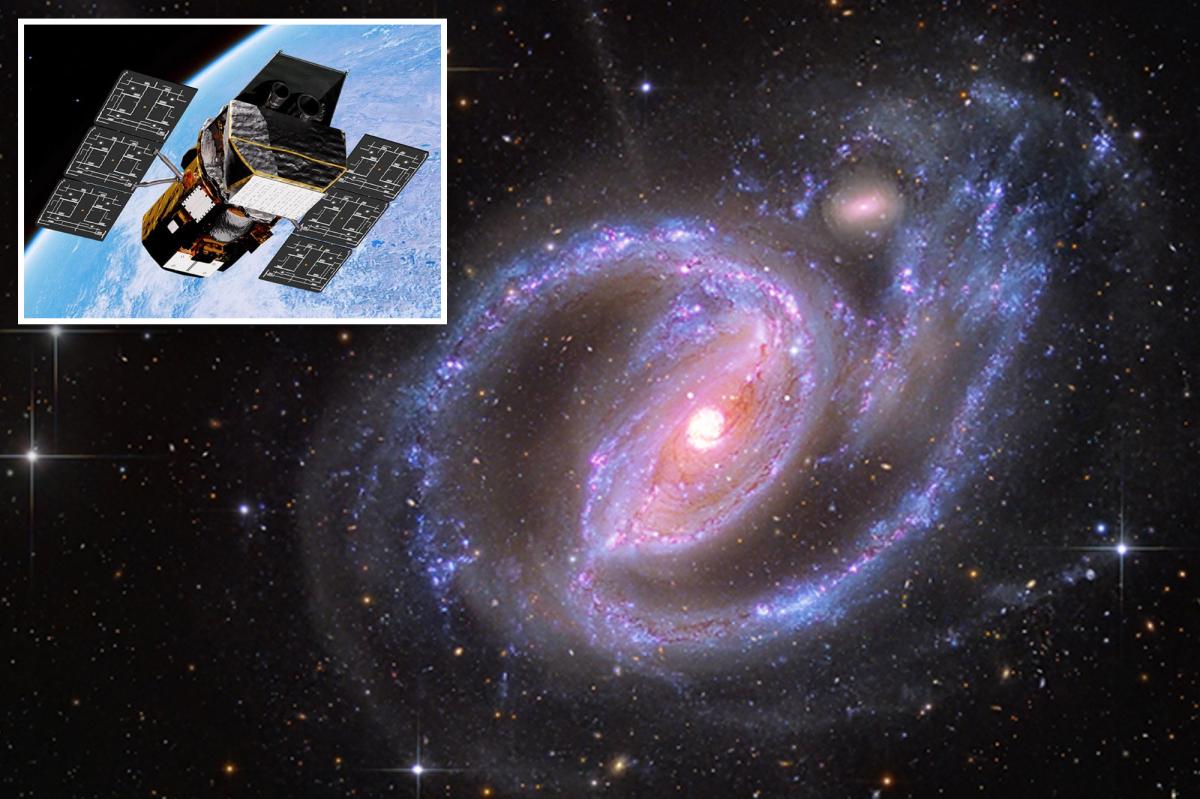
A spacecraft doomed to sink to Earth within weeks has shared new cosmic images. NASA’s Neil Gehrels Swift Observatory was launched in 2004 to detect and monitor gamma-ray bursts, but after 21 years of scientific operations, its low-Earth orbit began to rapidly decay due to increased solar activity. An image shows NGC 1097, a spiral galaxy about 48 million light years from Earth, on Thursday, October 8, 2026. NASA/CXC/SAO/ ESA et al. / SWNS NASA’s Neil Gehrels Swift Observatory was launched in 2004 to detect and monitor gamma-ray bursts, but after 21 years of scientific operations, its low-Earth orbit began to rapidly decay due to increased solar activity. NASA/SWNS An audacious mission to trap and lift NASA’s Neil Gehrels Swift Observatory to a higher orbit failed over the summer. Currently located about 200 miles above Earth, NASA says Swift is expected to re-enter Earth’s atmosphere later this year, potentially around November. The 1,470kg, 5.6m-tall observatory will most likely break up and largely burn, but NASA has not publicly confirmed whether the debris will reach Earth. This photograph published on Friday, October 9, 2026 shows an image of the Small Magellanic Cloud (SMC). NASA/CXC/SAO/ ESA et al. / SWNS An image shows the spiral galaxy NGC 4151, which has an actively growing supermassive black hole at its center, in a photograph released on Friday, October 9, 2026. NASA/CXC/SAO/ ESA et al. / SWNS Katalyst Space’s LINK robotic service spacecraft waits to be encapsulated inside a Northrop Grumman Pegasus XL rocket ahead of a failed mission to save Swift at NASA’s Wallops Flight Facility in Virginia, in this photo released Friday, Oct. 9, 2026. NASA/Ron Beard / SWNS NASA said Thursday (9/10) that the new collection of images is just a sample of the many cosmic objects that Swift and its Chandra X-ray Observatory have observed together in the quest to learn more about the mysteries of space. They include the Small Magellanic Cloud (SMC), one of the Milky Way’s closest galactic neighbors at a distance of about 200,000 light-years from Earth, as well as NGC 1097, a spiral galaxy about 48 million light-years from Earth that contains a supermassive black hole about 140 million times more massive than our Sun. The rescue mission, using Katalyst Space’s LINK spacecraft, ultimately failed to raise Swift’s orbit after an attitude control problem left the vehicle unable to capture the observatory.