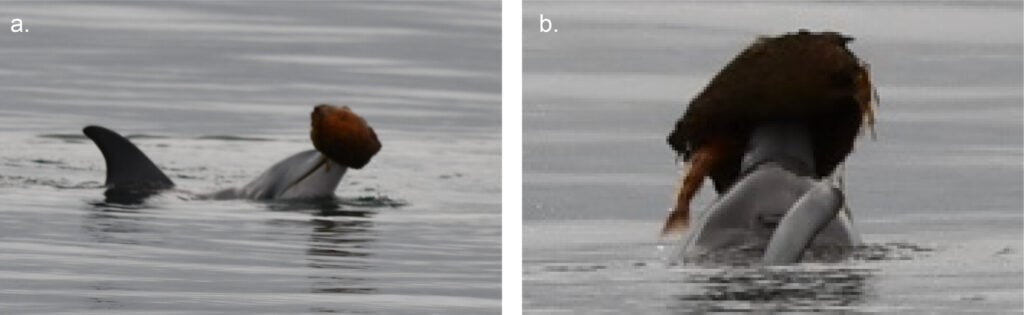
Almost 4,000 kilometers separate Shark Bay, on the west coast of Australia, from Hervey Bay, on the east coast. However, bottlenose dolphins in both places have come up with the same unusual way of catching a fish: using a large empty sea snail shell as a trap, bringing it to the surface and squeezing the prey into their mouths. The behavior is known as bombing. Researchers have tracked it for years in Shark Bay, Western Australia. Now, a new open access study in Marine Mammal Science presents the first published records from Queensland’s Great Sandy Marine Park. The huge geographical separation supports a surprising interpretation: dolphins on both sides of Australia appear to have invented the same tactic independently. But the wording matters. Researchers documented mating behaviors in distant populations; They did not perform a test that could reconstruct the exact first moment of invention on either coast. Bombing turns a fish’s refuge into a trap. A small fish chased near the seafloor may disappear through the opening of a dead gastropod shell. For most predators, such a refuge would end the chase. Instead, a shelling dolphin inserts its face into the opening, lifts the heavy shell, and tilts it above the water. The water drains away, bringing the trapped prey within reach. The first detailed scientific account of dolphins carrying conch shells came from Shark Bay. Photographic sequences showed dolphins lifting large shells, with one fish visible as the shell was emptied. Later observations established that the tactic is rare, quick, and easy to miss. It also requires more than simply carrying an object. A dolphin must locate a suitable dead shell, take advantage of the fish’s tendency to hide inside it, keep the opening oriented during ascent, and drain it without losing food. Consequently, researchers describe the shell as a tool and the tactic as a specialized form of foraging. Three Queensland dolphins provided the clearest evidence. Alexis Levengood and colleagues have been conducting opportunistic boat-based studies at Great Sandy Marine Park since 2022. Their paper focuses on two encounters in Hervey Bay during 2025, both with Indo-Pacific bottlenose dolphins, known locally as buthu in the Butchulla language. On July 6, the team approached an adult woman named Stevie Nicks. He used his rostrum to place a packing shell, Melo amphora, on the surface and lifted the entire shell out of the water along three surfaces. The rain ended the follow-up after nine minutes. Observers did not see any fish emerge from the shell and could not determine whether the attempt produced food. On October 1, a mother named Maserati repeatedly surfaced with another baler while a drone filmed from above. The video captured a fish escaping, followed by Maserati dropping the shell and chasing it. If he caught the fish, it was hidden under water with poor visibility. Three minutes later, Maserati’s twin Bentley surfaced with the same shell in the same place. The calf stuck his rostrum into the opening, lifted the shell, and slammed it against the surface. One photograph appears to show the body or tail of a suspected lizardfish protruding from the opening. Once again, the researchers could not confirm that any of the dolphins ate the prey. The article also includes photos of an ecotour boat taken in 2013 and 2019 in the same general area. Those records lack precise GPS positions and behavioral details, but suggest the Queensland shelling was present years before the 2025 research encounters. Why Opposite Coasts Suggest Two Inventions Before the new paper, all published shelling observations came from Shark Bay. Hervey Bay is located about 4,000 kilometers away, in a different dolphin population on the opposite side of the continent. There is no plausible chain of common dolphin associations connecting the two study sites. That’s why the authors say their observations provide evidence of independent innovation on Australia’s east and west coasts. Similar green ingredients may have offered similar opportunities: large empty shells on the sea floor, small fish using those cavities as shelter, and dolphins able to manipulate awkward objects. The conclusion is persuasive but inferential. The study did not compare genetic lineages or social networks across the continent, nor can it rule out events not recorded elsewhere. “Independently learned” means that the Queensland population could not reasonably have directly copied the Shark Bay dolphins. This doesn’t mean that all dolphins within each population reinvented the tactic on their own. That distinction fits into broader work on aquatic tools. A review of tool use by aquatic animals notes that water changes both the physical demands and opportunities for object manipulation. Shelling is a compact example: buoyancy helps move a large shell, while gravity is only useful when the dolphin lifts it off the surface. At Shark Bay, the tactic travels between associates. An invention can occur independently and still become cultural once it appears. A 2020 study on Shark Bay bombardment dolphins analyzed 5,278 group encounters recorded between 2007 and 2018. Researchers documented 42 bombardment events carried out by 19 individuals. Network-based diffusion analysis found the greatest support for transmission through social associations. It was estimated that dolphins were 10 to more than 300 times more likely to acquire shells through their social network than through genetic inheritance or learning alone. This was the first quantitative evidence that a toothed whale foraging tactic extended beyond the mother-calf bond. The result contrasts with another Shark Bay tradition. Some dolphins carry sea sponges on their faces as they explore debris for buried fish, a technique whose genetic and behavioral evidence supports maternal cultural transmission. The barrage appears more flexible, capable of moving horizontally between mates or obliquely from older non-parent animals to younger animals. Even the 2020 analysis left room for a separate discovery. Their best model estimated that about 43 percent of dolphins may have been shelled outside the measured social network. The authors warned that missed encounters could make asocial learning seem more common than it is. Bentley may have learned from watching Maserati. The Hervey Bay mother-calf sequence adds a possible transmission route. Bentley picked up the same shell three minutes after seeing Maserati use it, placed the stand in the same opening and tried similar moves. The new paper calls this potential evidence of vertical social learning, that is, information passed from parents to children. It is not conclusive evidence of deliberate teaching. Teaching typically requires evidence that a knowing animal changes its behavior in the presence of a learner, incurs some cost or receives no immediate benefit, and helps the learner acquire a skill more quickly. The Queensland researchers looked at a mother-calf sequence and did not test those conditions. The baby may have learned through observation, may have been attracted to an object its mother had just handled, or may have already had experience with shells. Investigators were also unable to confirm a successful capture. Their cautious conclusion is that the event is consistent with maternal social transmission and deserves further observation. That moderation is important when talking about intelligent animals. SpaceDaily has previously examined how bottlenose dolphins develop and copy their characteristic whistles. Sophisticated communication and prolonged maternal care make social learning plausible, but do not allow observers to infer a specific mental process from a surprising scene. Invention and culture can be the same continuous story. The most interesting interpretation is not that each bombing dolphin solved the puzzle on its own. It is that a useful behavior can originate more than once and then travel locally through different social routes. The use of tools begins with an innovation. It becomes a tradition when other animals acquire it and retain it partly through social learning. Shark Bay provides quantitative evidence that shelling is widespread among associates. Hervey Bay provides a geographically separate event, older photographic records and a nearby sequence in which a calf copied its mother’s handling of a shell. The evidence from Queensland remains small: two detailed encounters in 2025, three dolphins and two previous photographs. The bombings are so brief and rare that more practitioners may remain hidden. Longer observations, individual life histories and social network data will be needed to know how often it occurs and how calves or their peers acquire it. For now, the two coasts present a compelling natural parallel. Similar prey, similar shells, and equally flexible minds appear to have produced a remarkably similar invention. Once discovered, the trick may cease to belong to one intelligent dolphin and begin to move through a population as a culture.