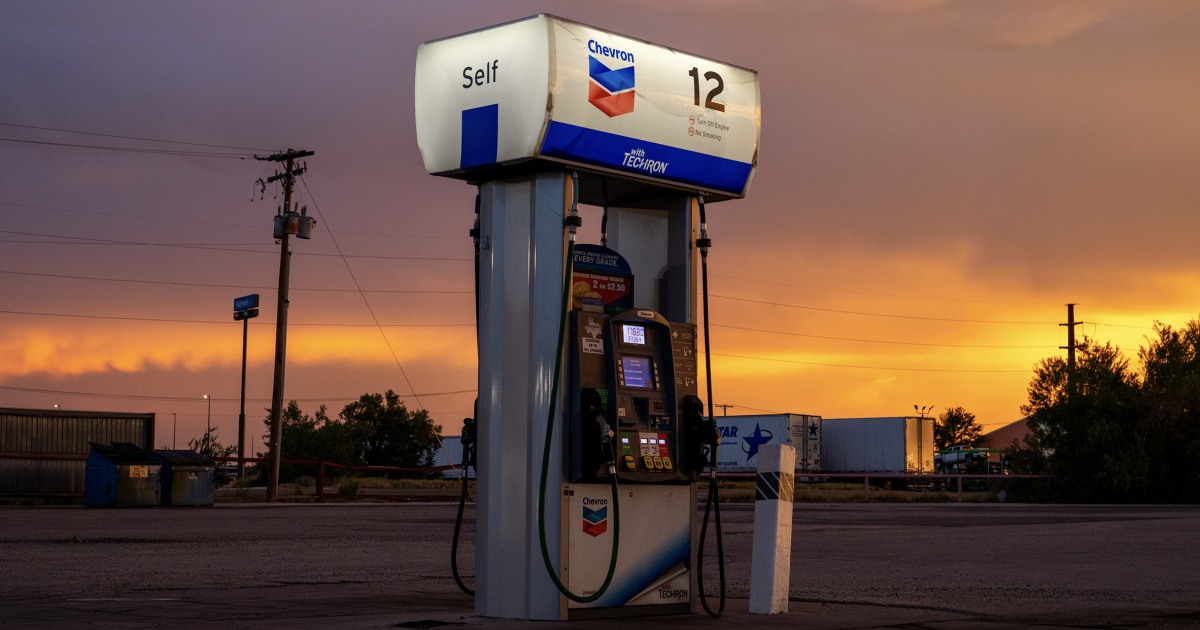
The price of oil jumped on Monday after Saudi Arabia shut down a critical pipeline and talks on the future of the Strait of Hormuz were postponed. The international benchmark oil, Brent crude, rose to $108, while US crude reached $103 per barrel. digits in recent days. Saudi Arabia’s Energy Ministry said Friday that “the pipeline was closed as a precautionary measure.” He did not say when the pipeline would be operational again. The attacks came as Iran-backed Houthi rebels in Yemen made sweeping gains that tightened their control over the Bab el-Mandeb Strait, another critical waterway. “Uncertainty over the duration of the lockdown is a key point of focus now in terms of knock-on consequences for global supply and energy prices,” Lloyd’s Bank analysts said. A demonstration in Sana’a, Yemen, to celebrate the Houthis’ takeover of the strategic port city of Mocha and the Bab El-Mandeb Strait on Friday. Mohamed Hamoud / Getty Images Adding to investor concerns, a meeting between Iran and Gulf countries over Hormuz was postponed on Sunday afternoon. That meeting, scheduled for Monday, was delayed “for the sake of consensus,” Oman’s foreign minister wrote in X. Tehran said the meeting was postponed at Riyadh’s request. On Monday, the Saudi state news agency said Crown Prince Mohammed bin Salman met with US Central Command Admiral Brad Cooper in Jeddah. Traffic through Hormuz remains only a fraction of pre-Iran war levels. On Sunday, only 14 vessels passed through the strait, and that number was just 12 on Saturday, 11 on Friday and nine on Thursday, according to MarineTraffic data. With crude oil prices rising as a result of those disruptions, so did gasoline prices. On Monday, the national average price for regular unleaded gasoline rose to $4.31 per gallon, according to AAA. The national average price of regular gasoline has increased more than 45% since the war with Iran began. The price of US crude oil has soared more than 50% since the war began on February 28. In addition, the price of diesel fuel continues to set new all-time highs. The national average price of diesel rose to $6.23 per gallon on Monday, AAA also reported. That commercial fuel, used in everything from trucks to shipping and trains, has become a particular focus for economists who say it could make almost “everything” cost more. “The cost of diesel affects almost everything,” KPMG chief economist Diane Swonk said in a recent interview with NBC News. “From running a farm… [to the] “The cost of food, but also everything that is shipped throughout the economy,” he said. When diesel prices go up, everything “gets that extra fee.” Volodymyr Zelenskyy and asked him to stop attacking Russia’s oil refining infrastructure, particularly given what is happening with the skyrocketing price of diesel fuel. “Mr. Zelenskyy you have to do one thing,” Trump said, “you have to stop phasing out diesel fuel in Russia.” “Let him pursue the objectives, but not the diesel, because it is causing a shortage of diesel,” the president continued. “Do not affect diesel fuel because it is harming the world.” “The increasing scale and intensity of Ukrainian attacks on Russian refineries this year have pushed Moscow to ban diesel exports,” ING commodities analysts noted on Monday. “This has only tightened global markets, following the disruptions in the Persian Gulf.” Russia’s ban on diesel exports is set to expire at the end of September, but “clearly, there is a possibility of further extensions,” the ING team said. After falling to as low as $4.77 per gallon in late June, new escalations between Ukraine and Russia have sent diesel prices up 30%. Since the beginning of the year, diesel prices have skyrocketed by 75%.