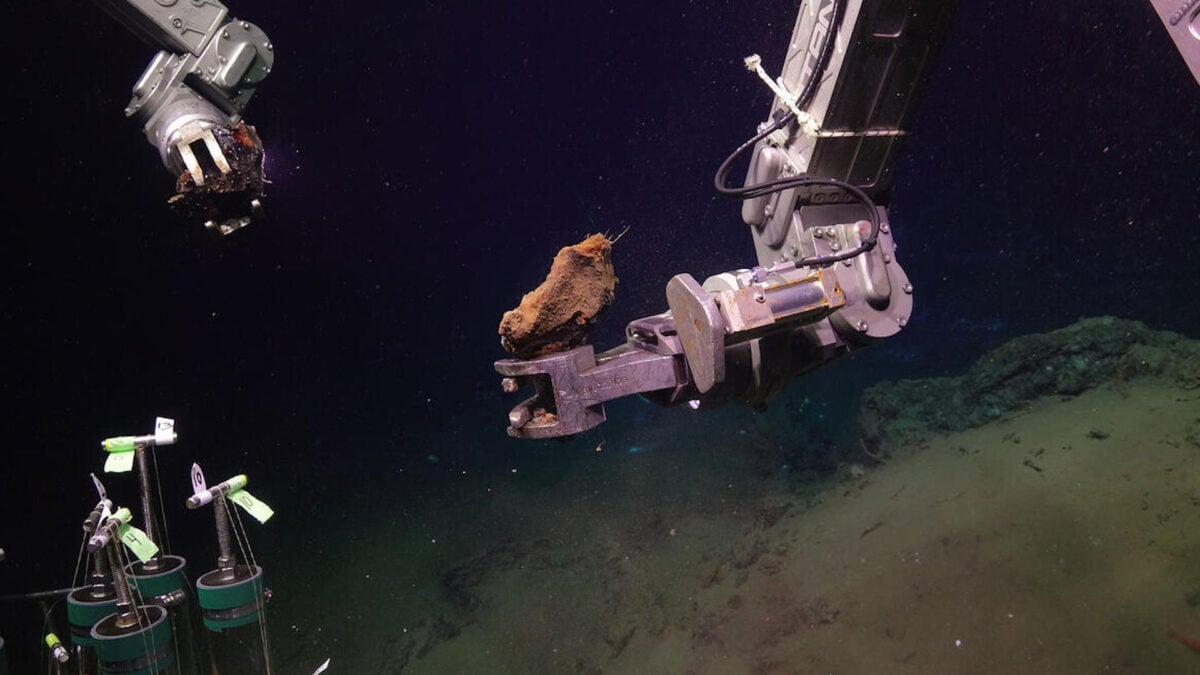
The emerging deep-sea mining industry could end up in flames after researchers discovered that some rocks collected from the ocean floor can heat up and even spontaneously combust once they surface and are exposed to air. In a recent paper published in Scientific Reports, researchers from the United States Geological Survey (USGS) warn that some rocks containing deep-sea minerals can catch fire once at the surface. The findings highlight a potential danger that must be better understood before mining massive sulfide deposits from the seafloor. Fire danger Using a remotely operated vehicle, researchers collected 57 rock samples rich in metal sulfides from four different regions in the Escanaba Depression. The hydrothermal area along the southern Gorda Ridge off the west coast of the United States created deep-sea deposits rich in metals such as zinc, copper and iron. The rocks were crushed and freeze-dried in the laboratory, and two of the samples spontaneously combusted when exposed to air. To find out how and why the rocks performed this pyrotechnic trick, the researchers tested how the samples responded to increasing temperatures. They then compared the chemical composition and mineralogy between the fuel rocks and other samples. The burning rocks were composed primarily of nanocrystalline brandsite, a form of iron sulfide that appears unstable when exposed to oxygen. Using heat and other forces, such as crushing, breaking, and grinding rocks, can provide enough energy to initiate oxidation. This can cause rock samples to heat spontaneously. Warning The discovery offers a dangerous caution for the deep sea mining industry. Although the industry has not yet started large-scale commercial operations, it is currently undergoing technological testing. The International Seabed Authority (ISA) recently issued 31 exploration contracts to extract sulfide minerals in two deep-water ridges, the North Mid-Atlantic Ridge and the Southwest Indian Ridge. While it is not certain that all seafloor rocks are prone to combustion, the researchers highlight that there is a potential danger that could impose new safety regulations on the industry. “Yeah [seafloor massive sulfide] “When mining occurs, rocks brought to the surface would experience dramatically different conditions than those on the seafloor, including exposure to oxygen and changes in temperature, pressure, and humidity,” according to a USGS statement. “Such changes could affect how sulfide minerals react and the amount of heat they generate.”