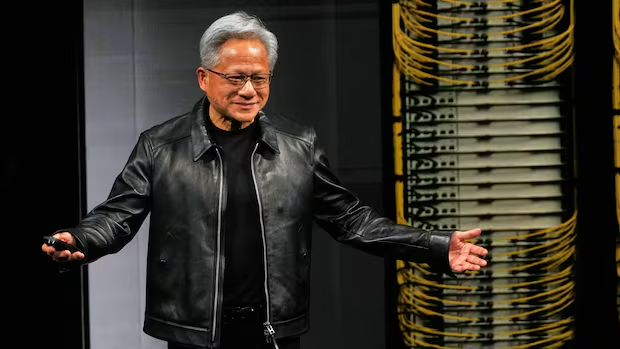
Jensen Huang, Nvidia’s leather-jacket-wearing, autograph-signing co-founder and CEO, has become a seemingly inseparable part of the AI chipmaker. But now that an investigation is underway into whether Huang was the target of a foreign intelligence effort, that tight control at the top of the company is raising concerns about whether he could actually be replaced, if such a move were deemed necessary. The investigation comes after the New York Times reported late last week that Huang was in a close romantic relationship with Alice Huang. a Chinese tech executive accused of spying on behalf of China. It is unclear when she met the executive at Singapore-based cloud computing company Megaspeed, but the two were photographed together in 2024. Nvidia’s board of directors said on Sunday that it had no reason to believe that state or company secrets were compromised, but that it was conducting an independent investigation in light of the reports. U.S. House Republican caucus leaders also asked Jensen Huang to attend a briefing about his relationship with the woman. In a message to his staff, Huang admitted to having an affair and apologized to his family and colleagues for breaking their trust. “I am fully committed to Nvidia and will work to regain their trust,” he wrote. Huang will remain as CEO while the investigation is underway. But if the board were to remove him, or if he changed course and resigned, technology analysts like Dan Ives say finding someone to take his place would be nearly impossible. “In my opinion, Jensen is unique,” said Ives, partner and senior managing director of Yorkville Ives & Co., a modern commercial bank based in New York. “Nvidia is here because of Jensen.” ‘The king of technology’ Nvidia began as a graphics card manufacturer in 1993 until company leaders, particularly Huang, realized that their graphics processor units could power more than just games. The company shifted to making chips for supercomputers in the early 2010s, betting on an artificial intelligence boom that wouldn’t arrive for many years. An early partnership with OpenAI led to a long-term relationship with the creator of ChatGPT, which still relies on Nvidia chips to power its technology today. Amazon, Meta, Google, and virtually every other company that creates AI tools rely on chipmaker hardware to power their systems. Currently worth around $4.5 trillion, Nvidia is the second most valuable company in the world and is invaluable to the AI ecosystem as a whole, according to Ives. From his place at the top of the massive company, Huang became something of a rock star, routinely signing fans’ autographs at public appearances. One of his signature leather jackets sold for more than $1 million at auction earlier this year. “He’s gotten to the point where he’s like the king of technology. Everyone listens to what Jensen has to say,” said Bob O’Donnell, president and chief analyst at Technalysis Research. Outside his own company, Huang has also championed the development of AI, financially backing companies such as cloud computing company CoreWeave and Anthropic, maker of the Claude chatbot. He has also dismissed fears about an AI bubble and defied apocalyptic warnings about the technology’s existential threat to humanity, and forged a close relationship with US President Donald Trump.WATCH | Nvidia shares fall amid investigation into Huang: Nvidia shares fall as company investigates CEO Jensen Huang Nvidia is conducting an internal investigation following a media report that CEO Jensen Huang had a close relationship with a Chinese businesswoman who allegedly passed information to Beijing. Nvidia shares fell nearly six percent in early morning trading. At current levels, the chipmaker would lose around $280 billion in value from its last closing price. Ives says the loss of Huang’s defense would be a big blow to the industry if he were to withdraw. Meanwhile, within the company, Huang created an unusually flat chain of command, in which many employees reported directly to him rather than to senior executives. In a podcast earlier this year, Huang said that up to 60 people reported directly to him. The company’s site lists only a handful of high-ranking executives besides Huang. Two of Huang’s children are also on staff at the company: his son Spencer is a product manager for robotics, while his daughter Madison is a senior director of product marketing. No clear successor Because Huang has maintained control of Nvidia for so long, analysts say there is no clear successor. “There’s not one person, two or three people who can replace Jensen. And that’s a scary thing for investors, given this… black-eye moment that we’re seeing,” Ives said. If Huang were forced to resign, Ives worries that Nvidia would never fully recover from the loss of his leadership, given his integral role in the company’s growth. But others say that with a company as big as Nvidia, there are others who could take the top job.WATCH | A look at the spy scandal: Nvidia CEO Jensen Huang’s shooting star | About itU.S. Shares of tech giant Nvidia plunged after CEO Jensen Huang admitted to having an affair with a woman accused of spying for Beijing. Andrew Chang looks at what we know so far and what the scandal means for the world’s most valuable AI chip maker. Images provided by The Canadian Press, Reuters, Adobe Stock and Getty Images “You can’t create a company that big by yourself, right? It’s just not possible. There’s a huge team of very strong, smart, capable people,” O’Donnell said. While he agrees that the loss of Huang would be huge, he says the company’s technology roadmap, used to plan for the next few years, is already laid out, making the job of any potential successor easier. O’Donnell expects Nvidia is on track to maintain its leading position among chipmakers for now, and doesn’t expect a shakeup at the top to change that. Additionally, because the board says it has confidence in Huang, O’Donnell says he doesn’t expect those members to try to oust him. Still, if Huang remains CEO, his control over the company probably won’t be as strong in the future, O’Donnell says, as other high-ranking executives are likely to take center stage as spokespersons and negotiators at least sometimes. “It’s hard to replace an iconic figure who just lights up a room,” he said. But “if the board is smart, and I’m sure they are, they will recognize that they will have to address this so that people can regain trust in the company.”