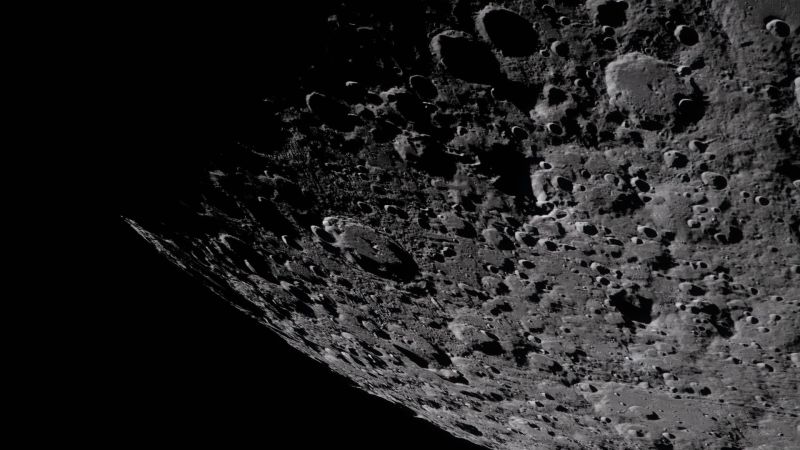
If, like Elon Musk, you’ve been dreaming of a future where large populations of humans can live on the Moon, you’re likely to be disappointed. Although there could be trillions of pounds of water trapped inside tiny glass beads scattered across the lunar surface, scientists estimate this won’t be enough to sustain a large city for long, according to a study published Monday in the journal Frontiers in Space Technologies. Musk announced in February that his aerospace company, SpaceX, had shifted its focus from developing a settlement on Mars to “building a self-growing city on the Moon,” because it would be quicker to achieve, potentially “in less than 10 years.” That raised the question: “Well, how big could a city on the Moon be with that water supply? And the answer was very surprising,” the study’s lead author, Martin Elvis, a senior astrophysicist at the Harvard and Smithsonian Center for Astrophysics, told CNN. Taking one billion tons of water as a “generous” estimate, Elvis and his colleague, astrophysicist Jonathan McDowell, who is now an honorary professor at Durham University Space Research Center (SPARC) in the United Kingdom, calculated how long populations of various sizes could last if they used water for drinking, for hygiene, for growing food, as rocket fuel, and even for breathing. They found that a population of 1 million people (about the number of people living in Sweden’s capital, Stockholm) would run out of water in less than two and a half years, according to the study. However, if water were efficiently recycled, such as at the 98% water recovery rate achieved by the International Space Station, it would take a city of 1 million people 100 years to use it up. And “that depends on people being very nice” about their water use, Elvis said, including “always using pretty dodgy bathrooms and not doing laundry,” and I think this behavior “is unlikely to be sustainable.” “For such a large investment, a lifespan of about a century appears to fall short of the long-term, sustainable settlement beyond Earth that some advocate,” the researchers noted. They estimated that a small town of about 100,000 people (slightly less than the number of people living in Sandy Springs, Georgia) could survive for 1,000 years, which “seems like enough time to justify calling it sustainable.” “If you have a small town of only 10,000 people… then you have… 10,000 years of water, and that starts to look like, well, on a 10,000-year time scale, we can find another solution,” McDowell told CNN. For example, there is “a lot of water in the solar system,” including water in the asteroid belt and on the moons of Saturn, he said. So perhaps in the future, those on the moon could import “deliveries of water in the quantities needed to sustain a large population. It’s hard to see in practice how to do that with current technology, but in the long term, perhaps it can be done.” In the short term, he suggested that instead of a city on the moon within 10 years, as Musk proposed, “I would say within 30 years we could have a city on the moon. That would be the way I would translate what Elon said.” “This is an important study. I think the authors have performed a valuable service by injecting some realism into the discussion of long-term plans to establish large human settlements on the Moon,” astronomer Ian Crawford, professor of planetary science and astrobiology at Birkbeck, University of London, who was not involved in the research, told CNN. “If such settlements are to be established, I think the authors are correct in pointing out that water (or at least hydrogen to make water from oxygen in lunar rocks) will need to be imported,” Crawford added by email. A “moon village” of 1,000 people (roughly the number of people who stay in Antarctica during the winter) could be “relatively carefree in our use of lunar water,” the researchers noted in the study. Crawford said that in the short term there is probably enough water at the lunar poles to support small-scale research outposts of this size, “and I think this will be the most likely use in the coming decades.” However, he added that “it is also important to note that the water ice at the lunar poles is of great scientific interest and we need to be able to study it properly before it is dug up for water.” Ice on the Moon has accumulated over billions of years since its formation and “therefore preserves a chemical and physical record of the environment in which our Earth has existed for all this time, and which led to the development of life on Earth,” Simeon Barber, a principal investigator at the UK’s Open University searching for water on the Moon, told CNN by email. “We should at least discover the secrets that this ice holds for our own evolution and that of our planet (and other planets) before considering extracting it for industrial use,” added Barber, who was not involved in the study. Agriculture is the most demanding of water resources, and the study uses the World Bank estimate that feeding one person for a day requires two to five tons of water, or 2,000 to 5,000 liters. According to the study, ways to reduce water use could include adopting a vegan diet, since the water needed to produce beef is six times that of soy and chicken requires twice as much. However, even if people optimize their water use, there is still “enormous uncertainty about how much water there really is on the Moon,” McDowell said. “But also, how easy will it be to extract it?” McDowell, who said that “water is going to be the gold of the solar system,” added that there are some suggestions that in very cold, shadowy craters, the water content could be quite high, “which would make it relatively easy to extract. But in much of the South Pole area, there could be traces of water between the rocks and that, even if it adds up to a lot, it would be very difficult to get out of the rock.” Barber said the “extreme cold and extensive darkness” in those regions make them an “inhospitable place for robotic or human workers. The water is not in the form of shiny, pristine ice cubes that we can melt and drink; it is probably laced with a cocktail of poisonous chemicals that must first be removed.” According to researchers, the eight largest craters on the Moon are estimated to contain around 34 million tons of water. With so few large craters to explore, interested parties could “try to grab the biggest and best ones and exploit the water,” said Elvis, who urged those involved in the space race to work together, not against each other. The researchers “are surely right that careful management of the limited reserves of lunar water will be necessary,” Crawford said. “In turn, this implies the need for an internationally agreed regulatory framework, to prevent a ‘gold rush’ mentality from developing that could prematurely deplete a valuable lunar resource.” Subscribe to CNN’s Wonder Theory science newsletter. Explore the universe with news about fascinating discoveries, scientific breakthroughs and more.