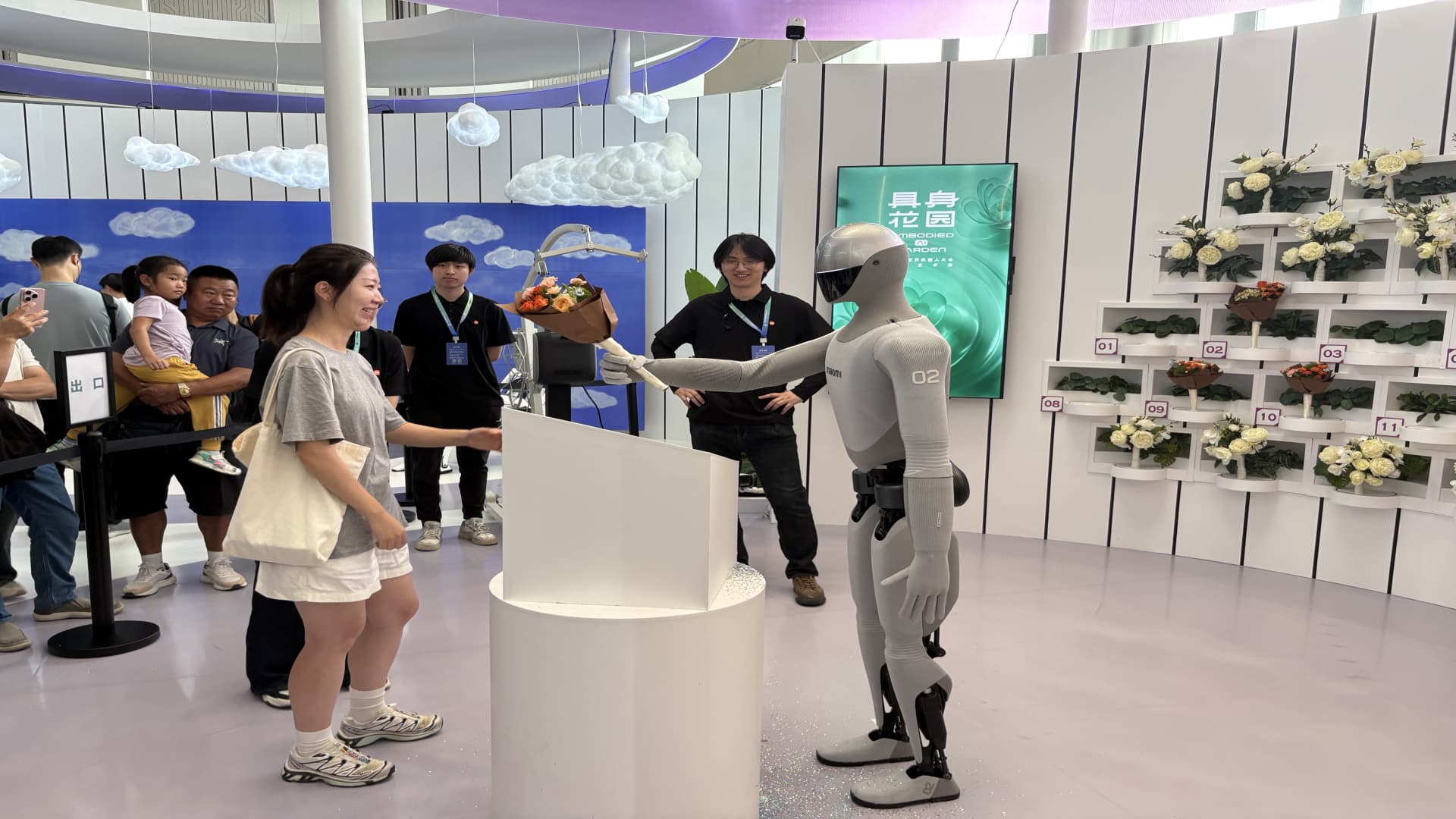
Chinese consumer electronics company Xiaomi showed off its humanoid robot in Beijing at the World Humanoid Conference in August 2026. Evelyn Cheng | CNBCBEIJING — The big challenge for humanoid robots remains getting the technology to work well, according to industry leaders who spoke at the World Robot Conference in Beijing this week. Robots are still not as efficient as humans and take time to learn new skills, creating a bottleneck for the industry, Unitree founder Wang Xingxing said at the conference a day after his company’s IPO day surged 460%. His comments underscored the challenges facing humanoid robots entering the human workforce. Unitree shares fell 18.7% on Thursday. The U.S. Federal Communications Commission last month added foreign-made advanced robotic devices, including humanoids, to a list restricting imports into the U.S. The statement did not specify a country and said retailers could still import models that the FCC had previously approved. But the impact of that limitation isn’t as great right now because there aren’t as many humanoids in use in the U.S., Jeff Burnstein, president of the Association for the Advancement of Automation, told CNBC. The impact it could have in the US is on autonomous mobile robots, which are used in factories much more than humanoids,” he said. The state of the technology means that companies deploying robots to increase efficiency are not even focusing on humanoids at the moment. “What I’m hearing from customers in the US. [is that] ‘we want solutions. We have a problem. We need a solution. We don’t care if it’s a humanoid. We don’t care if it is a traditional robot, a collaborative robot. We don’t even care if it’s a robot. We need a solution,” Burnstein said. “So the onus is on humanoid players to prove we have a solution,” he said, noting that robots need to be affordable, safe and ready to use. Keenon, a startup, is developing humanoids to use alongside simpler delivery robots to handle laundry services in hotels, for example, according to chief operating officer Wan Bin. Keenon’s business partners include Buffalo Wild Wings and Hilton. Completing 50% of a task well is relatively easy, even 80%, he said, but reaching a 99.9% completion rate really tests engineering and training capabilities, Wan said. He said the company has shipped more than 100,000 robots and expects to surpass 150,000 units by the end of next year. Choose CNBC as your preferred source on Google and never miss a moment of the most trusted name in business news.