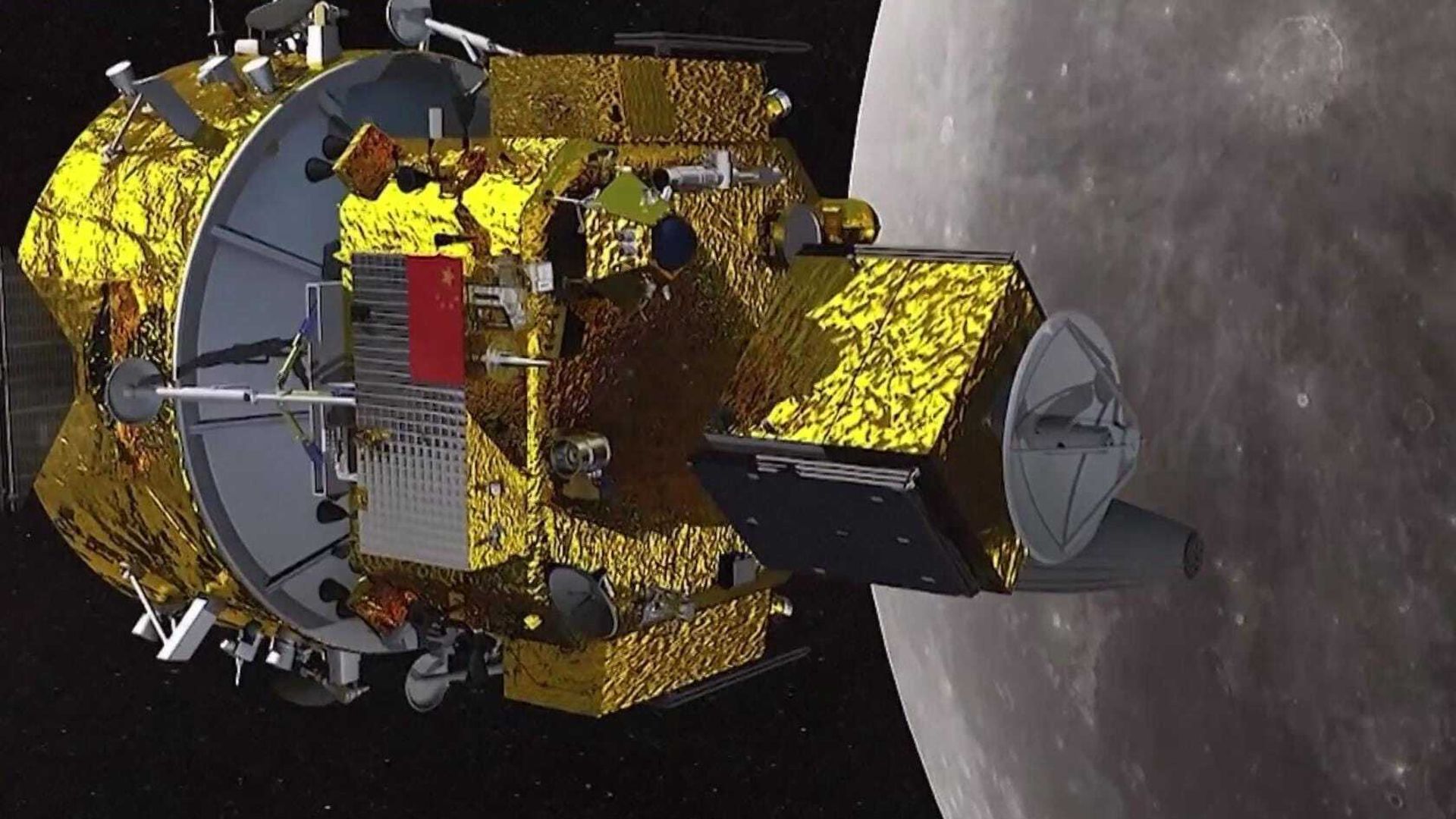
China’s lunar exploration program is preparing an ambitious robotic mission, composed of an orbiter, a lander, a rover, a chute and a wide range of international experiments, including a payload backed by the United States. In April this year, the Chang’e-7 hardware was transported to the Wenchang launch site, ahead of a launch on August 24 (Beijing time) on a Long March 5 Y14 rocket. The lander’s destination is the rim of Shackleton Crater in the lunar south polar region. After launch, the Chang’e-7 orbiter will spend several months orbiting the moon before releasing its lander for a landing attempt near the end of the year. While Chang’e-7 will carry out ambitious and innovative lunar science, it will also serve to lay the groundwork for the first Chinese human landing on the lunar surface by 2030. James Head is a leading lunar scientist in the department of geological sciences at Brown University in Providence, Rhode Island. He says China’s upcoming lunar launch will set a new benchmark for lunar scientific travel. “Chang’e-7 is the most ambitious, comprehensive and complex robotic lunar mission ever attempted by any nation or entity,” Head told Space. Similarly, Zhang Jingbo, spokesperson for the China Manned Space Agency (CMSA), said earlier this year that the mission will “fully use the technological knowledge and practical experience accumulated over decades” to “spare no effort to strive for the goal of achieving the first Chinese moon landing in 2030.” craters in a quest to find pockets of water ice. The hopper uses active shock absorption technology to land safely on slopes. The lander will also deploy China’s inaugural deep space “historical imaging navigation” system. Although scientists around the world believe there is water ice on the moon, said Ye Peijian, an academic at the Chinese Academy of Sciences, no one has definitively found or fully evaluated that resource so far. “Now China is going to look for him, […] And we are using many methods, from searching the surface to exploring the interior of the craters,” Ye told China Central Television (CCTV). The rim of Shackleton Crater; the lunar south pole is located on the rim near the upper right corner of the image. (Image credit: NASA/GSFC/Arizona State University) Back-to-back tasks The Chang’e-7 mission will take an integrated exploration approach, CCTV added, combining orbit, landing, roaming and jump, to study the Moon’s environment and resources. Additionally, a Chang’e-8 mission is scheduled for around 2028, designed to test technologies for building habitats using lunar soil. Together, the two robotic projects, Chang’e-7 and Chang’e-8, are tasked with helping orchestrate China’s planned multi-phase International Lunar Research Station (ILRS) launch site. 2026 in Wenchang, China’s Hainan Province (Image credit: VCG/VCG via Getty Images) Variety of instruments The Chang’e-7 mission hardware is equipped with a variety of instruments from other nations and organizations, such as: On the lander, a PmL-Ch7 array from the Russian Academy of Sciences to detect lunar dust and a Langmuir probe to measure the temperature and density of nearby plasma An Italian laser retroreflector The module’s array. lander is provided by the Laboratori Nazionali di Frascati. A small, state-of-the-art, wide-field optical telescope mounted on the lander developed by the International Lunar Observatory Association (ILOA Hawaii) and the Hong Kong University Space Research Laboratory (HKU-LSR) images the moon’s surface. will evaluate high-energy particles related to space weather and cosmic radiation shed by the sun. The moon-based dual-channel Earth radiation spectrometer on the orbiter has been provided by the Swiss Physical Meteorological Observatory. The ILO-C instrument from ILOA Hawaii and the Space Research Laboratory at the University of Hong Kong will be located directly on the Chang’e-7 lunar lander, bound for the illuminated rim of Shackleton Crater. “The HKU Space Research Laboratory is proud to partner with ILOA for this historic lunar mission and we look forward to working with them to maximize the scientific output that this exceptional wide-field optical lunar camera will deliver,” said Quentin Parker, Professor Emeritus of the University of Hong Kong. Moon-based Operating in the extreme lunar environment, the compact camera will take color astronomical images from the Moon for the first time, said Elisa Perednia, president of ILOA. The camera is designed to capture unprecedented wide-field, full-color images of the Milky Way’s galactic plane from a stable Moon-based vantage point. Note: The camera aboard China’s lunar lander was pioneered by ILOA founding director Steve Durst, who passed away earlier this year. “We are proud to have joined the mission and helped make Steve’s wonderful vision a reality,” HKU-LSR’s Parker told Space.com.