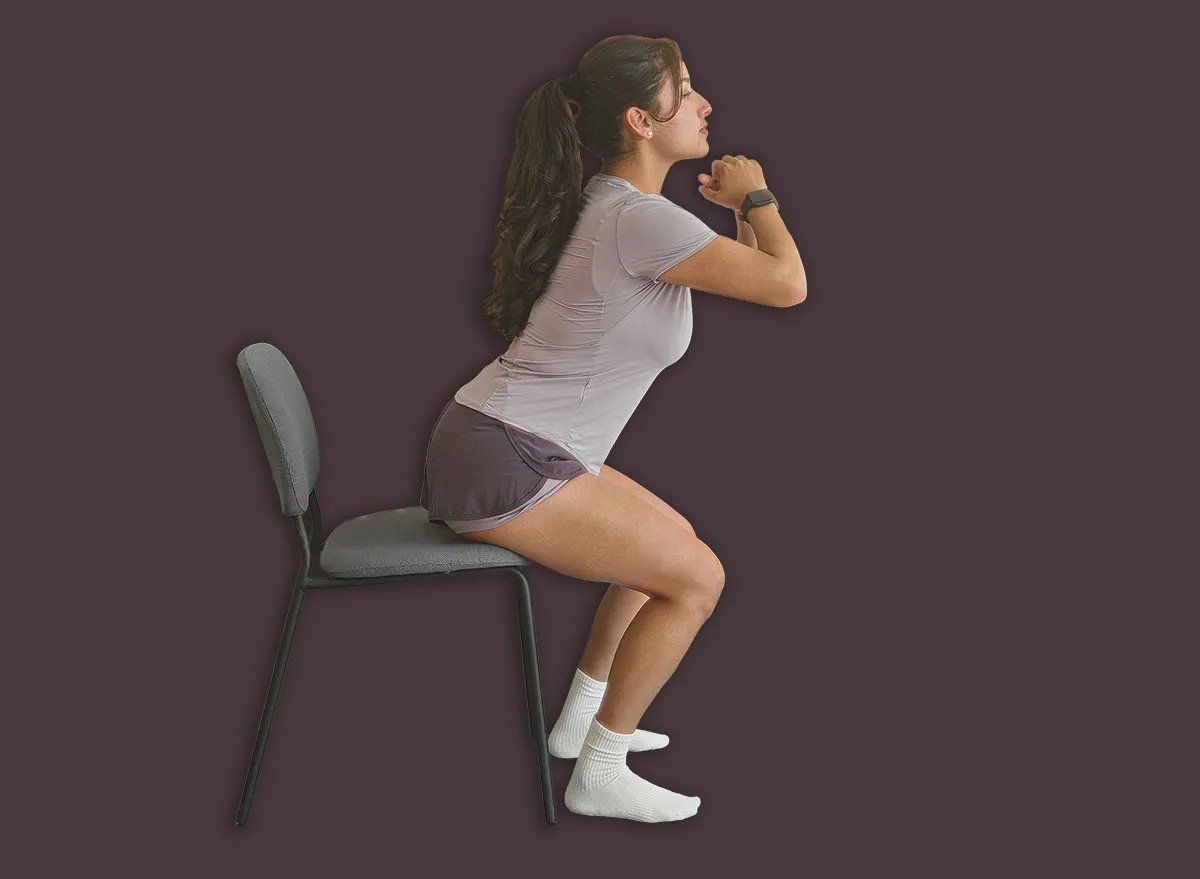
Balance training should be a top priority in your exercise routine as you age. Maintaining balance on your own two feet is something that becomes increasingly important as you age. If you’re looking to improve and maintain your balance, optimizing your exercise routine is essential, and balance training should be a top priority. However, you don’t need to invest in a balance board or attend a yoga class to see noticeable results. To start, you can use a sturdy chair and your body weight! We spoke to Portia Page, Balanced Body Educator and NCPT, who shares five chair exercises that can help you achieve better balance after age 65. “One of the biggest advantages of chair balance training is that the chair provides safety without removing the opportunity to challenge the body. For someone who is afraid of falling, has already experienced a fall, is out of shape, or simply does not feel confident balancing without support, asking them to immediately stand on one leg can create more fear than benefit. Fear can cause people to stiffen and hold their body.” breathing, moving less naturally, or avoiding balance training altogether,” explains Page.6254a4d1642c605c54bf1cab17d50f1e A chair provides a safe, stable environment where you can train your underlying skills. According to Page, balance is not “an isolated skill.” Instead, it requires cooperation and information between the vestibular, visual, and somatosensory systems, as well as sufficient mobility, strength, coordination, confidence, and reaction time. “Exercises in chair exercises can address several of those components while reducing the immediate fear of losing balance,” Page says, adding, “I also like chair exercises because they allow us to create a progression rather than an all-or-nothing challenge. Someone may start completely seated, progress to sitting with greater reaches and weight shifts, move to supported standing, decrease the amount of reliance on the chair, and eventually perform more challenging standing exercises.” While yoga can absolutely be a beneficial part of a complete balance routine, chair workouts offer a practical and adaptable starting point for people who are not comfortable performing standing balance movements without support. So, grab a sturdy chair and let’s get started. Sit-to-Stand “Sitting and standing strengthens your hips, glutes, thighs, and core while practicing one of the most important movements we perform every day. Being able to control your center of mass while moving from sitting to standing is directly related to functional independence and requires overall balance as well as strength,” Page explains. Start sitting in front of a sturdy chair with your feet firmly planted on the floor. Lean forward slightly. Try to stand without using your knees, hands, or any additional support. (If you need help, place your hands on the chair or thighs.) Use the control to slowly return to a sitting position. Aim to do 2 to 3 sets of 8 to 12 reps. Over 45? If you can maintain these 3 positions, you are stronger than most seated marches “Marching challenges core stability, hip strength, coordination, and the ability to shift weight from side to side. That alternating pattern is also directly related to walking, where we continually transfer our weight from one side of the body to the other,” Page tells us. Start seated in a chair with your feet hip-width apart on the floor. Gently pull your lower abdomen in and keep your torso elevated. Slowly raise one knee to hip height. Hold for a moment before lowering yourself back down. Continue in a “march” form. Perform 2 to 3 sets of 10 to 20 alternating marches. “We sometimes overlook the feet and ankles when we talk about balance, but they are incredibly important. The muscles around the ankles continually make small adjustments to help us stay upright. Strengthening your calves and the muscles along the front of your lower leg while improving awareness of your feet can help you stand and walk more steadily,” explains Page. Begin sitting upright with your feet hip-width apart on the floor. Engage your core. Come back onto your heels and lift your toes off the floor. Pause for a moment. Then, come up on the balls of your feet and lift your heels. Continue alternating between the two movements. Try 10 to 15 repetitions of each movement. You can also perform alternating 1 heel up/1 toe up and switch, adjusting the pace and adding arm movements for an additional challenge. This quick stability test reveals how balanced you are actually sitting. It’s about being able to move the center of mass and regain control. Reaches and weight shifts teach the body to move out of its usual centered position and then return safely. That’s a skill we use constantly in everyday life, like reaching into a cabinet, picking up something off the floor, turning or moving around a piece of furniture, or going up or down a step from a sidewalk, etc.,” Page tells us. Begin sitting upright with your feet planted on the floor. Slowly shift your weight onto a sit bone. Return to the center. Then, shift your weight toward the other sit bone. Progress the exercise by extending one arm to the side, forward, or diagonally with control. Perform 5 to 8 controlled reaches in various directions per side. “Ultimately, if we want to improve standing balance, we need to practice standing balance. This exercise provides a bridge between seated exercise and unsupported balance work. It strengthens the hips and legs, develops proprioception, and practices the single-leg support we need every time we take a step,” says Page. Start by standing behind a sturdy chair, holding onto the backrest with both hands. Shift your weight onto one leg, lifting the opposite foot slightly. Hold the position before lowering. Change sides. Perform 5 to 10 repetitions per side or short stops of 5 to 10 seconds. As your balance improves and when it is safe to do so, move forward while holding onto the chair with one hand or lightly with your fingertips. Alexa Mellardo Alexa is a freelance writer, editor, and content strategist based in Greenwich, CT. She has over 11 years of experience in wellness, fitness, food, travel, lifestyle and home. Read more about Alexa