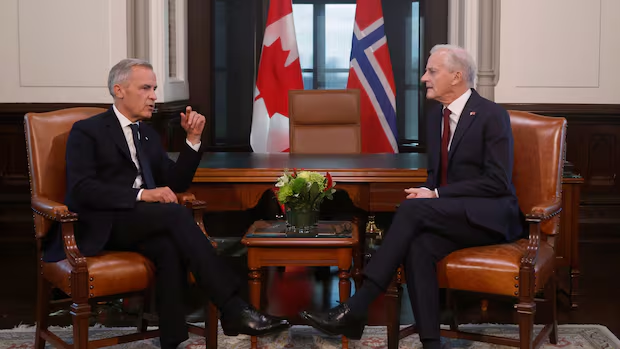
Listen to this articleEstimated 4 minutesThe audio version of this article is generated using AI-based technology. Pronunciation errors may occur. We are working with our partners to continually review and improve results. Prime Minister Mark Carney says his focus on building international relations, including with Norway, is part of the response to new threats from Russia. During a press conference with Norwegian Prime Minister Jonas Gahr Støre in Ottawa on Sunday, both leaders were asked about the Polish prime minister’s warnings that Russia could be planning attacks against European countries that support Ukraine. Støre said those warnings should be taken seriously and that Norwegian intelligence has concluded there are “real threats coming from hybrids.” “One of the advantages of this relationship and its deepening across a broad range of relationships is, yes, greater intelligence sharing, greater insight, greater capabilities that are built together,” he said. WATCH | Arctic security on Carney’s agenda during Norway visit:Arctic security on Carney’s agenda during Norway visit Prime Minister Mark Carney is in Norway for a three-day trip to defend and strengthen alliances with Europe. Carney said that includes having the “right partners” among Arctic nations working together. “The phrase I always remember… is ‘High North, low tension,'” he said. The way to achieve this, he said, includes submarine and space capabilities. In July, Carney decided to buy a dozen submarines from a European shipbuilder rather than a Korean company, after a hotly contested bidding process that lasted months. The chosen partnership involves a German company but partners from Norway, with the three nations collaborating to produce and maintain the submarines. Carney said that “the time spent, whether in the high north of Norway, a meeting with the French president who is directly involved in several of these decisions, our meeting today and beyond, everything is connected.” Russia accuses West of ‘direct threat’ to Arctic: Russia accuses NATO of creating a “direct threat” as tensions rise over military activity in the Arctic. Russia’s foreign minister accuses NATO of creating a “direct threat” to his nation with military actions in the Arctic. This comes as both Russia and Western allies such as Canada accuse each other of threatening peace in the region. But the former Canadian ambassador says the true picture is more complicated. Arty Sarkisian explains. Before his meeting with Støre in Ottawa, Carney traveled to Saint Pierre and Miquelon to meet with French President Emmanuel Macron earlier in the day. Støre’s visit comes as Carney seeks closer ties with Europe, including possible “associate membership” in the European Union. Norway is not a member of the EU, but for three decades the country has had an agreement with the political and economic bloc that gives both sides free access to each other’s markets. of goods and services, and gives Norway access to most EU programs.WATCH | Carney promises deeper ties between Canada and EU: Carney promises deeper ties in EU speech, but offers few details A day after the door opened for Canada to become an “associate member” of the EU, Prime Minister Mark Carney gave a speech in the European Parliament promising deeper ties with Europe, although questions remain about what that includes. Carney is seeking deeper defense ties with Norway, as well as investments from its huge oil-based sovereign wealth fund. Carney was in Norway in March, the first sitting Canadian prime minister. since 1980 to visit the Nordic country. During that visit, the two leaders committed to advancing collaboration in fields ranging from Arctic space and security to critical minerals and energy. Carney and Støre also touted their reputation as low-risk global oil producers amid supply shocks from conflicts such as US President Donald Trump’s war against Iran. Norwegian officials have often described Canada as a similar country, as both seek to balance a large oil sector with a push for green energy and respect for indigenous peoples. Both emphasized the use of multilateral institutions to resolve disputes while identifying themselves as strong supporters of NATO and deeply linked to the EU, without being members. Both countries have put support for Ukraine at the forefront of foreign policy, amid Russia’s full-scale invasion that began in February 2022. Since late 2024, Canada has had an Arctic foreign policy that calls for closer ties with the Nordic countries on defence, strategic sectors and environmental issues.