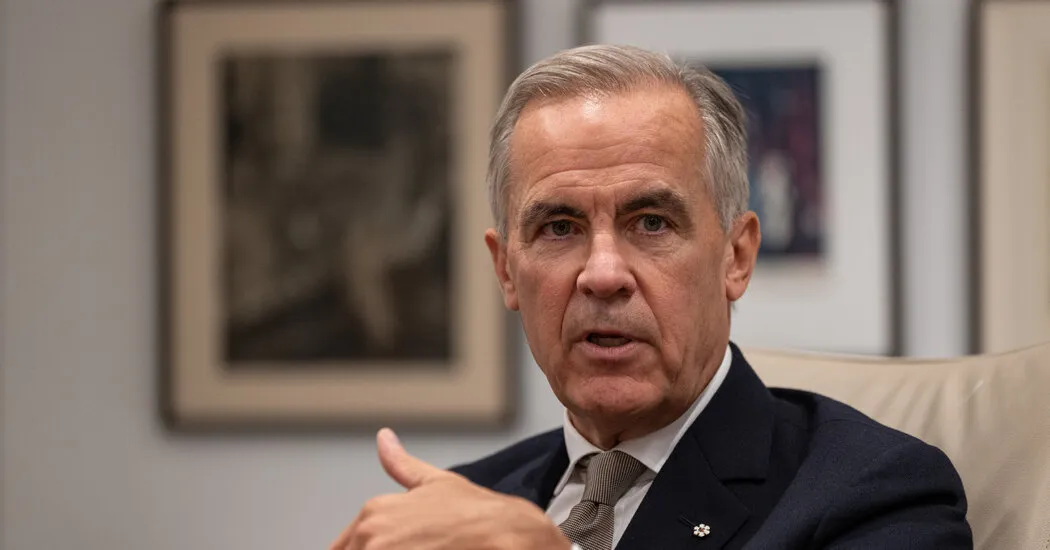
Prime Minister Mark Carney of Canada is on a mission to break his country’s dependence on the United States and build deeper trade, defense and cultural ties with European and Asian powers. In a wide-ranging interview with New York Times reporters earlier this week, he spoke in detail about the opportunities and limits of each of the major partnerships he is pursuing. a one-for-one replacement for the vast and unique economic relationship between Canada and the United States. For example, he acknowledged that the European Union’s economy was barely growing, but identified it as the top priority for Canada, saying the two were complementary in key ways; exposed the limits of Canada’s revitalized relationship with China; and admitted that it could not guarantee an end to all Indian-related crimes in Canada, despite seeking a closer relationship with Delhi. Europe: not just economics During a visit to the European Parliament in Strasbourg last week, Carney put his country on the path to becoming an “associate member” of the bloc, a status that does not yet exist formally but could bring closer ties in several areas. Despite the bloc’s slow growth, Carney said, Canada has a lot that “It’s not growing, but it’s the second-largest economy in the world, in hard dollars or euros, and we’re underpenetrated in that economy,” he said in his interview Wednesday at the Times headquarters in Midtown Manhattan, apologizing for speaking “like an economist.” Carney cited space, defense procurement, cyber policy, artificial intelligence and pharmaceuticals as economic areas where Canada and the European Union could grow together. He added that the cultural affinity between Europe and Canada, which was resolved by Europeans, was a critical factor behind the push for closer ties. “Europeans are not going to tell us what to put on our Netflix or Spotify home pages, and that matters,” he said, referring to a sore point in Canada’s trade talks with the United States, which collapsed last year. month. During those talks, American negotiators pressed against Canada’s demand that online streaming services promote Canadian cultural content more prominently to Canadian consumers. China: Limited, but important Earlier this year, Carney visited Beijing after years of strained relations with China that began during the “Two Michaels” crisis. The Chinese government jailed two Canadian citizens, Michael Kovrig and Michael Spavor, on spurious grounds after Canada extradited Meng Wanzhou, a senior Huawei executive and daughter of the telecommunications giant’s founder, to the United States, where she was accused of wire fraud. During his visit in January, Carney and President Xi Jinping declared a new chapter in the relationship, calling it a “strategic partnership,” a term with particular weight in Chinese diplomatic vernacular. If the deal is limited, China will allow Canadian agricultural products (mainly canola) to enter with lower or no tariffs, while Canada would allow a small number of Chinese electric vehicles at a low tariff rate. The deal drew criticism from the White House at the time, but a few hours before Xi landed in Washington for a state visit on Wednesday, Carney shrugged it off. Canada’s deal with China was “a fraction of the level of U.S. cooperation with China,” he told The Times. Carney said deepening cooperation with China did not mean he was oblivious to the risks involved. “Two things can be true at the same time; there are certainly problems,” he said. “We are very attentive to foreign interference from any actor in our society, but we are also calibrating our relationships according to our values,” he added. Canadians of Chinese descent have accused Beijing of transnational repression and there is evidence that China has intervened in Canadian political affairs. In preparing for this new chapter, Carney said, he spoke with Xi about “establishing clear guidelines on the relationship, where we seek to cooperate, where we did not expect to cooperate.” Artificial intelligence is one area where Canada will not have deep cooperation with China, he said. Instead, it sees potential in agriculture and clean energy, and hopes to develop cooperation in financial services with China. That would require China to loosen the restrictions it currently has on the free flow of capital in and out of the country, a process Carney acknowledged would be “very challenging.” India: progress, but no guarantees Canada’s relationship with India has been equally tumultuous, but has seen a positive reset under the Carney government. He visited India earlier this year and Prime Minister Narendra Modi is expected to visit Canada in December. Relations broke down in late 2024, when Justin Trudeau, who was prime minister at the time, revealed that the Indian government was involved in the assassination of a Sikh community leader in British Columbia. Trudeau also said that Indian government agents, some posing as diplomats, had orchestrated a series of violent crimes against Sikh communities across Canada, including extortion, arson and intimidation. The two countries withdrew their top diplomats and lower-ranking emissaries following Trudeau’s intervention. Carney has tried to repair the relationship. During his visit to India earlier this year, he reached a major agreement on uranium while avoiding discussion of diplomatic rupture. On Wednesday, he told the Times that Indian authorities had been coordinating with Canada to “protect communities.” He declined to provide details, saying he did not want to delve into specific prosecutions. “We believe that the security cooperation that is part of the relationship, which could not take place in the event of a breakdown, is useful and good,” Carney said. “I think regardless of the relationship, it’s important to have a relationship to be able to deliver messages directly, rather than preaching from afar and with limited effect,” he added. “So there has been progress.” Asked whether he believed transnational repression and meddling in Canadian affairs had improved so radically since Trudeau’s intervention that they no longer posed a threat to Canadians of Indian descent, Mr. Carney said: “You asked your question almost like, ‘Can I guarantee that no crime will happen in Canada?’ “I can’t guarantee that.” Colby Smith contributed reporting.