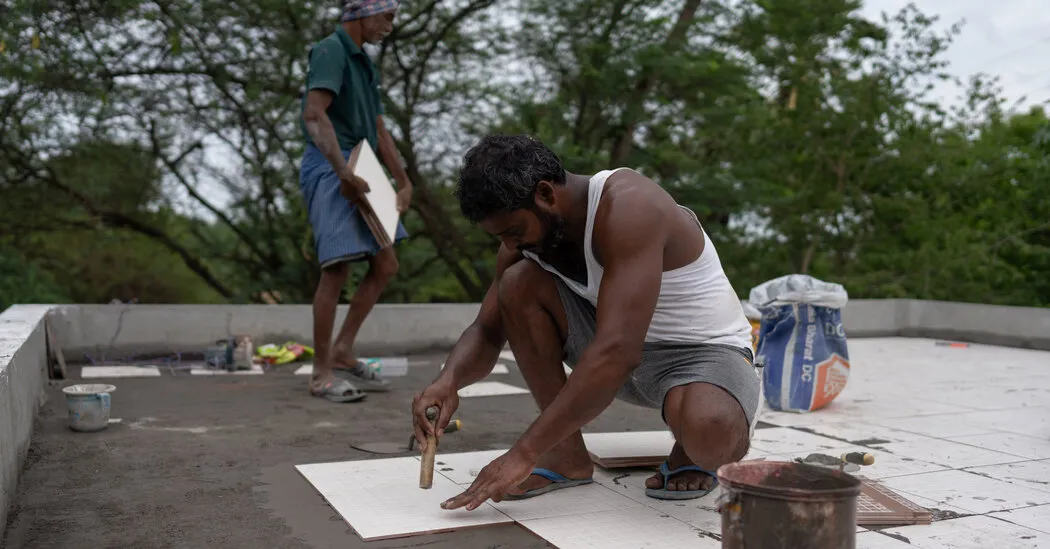
In India, the increasing frequency of heat waves and brutal summers is drawing attention to the cost to the human body of repeated exposure to extreme heat, both day and night, indoors and outdoors. There is growing evidence that heat stress affects people’s health and productivity. Increasingly, researchers and nonprofit groups are experimenting with ways to make indoor life more comfortable for the most vulnerable. In many parts of the country, indoor temperatures can reach 45 degrees Celsius (113 degrees Fahrenheit) during heat waves, according to India’s National Disaster Management Authority. Roofs contribute up to 70 percent of a building’s heat when temperatures are high, according to SEEDS, a New Delhi-based nonprofit that works with communities on climate resilience and conducted a study for the disaster authority. Materials typically used to build houses include cement and brick, which absorb heat during the day and slowly release it at night. Without proper ventilation, these essentially create heat traps inside. The SEEDS study proposed multiple ways to cool roofs, including simple solutions like painting them white, which reflects, rather than absorbs, solar heat. Reflective tiles also help because they insulate a house so it doesn’t absorb too much heat, as do more traditional materials like bamboo and thatch that can be layered over concrete roofs to provide a layer of insulation and reduce heat absorption. Growing vines on house walls can reduce heat absorption, although in some cases domesticated animals make them less effective at chewing them. In July, I visited two coastal villages near the southern Indian city of Chennai, where the Terwilliger Center for Housing Innovation, a unit of Habitat for Humanity International, had commissioned pilot projects using materials such as heat-reflective paint and cold tiles, which are typically glazed to reflect heat back into the atmosphere. Projects are recording the difference such interventions made in reducing indoor temperatures. Devi, a 40-year-old mother of five in Pulicat town, also known as Pazhaverkadu, was among those whose house had a cool roof installed two years ago. The tile roof “had made a difference during the day,” but he said he didn’t notice a noticeable difference at night. Preliminary sensor data for the study collected last year showed that untreated roofs had temperatures as high as 60 degrees Celsius (140 degrees Fahrenheit) during the day, and that homes with the hottest roofs had consistently higher interior temperatures. Cool roofs can reduce indoor temperatures by four to five degrees, according to a study by the center. With tile roofs, “it takes longer for heat to seep inside and therefore interior temperatures are more uniform,” said Anoop Nambiar, South Asia regional director at the Terwilliger Center. Nambiar said they are also durable and last at least 15 years. The materials represent just one method of making homes more livable in the heat: ventilation and natural light are equally essential, he added. But the application of cool roofs is sporadic, said Rajan Rawal, an architect and professor at CEPT University in Ahmedabad, and in cities, it only helps cool an individual building and not an area.