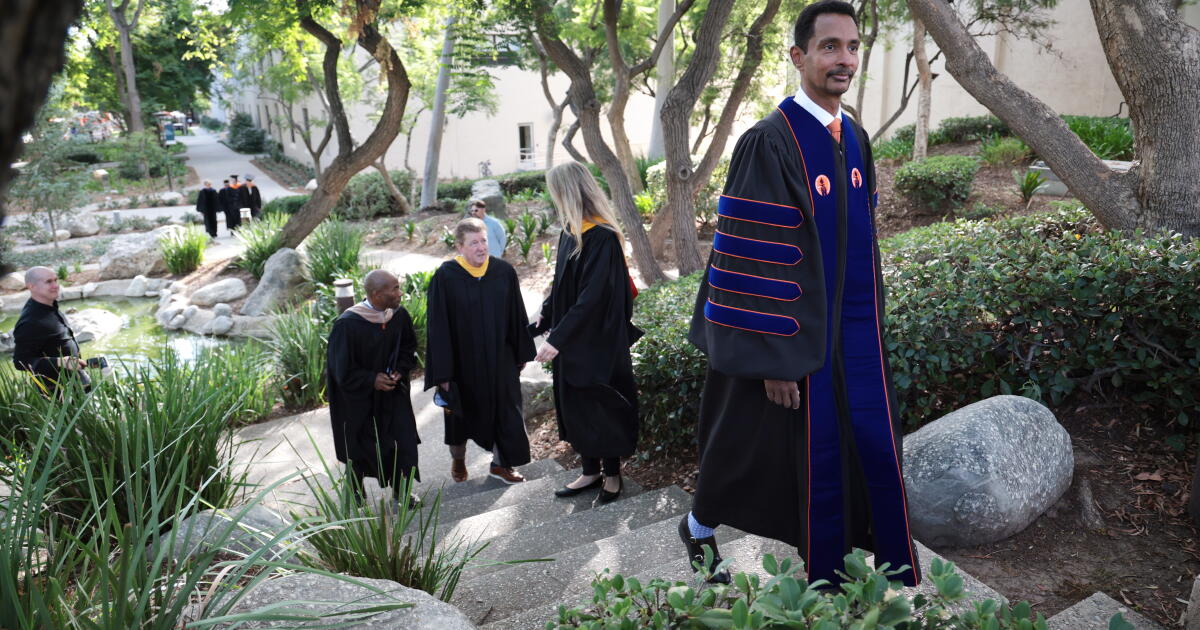
As a teenager in Sri Lanka, Ray Jayawardhana wrote to NASA’s Jet Propulsion Laboratory asking about its Voyager and Viking missions. In response, he received a brochure with photographs of Jupiter and Saturn. On Thursday, the astrophysicist who studies distant planets and writes about extraterrestrial life was installed as Caltech’s 10th president. He runs an institute behind many scientific feats: he founded JPL 90 years ago, created the Richter earthquake scale, and helped build the first detectors to observe cosmic gravitational waves. His students, professors and postdocs have won 49 Nobel Prizes. In an interview with The Times, Jayawardhana, 55, the first astronomer and first South Asian American to lead Caltech, said the institute needs to “find clarity in a time of change and uncertainty” driven by artificial intelligence, changing federal policy and global events. He takes over as Caltech faces its most significant threat: NASA has opened the JPL management contract to outsiders for the first time in its history, forcing the institute into a high-stakes competition. There are potentially dozens of institutions in the mix, possibly including the University of California, Texas A&M and USC, whose representatives attended a briefing at JPL last week about the opportunity to run the lab. Additionally, Caltech, Stanford and seven other campuses are under investigation by the Department of Labor for possible fraud in the use of J-1 visas to attract international scholars. Jayawardhana defended the decades-long partnership between higher education institutions and Washington, which invests billions of dollars in research universities. But he said universities must “accept responsibility” for delivering value to taxpayers and “learn from criticism that is legitimate.” “It is time to renew that pact and at the same time recognize that the ecosystem needs to evolve,” he said. Caltech need only look up to see reasons for optimism now and into the future. NASA’s Roman Space Telescope, carrying an instrument built by JPL, launched in August. In September, NASA advanced PRIMA, a $1.2 billion far-infrared telescope built around detectors from Caltech and JPL, toward launch in 2033. It called Caltech, which enrolls fewer than 2,400 students and admitted less than 4% of applicants this year, almost as selective as Harvard, “really small but really powerful.” Since Jayawardhana took office on July 1, donors have pledged about $73 million in donations. Jayawardhana based his inaugural address around the notion of “first light,” which astronomers call the moment when a new telescope first opens to the night sky. He described Caltech’s “uncommon courage,” one that “comes for bold ideas” and “the stimulating legacy we have been entrusted with.” “We adopted it at a time of impressive scientific possibilities, but also of erosion of public trust and increasing pressure to measure the value of research by the immediacy of its results,” he said. “As scientists, we must remain optimistic in the face of uncertainty.” JPL up for bid Nowhere is uncertainty more acute than at JPL. NASA has awarded Caltech the contract without competition since the agency’s founding in 1958. In May, NASA said opening it would “ensure continued accountability and strong value for American taxpayers.” NASA plans to choose a winner in early 2028 who will take over after the current Caltech contract, valued at up to $30 billion over 10 years. JPL has cut more than 1,500 employee and contractor jobs since the beginning of 2024, about a quarter of its workforce, under the Biden and Trump administrations. The reductions included work on the now-canceled Mars Sample Return mission. NASA’s reimbursements to Caltech for the cost of operating JPL fell about 12% to $2.3 billion in the fiscal year that ended Sept. 30, 2025. NASA also paid Caltech $58.4 million in 2025 for running the lab. Jayawardhana said it makes sense for NASA to evaluate “what works well” in the way the lab operates. Caltech welcomes “the opportunity to demonstrate” what it called “the continued and unparalleled value of the partnership.” He said maintaining the partnership with JPL is a “high priority.” Caltech is also restructuring the way the lab does business. Under an agreement established last year, private companies and nonprofit organizations can fund work at JPL directly. Jayawardhana said that has brought $50 million in work to JPL in about nine months. On Wednesday, Caltech named Artemis II commander Reid Wiseman associate vice president and deputy director of JPL, effective Nov. 30. He also announced a $27.5 million gift from Foster and Coco Stanback for aerospace research at Caltech and JPL. A technician works on a component of the Near-Earth Object Surveyor, a space telescope designed to find asteroids and comets that could threaten Earth, at JPL on March 19, 2025. It is not scheduled to launch before September 2027. (Myung J. Chun / Los Angeles Times) JPL is the largest unit of Caltech in Washington. “I don’t think it’s totally replaceable,” Jayawardhana said of federal funding, calling corporate and philanthropic money “complementary.” Caltech’s federal research funding increased about 13% to $370.6 million in the fiscal year that ended Sept. 30, 2025, and grew to $381.4 million in the last fiscal year. But the tension is noticeable in other places. In a July 2025 memo, then-President Thomas F. Rosenbaum warned that federal money, “approximately one-third” of the campus budget, could no longer be counted on and that Caltech was “prepared to implement a substantial reduction in graduate admissions by fall 2026.” This fall, 213 new graduate students and postdocs arrived on campus, compared to 287 the year before. Visas and Citations Nearly half of Caltech’s graduate students, 46%, come from abroad, along with 16% of undergraduates. Since President Trump took office, his administration has expanded the travel ban to 39 countries and focused scrutiny on the J-1, a State Department exchange visa that universities use to bring visiting researchers and scholars. teachers. On October 8, Vice President JD Vance and the Department of Labor inspector general announced an investigation into possible fraud in the J-1 program, alleging that universities, including Caltech, use the visas to bring in foreign researchers and students at the expense of Americans. “I can’t comment specifically on it,” Jayawardhana said of the allegations. Caltech “has received an administrative citation,” he said. “Our lawyers are reviewing it.” Caltech staff members greet then-incoming Caltech President Ray Jayawardhana during a hiring announcement event in January. (Christina House / Los Angeles Times) Navigating AI, free speech and diversity Tensions over AI arose on campus this fall when nearly 800 current and former Caltech mathematicians protested a student-run “Mathathon” backed by about $2 million in computing credits from OpenAI and Anthropic, warning of “sloppy mathematics.” OpenAI later retired. Mathematics is “certainly changing quite dramatically” because of AI, Jayawardhana said, calling it “a precursor to what’s to come in other fields.” As “AI increasingly handles that scientific process,” he said, what human scientists contribute “is going to change.” As chancellor of Johns Hopkins, Jayawardhana signed a 2024 declaration committing the university to restraint in taking public positions on social and political issues, a practice often called institutional neutrality. He said the practice should also be applied at Caltech. “Listening or allowing ideas to be heard is not the same as endorsing them,” he said. The Trump administration has also pressured universities to end diversity programs. Last year, Caltech changed the title of its chief diversity officer to associate vice president for “campus climate, engagement and success.” The change, which was not explained publicly, came weeks after the Department of Education warned universities that diversity, equity and inclusion programs could cost them funding. Jayawardhana said Caltech is “merit-based,” aims to keep “the doors open, and wants to recruit from a cross-section of society.” its surface. Jayawardhana said that instilled an early belief that “if people could do that, what couldn’t they do?” After studying at Yale and Harvard and holding positions at UC Berkeley, University of Michigan, University of Toronto, York University and Cornell, he joined Johns Hopkins in 2023. Following the Caltech tradition, Jayawardhana still conducts his own research, studying planets around other stars. Jayawardhana has written for years about the search for life beyond Earth and is the author of four books. He made extraterrestrial life the focus of a talk with alumni on campus this month. “The universe is a big, very, very big place, and it would be presumptuous, to say the least, to imagine that life originated only on a small rock around a fairly ordinary star,” he told the alumni. He said that if repeated signs of life outside Earth are found, “I think it could be a moment in human history comparable to Darwin or Galileo.” “I do this for a living,” he said of astronomy and science, “and yet I find it mind-blowing.”