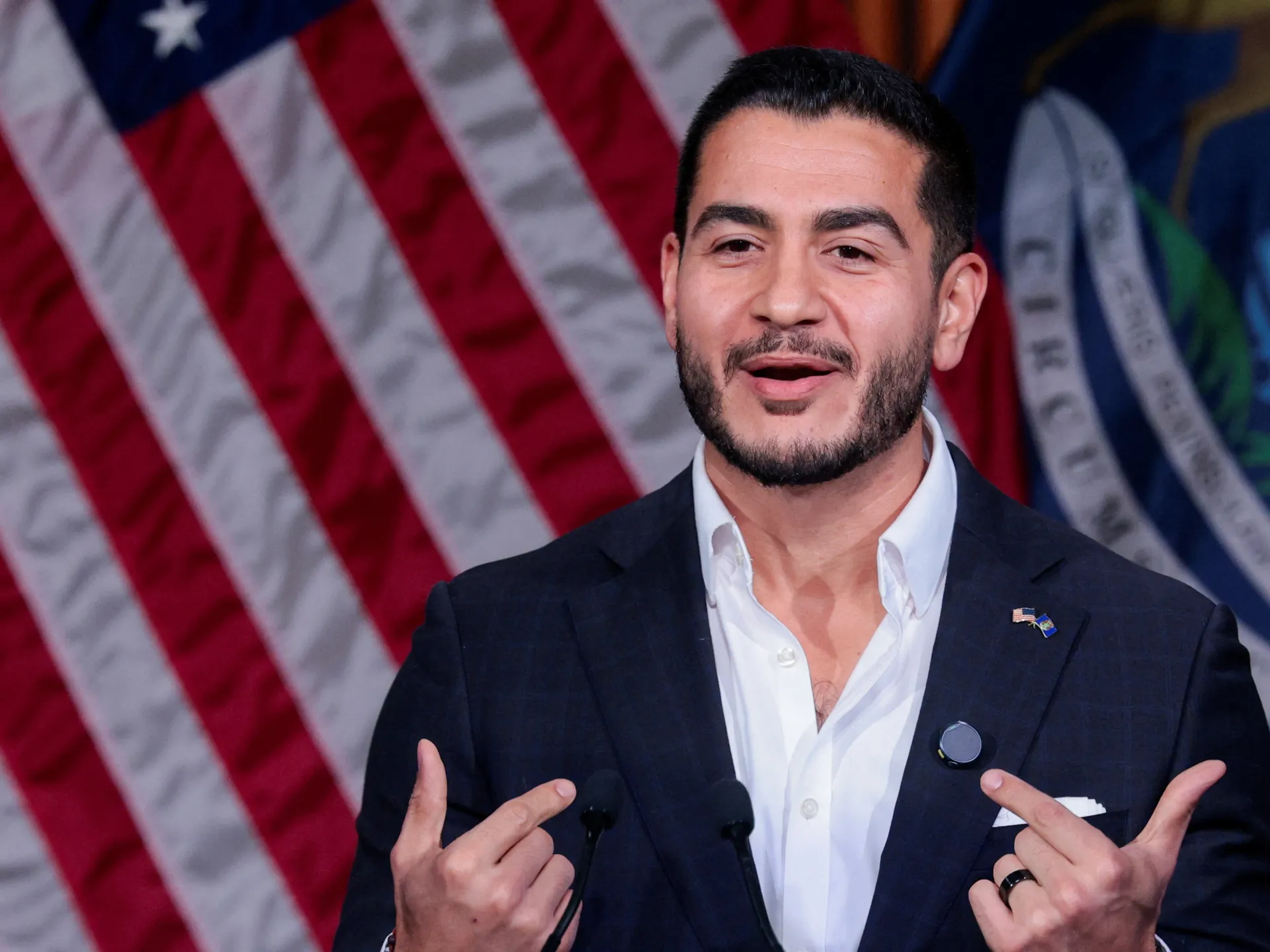
Abdul El-Sayed had an awkward message for US President Donald Trump and Vice President JD Vance as he celebrated his historic election victory in Michigan. They had used a series of racist labels and rhetoric to attack El-Sayed ahead of the midterm elections, in which he was running against Trump’s hand-picked candidate, Mike Rogers. Trump mocked his name and said that as president, he could call the doctor and former Michigan public health official whatever he wanted. Trump called El-Sayed a “jihadist,” while Vance described him as a “psychopath.” Recommended Stories list of 3 itemsend of listNow, the 42-year-old winner of the Michigan race noted, they would soon have to address him as a senator.“JD, habibi [Arabic term of endearment]It’s an irony: You are constitutionally obligated to swear me in in January,” El-Sayed told his enthusiastic supporters in the early hours of Wednesday, shortly after he was projected to win the hotly contested race. “Donald, I know you have a problem with my name, so when JD swears me in, you can call me ‘senator.’ I hope we never have to see people like you in Michigan again.” The Democrat’s victory over Republican Rogers on Tuesday made him the first Muslim elected to the US Senate, following a campaign marked by attacks on his faith and criticism of his opposition to US military adventurism in the Middle East and Washington’s support for Israel. Given the historical significance of his election, El-Sayed focused on his promise to challenge economic inequality, health care and the cost of living in the country. “Michigan, we just don’t It should be so difficult. It shouldn’t be that hard to buy a second bag of groceries or fill up your tank,” he said. “It shouldn’t be that hard to pay your taxes and know that that money will be spent on you and your children instead of dropping bombs on someone else and their children.” The Muslim doctor will win more than 52 percent of the vote, with more than 95 percent of the votes counted. El-Sayed was born and raised in the Detroit, Michigan, metropolitan area and is of Egyptian descent. He has often described his upbringing as that of a typical child in a “brown” immigrant family; a doctor and public health expert, he studied at the University of Michigan, where he was the valedictorian of his class of 2007. At his graduation ceremony, guest speaker and former president Bill Clinton praised the incoming senator for his speech focused on inclusion and equality. “I wish all the people in the world who believe that we are destined to suffer a clash of civilizations and that we cannot overcome religious divisions could have heard him speak today,” said Rhodes Scholar at the University. from Oxford in the United Kingdom He also earned a medical degree from Columbia University in New York. Before entering electoral politics, El-Sayed built his career in public health, working as an epidemiologist and eventually led the Detroit Health Department as executive director. He later became director of the Wayne County Department of Health, Human and Veterans Services. The incoming senator is married to Indian-American psychiatrist Sarah Jukaku, with whom he has two daughters politically. 2018, when he ran for governor of Michigan on what many considered a progressive platform. He campaigned to expand access to health care and challenge corporate influence, but lost the Democratic primary to Gretchen Whitmer, who subsequently won the governorship. Despite the loss, the campaign helped establish El-Sayed as a prominent voice in Michigan politics. Political positionsEl-Sayed has advocated for universal health care, lower costs of living, and a foreign policy that puts needs first. The doctors’ campaign has made health care affordability a central issue, arguing that access to medical treatment should not depend on a person’s income or employment status. El-Sayed has also focused on rising grocery and fuel prices, criticizing corporate influence on the economy and arguing that working families are struggling. to cover everyday needs. Abdul El-Sayed visits a polling place in Michigan Union during election day. [Julia Demaree Nikhinson/AP Photo]In foreign policy, El-Sayed has been an outspoken critic of US military involvement in the Middle East, opposing the US-Israel war against Iran and calling for an end to US military assistance to Israel. El-Sayed blamed Iran’s war – which he has described as “stupid” – for higher gas prices and inflation, accusing the Trump administration of starting an unjustified conflict. instead, the money should go towards education, healthcare and childcare. “They tried to call you hateful if you believe that Palestinian children should grow up in the land of their ancestors without being murdered for our tax money,” he said after declaring victory. “If you believe in equal rights to peace, dignity and self-determination, that is not hate, it is love.” The Michigan-based politician also criticized Trump’s trade war with Canada, arguing that the tariffs have hurt the economy of his state, which is closely connected to its northern neighbor. Senate Campaign El-Sayed launched his Senate campaign in 2026, seeking to replace outgoing Democratic Sen. Gary Peters in Michigan, a key battleground state. defeated Congresswoman Haley Stevens in the Democratic primary, marking a significant victory for progressives and a setback for the American Israel Public Affairs Committee (AIPAC), which had openly supported her opponent. Although he initially pledged to support El-Sayed in the November election, Stevens endorsed Rogers days before the vote, sparking widespread criticism. More than $50 million was spent during the primary campaign, including at least $30 million from AIPAC in support of Stevens. campaign focused on addressing the rising cost of living, expanding access to health care, and reducing corporate influence in Washington. He also called for an end to US military assistance to Israel, putting him at odds with sections of his own Democratic Party. Abdul El-Sayed and his wife, Sarah Jukaku, take the stage after declaring victory. [AFP]His campaign also faced Islamophobic attacks and accusations of anti-Semitism. After his primary victory, far-right commentators seized on his use of the Arabic expression “inshallah,” meaning “God willing,” to portray him as a religious threat to the United States. Trump accused El-Sayed of hating Jews and Israel, while his Republican opponent, Rogers, alleged that he had sympathies and ties to the Muslim Brotherhood. In the last televised debate in October, Rogers suggested that El-Sayed had the same supporters as groups like Hamas, implying that his platform was a threat to “national security.” El-Sayed vehemently denied the allegations. On Wednesday, he responded to those who had tried to use his faith and ethnicity as weapons against him. “We don’t want our money to be sent to commit apartheid, genocide or war,” El-Sayed said. Until now, he said, his campaign had used “inhallah” to emphasize his hopes for victory. “But today, tonight, we can turn that inshallah into alhamdulillah. [praise be to God].”