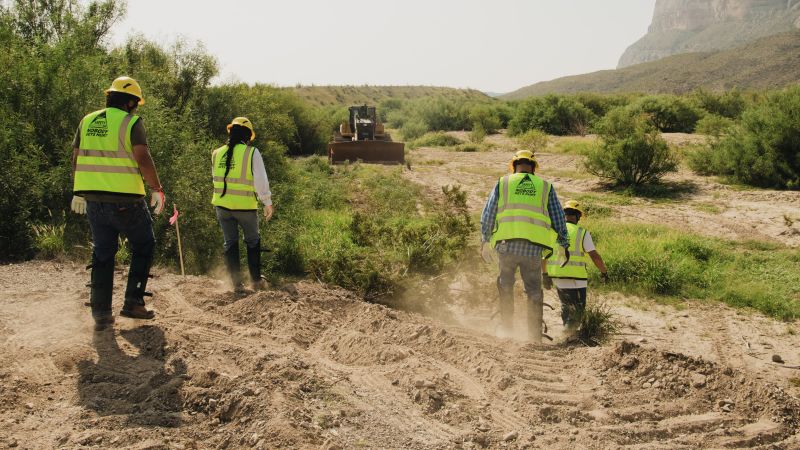
Big Bend National Park, Texas — The towering cliffs, rugged mountain tops and harsh desert climate of the Big Bend region of Texas have long proven to be the best barrier the United States could have with Mexico. For generations, the idea of needing to build physical structures to stop illegal migration was considered “crazy,” as a former Big Bend National Park superintendent put it. But now the broad reach of President Donald Trump’s southern border plan has extended to this remote region where only about 1% of unauthorized crossing apprehensions are recorded. Bulldozers are clearing land in the beloved national park, where wildlife roams and the landscape has remained untouched for thousands of years. “We didn’t have to worry about any kind of barrier. We had a God-made barrier,” said Sheriff Thaddeus Cleveland of Terrell County, a vast, sparsely populated area northeast of the park. He spent 26 years in the U.S. Border Patrol and heard little to no feedback about the need for additional infrastructure in the area where he grew up, he said. “But that has definitely changed.” U.S. Customs and Border Protection says it does not plan to build the same type of 30-foot-tall barrier that has appeared in parts of Arizona, California, New Mexico and Texas inside the national park. But critics say the plan being prepared is no less destructive. Earlier this month, diggers were filmed uprooting trees and shoveling dirt as wild animals trot past. They were conducting preliminary work ahead of the budgeted $1.72 billion major construction project designated for the area within Big Bend National Park, the agency said. It’s part of a broader plan to finish the border wall – or some form of it – before Trump leaves office, with steel walls and vehicle barriers and hundreds of miles of new roads cutting through tremendously remote areas. Those with concerns or open opposition to work in this remote wilderness range from a few elected Republicans to young activists, including a pro-border control sheriff and a retired National Park Service superintendent. Photographer Natalie Newman committed to Big Bend in February, when then-Homeland Security Secretary Kristi Noem waived certain federal laws related to environmental safety, historic preservation and wildlife protection, among other initiatives, saying there was “an acute and immediate need to construct physical barriers and additional roads” in the Big Bend region. “It started out just documenting its beauty, trying to get people to see why it is special and what makes it special and what makes it so beautiful and worthy of protection. But that has morphed in the last week,” she told CNN, standing near Santa Elena Canyon, where towering cliffs rise nearly 1,500 feet from the Rio Grande and where she first saw excavators at work in the national park. “More than anything else, I feel anguish about all of this,” he said. Newman enjoys the wilder parts of this park that’s larger than the state of Rhode Island, where you may see fewer people than javelins, a mammal that looks like a small wild pig, although it’s a completely different species. Cacti and wildflowers bloom throughout the state and federal land around Big Bend, which, along with even larger nature preserves across the border, are part of the Chihuahuan Desert, the largest such ecosystem in North America. But these days, when your binoculars are pointed at something in the distance, you’re more likely to be checking the progress of road clearing than any of the hundreds of bird species that frequent the park. He said he will continue to share that news and do his part to defend the national park. “Every day I hope for the day that someone somewhere will do something to put an end to this,” he said. If there is no way to stop it, retired parks superintendent Bob Krumenaker said what could happen in Big Bend would rival the Hetch Hetchy Valley flooding a century ago, an event that changed arguments about environmental preservation. That’s why he calls the whole plan “crazy.” “If they continue with this and build most of the things they’ve talked about, or even a good fraction of them, this will be the largest desecration of the national park system – not just Big Bend National Park – since they built a dam in a pristine valley in Yosemite National Park more than 100 years ago. This is a story our children and grandchildren will tell,” he told CNN. Added to the natural destruction is the damage being caused to people’s confidence, Krumenaker added. “It’s just a tremendous erosion, if not violation, of the agreement that Texans and the American people made when they established that national park. The federal government that I worked for for 41 years is disrespecting its citizens in a huge way.” Krumenaker, now president of the advocacy group Keep Big Bend Wild, spent five years as superintendent of Big Bend National Park and is familiar not only with the multiple studies and approvals needed for any material changes, but also with his federal partners in the Border Patrol and the need for security. “I fully support a secure border in Big Bend, but this is the least active place in the country for illegal border crossings,” he said. “This is purely political, and it will be; it risks destroying one of the best places in the country. It’s just horrible.” He recalled that, as superintendent, he had an annual budget of between $8 million and $9 million and a maintenance to-do list of about $100 million that they would trim when they could. Those numbers are dwarfed by the $1.72 billion earmarked for the Big Bend work, part of the larger $46.5 billion allocated for border wall construction in Trump’s signature legislation, the “Big Beautiful Bill.” Sheriff Cleveland thought talk of security construction was “nonsense” when he first heard about it. His experience in local and national law enforcement tells a different story than the one put forward by CBP that Big Bend is “a high illegal entry area.” What he calls the “God-given barriers” of steep mountains and valleys around the river and an undeveloped roadless landscape would prevent any vehicle from reaching his plot. However, new vehicle barriers are being planned for Terrell County, part of the overall $7 billion plan for the Big Bend sector of the border that includes the national park and lands on either side. “I believe in border security… but let’s put a barrier where it makes sense,” he told CNN. “Let’s spend money where we need to spend it.” Cleveland believes the use of technology would better support him and other rural areas. He points to a solar-powered radar tower with a relatively small footprint that can scan the landscape and identify humans by their gait, activating cameras to lock on and send information to agents. Another option would be for drones to track people and help first responders plan a safe interception amid rugged terrain, he said. “The biggest problem is that the people who make the decisions here for the Big Bend sector have never set foot here.” Cleveland ran for sheriff as a Republican, but says he might become an independent: What he sees as wasteful federal spending on something unnecessary doesn’t fit his own fiscal conservatism. He signed a letter that former Land Commissioner Jerry Patterson carried around the area, praising Trump for closing the border and asking the administration to consider cheaper, less destructive options for the Big Bend region. Others in Texas are taking a similar approach. U.S. Sen. John Cornyn wrote to DHS Secretary Markwayne Mullin last week urging him to meet with local stakeholders before proceeding with construction on state or federal property. Part of Mullin’s involvement so far has been to waive another federal law, effectively ending a lawsuit that claimed that law was being violated. Land Commissioner Dawn Buckingham was more direct, sending a cease-and-desist letter warning of potential legal action to Customs and Border Protection after saying a federal contractor was sent to work at Big Bend Ranch State Park without permission. The accompanying press release was titled “Don’t Step in Texas.” Gov. Greg Abbott commented before Trump entered the White House for the first time that he did not want a border wall across his state. “There are meandering regions of the Rio Grande where it would be extremely difficult to build a wall. There are parts like the Big Bend region; we don’t want to see a wall in beautiful Big Bend National Park,” Abbott said in December 2016, as reported by The Associated Press. CNN asked for his current views and was directed to an earlier statement from Abbott’s press secretary, Andrew Mahaleris: “Rugged, isolated areas like Big Bend are great opportunities to deploy technology to help secure the border.” Critics say most Republican elected officials across the state have been too silent in their condemnation of border barrier construction projects because they fear the wrath of Trump’s criticism of his signature issue of border security. “The only person who is supposed to represent Texas right now, our governor, is silent,” said resident Jess Bartko. “What they are doing is actively waging war on our parks, our public lands, our community and our livelihoods.” On Wednesday, Bartko and about 100 other protesters gathered along the river, whose course gives the area its name and which attracts many of the half-million annual visitors to the national park. Tourism is very important here: running the river and looking at the night sky. There is concern that both will be affected. As for the upheaval, there could be debris in the river, and construction lights from worker sites and camps could contaminate some of the darker skies over the lower 48 states, blurring star-studded views of the cosmos. This week some roads and facilities were closed in the national park due to construction. Down on the river, next to the entrance to Santa Elena Canyon, one of the park’s “crown jewels,” protesters screamed and shouted, their shouts echoing off the cliff walls as they pledged to keep working to protect Big Bend. “The land remembers, the water remembers, it will remember us and our struggle,” Joan Escamilla told her fellow national park supporters. “You can bury my heart in the Rio Grande.”