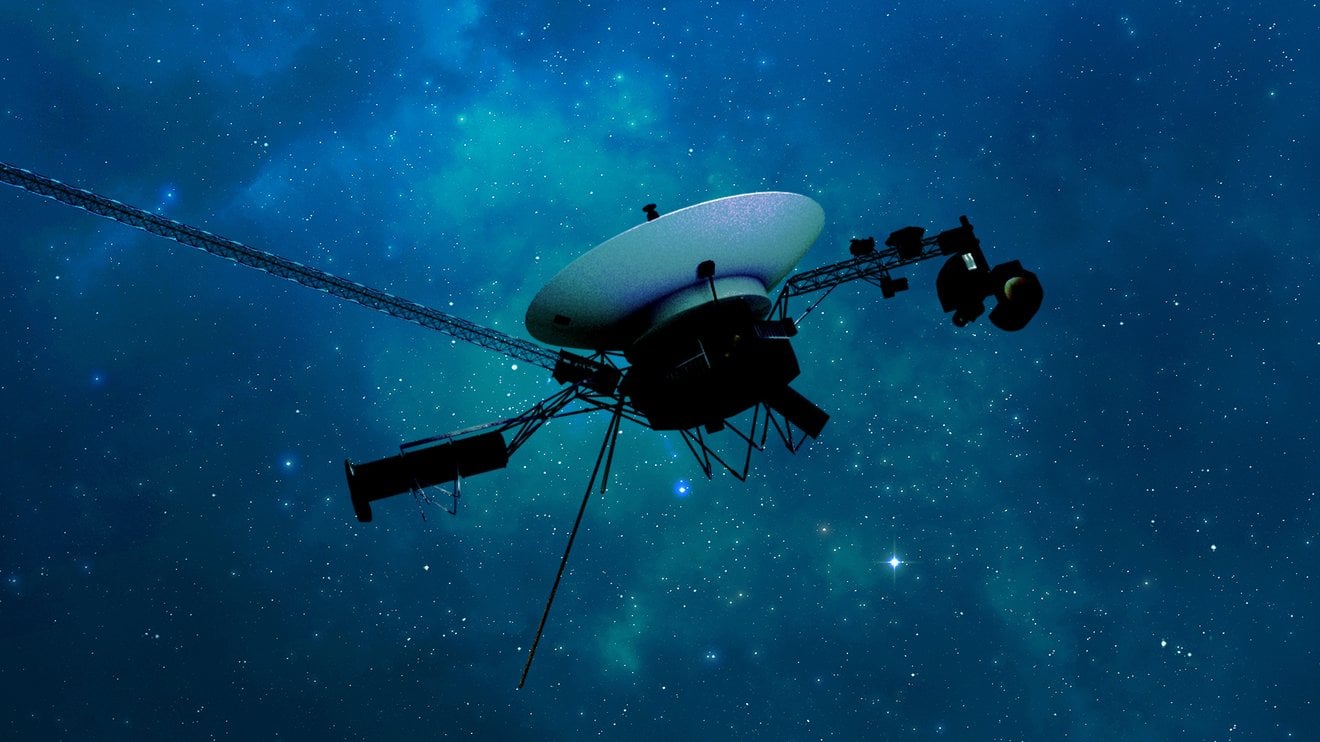
An innovative solution helps the venerable Voyager 1 spacecraft pass a key milestone. Flashback to 1977. Jimmy Carter was president of the United States, Star Wars was a box office hit, and the two Voyager spacecraft set out on a historic Grand Tour of the solar system. Now, teams at NASA’s Jet Propulsion Laboratory are working to keep the missions active while expanding the boundaries of interstellar space beyond the solar system. NASA recently announced that after a brief drama and loss of communications with Voyager 1, a solution called ‘Big Bang’ managed to resurrect the spacecraft. The Big Bang swap alternated three units (two primary heaters and an old 8-track digital recorder) with three secondary low-power options. The brief loss of communications occurred on October 20 and lasted 48 hours. Engineers work on a Voyager spacecraft before its launch. Credit: NASA/JPL-Caltech “This is the first time we’ve seen the spacecraft do something like this, but we’re also at a point in the mission where we have to expect the unexpected,” said Kareem Badaruddin, in a recent press release. “We are relieved to be back in contact with Voyager 1 and are eager to understand what happened.” The Big Bang method was also successfully implemented to keep Voyager 2 running last August. Traveling far from the Sun, the Voyager missions rely on plutonium-fueled radioisotope thermoelectric generators for power. PU-238 has a half-life of just under 88 years, meaning missions are now steadily losing power. This loss is equivalent to about 4 watts of power each year. Voyager 1 currently uses just over 200 watts of power, enough to power an electric blanket. This has forced mission controllers to make some difficult decisions, including shutting down the low-energy charged particle LECP experiment in early 2026. The missions launched with 10 instruments in 1977. The changes had to happen at the same time, as the units involved also heat the spacecraft and ensure it continues to operate in the cold depths of deep space. The Voyager Program’s Legacy Voyager 1 launched on September 5, 1977, actually after Voyager 2. Voyager 1 flew by Jupiter in 1979 and Saturn in 1980. A flyby past the enigmatic Titan for a closer look on November 12, 1980 meant that the mission would leave the plane of the solar system afterwards. Voyager 2 passed by Uranus in 1986 and Neptune in 1989. The paths of Voyager 1 and 2 outside the solar system. Credit: NASA/JPL-Caltech Voyagers continue doing science as they travel through interstellar space beyond the boundaries of the outer solar system. The two Voyagers are the first missions to directly sample the region of space beyond the heliosphere. Voyagers are heading beyond the arc shock of the solar system into interstellar space. Credit: NASA At this time, the important Plasma Wave Subsystem (PWS) plus a magnetometer instrument on Voyager 1 remain active. Without the Big Bang change, mission controllers would have had to make the difficult decision to shut down another crucial instrument in 2027. Voyager 1 witnesses a “crescent Saturn.” Credit: NASA/JPL-Caltech Crossing the ‘One Day of Light’ Mark Moving at 16.9 kilometers per second relative to the Sun and the solar system, Voyager 1 will become the first human-made artifact to reach the one day of light mark this month on Wednesday, November 18 at 5:16 a.m. EST. That’s approximately 26 billion kilometers or 172 Astronomical Units (AU) away. For context, the Moon and cis-lunar space that mark the furthest distance humans have traveled to date are just over a light second away. NASA’s global Deep Space Network continues to monitor increasingly weak signals from the Voyager spacecraft. Controllers will likely have to deal with more signal outages in the coming years. The global DSN tracks missions, including one of the Voyager spacecraft. Credit: NASA/DSN Along with the now-silent Pioneer 10 and 11 and the still-active New Horizons mission, Voyager 1 and 2 are leaving the solar system for galactic space. The upper stage stellar thrusters that help these missions reach escape velocity are also on their way out. The next mission to escape the solar system won’t happen for some time, although the proposed Interstellar Probe mission could one day make the trip. Voyager 1 is now moving away in the direction of the constellation Ophiuchus, near its border with Hercules. Congratulations to the intrepid and resourceful Voyager 1 team. Hopefully, the mission will surpass its half-century in space next year.