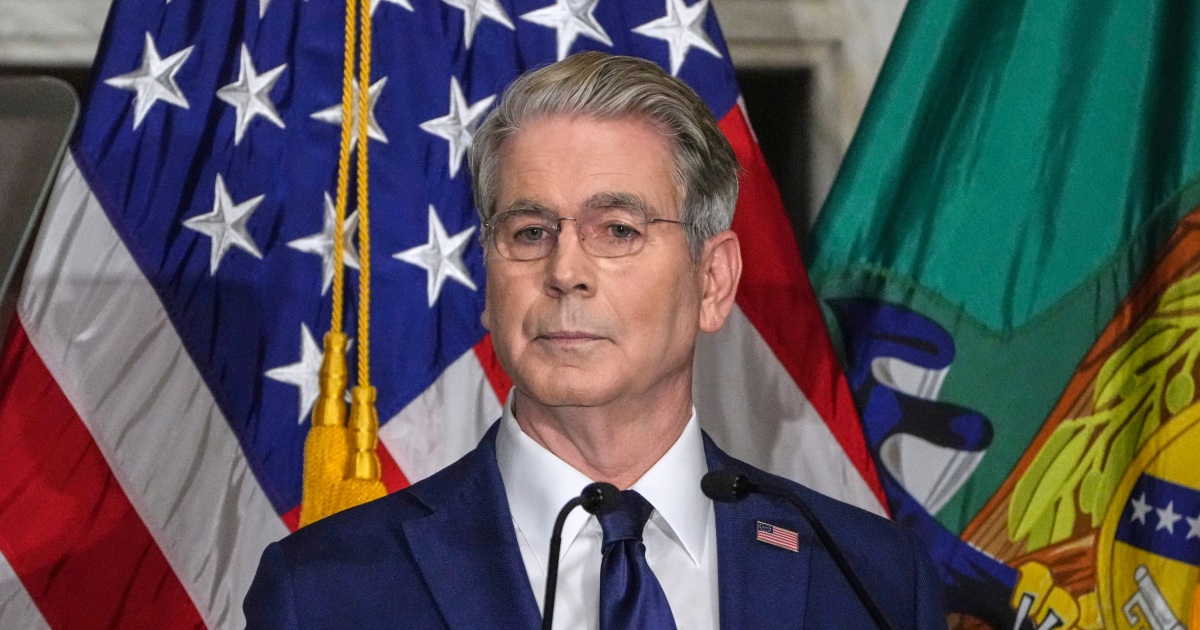
Treasury Secretary Scott Bessent on Monday announced plans for a wave of new sanctions aimed at further isolating Iran, after threatening the Islamic Republic with “an economic D-Day.” The sanctions will target international entities dedicated to facilitating Iranian trade related to shipping, oil, cryptocurrencies, gold and aviation. Bessent said President Donald Trump was making phone calls to world leaders with “specific requests” to stop trading with the Iranian regime. Bessent said the United States was launching an “economic attack” against Iran’s financial connections “around the world” in order to “cut off all economic conduits” used by Iran “until Tehran is left alone.” The Treasury announced Monday that it will sanction nearly 60 corporations, individuals and vessels in multiple jurisdictions that it says enable the Iranian regime’s “recklessness.” That list includes several Chinese citizens. China has said it is illegal for its citizens to comply with unilateral US sanctions. Bessent said the United States was engaging in “quiet diplomacy” with Iranian trading partners to warn them of the consequences of continuing to trade with Tehran. Any entity that facilitates money laundering on behalf of Iran will be removed from the US dollar system, he said. “No one is above the reach of US sanctions,” Bessent said, adding that there is now a “healing period” for nations to end specific relationships with Iran. However, Bessent did not present any immediate concrete action against other countries. Markets showed little reaction to Bessent’s comments. Iranian officials downplayed the economic threat. “This time too they will fail,” Iranian Economy Minister Ali Madanizadeh said in response to Bessent’s comments, according to the semi-official Fars news agency, adding: “The government is fully prepared for this economic war.” Madanizadeh said it would not be easy to isolate the country from global economic channels and that Iran would retaliate, according to the semi-official ISNA news agency. “If they take any action, they should expect an attack from us.” Separately, Iranian President Masoud Pezeshkian said the United States must stop trying to intimidate Iran. “The United States must correct its tone and approach in dealing with Iran, because relying on force and intimidation will only complicate the process,” he said, according to the semi-official Tasnim news agency. “Our nation, relying on your solidarity, will overcome any pressure and threat.” Pezeshkian made the comments during a meeting Monday with Field Marshal Asim Munir, head of Pakistan’s army, a key mediator between the United States and Iran, according to Tasnim. After six months of kinetic combat and a U.S. naval blockade of the Strait of Hormuz, the Trump administration has few levers left it can pull to convince Iran’s major trading partners to materially reduce their economic ties, Alan said. Eyre, a distinguished diplomatic fellow at the Middle East Institute. The White House “seems to think that this announcement in and of itself will cause countries to sever relations with Iran without any follow-up, which I think is very unlikely,” Eyre told NBC News. For decades, the United States has imposed direct sanctions on Iran and companies involved in prohibited activities such as weapons acquisition. But Iran has, in many cases, successfully evaded sanctions by creating new front companies. Bessent on Sunday vowed to launch “the biggest financial offensive in history” in an op-ed in the Financial Times. “The world must understand that our goal is to cut off all economic lifelines supporting the tyrannical regime until Tehran is left alone,” he wrote, adding that any country that partners with Iran would also be financially isolated. Monday’s actions are designed to attack “secondary” countries whose trade and commerce relationships still benefit Iran. Before the announcement, the United Arab Emirates, a close US ally whose leadership has forged close ties with the Trump administration, announced it would end all trade relations with Iran. Experts say the success of Bessent’s announcement will depend on whether Iran’s most powerful trading partners – China, India and Russia – decide that the US threats are credible. “If you’re a country like Russia or China, you see Iran as an ally, and you’re not going to suddenly stop trading with them; that damages Moscow’s credibility in the eyes of its friends around the world,” said Andrew Gawthrope, a Leiden University professor specializing in American foreign policy. “There’s just not much the United States can do to these countries to get them to accept this,” he said. It has been almost six months since the United States and Israel attacked Iran with the premise of preventing it from obtaining a nuclear weapon. The United States has racked up its own costs. Defense Secretary Pete Hegseth said last month that the war has cost the United States $37.5 billion, although estimates put the total economic impact at as much as $150 billion. Moody’s Analytics chief economist Mark Zandi told NBC News last month that he estimated the war has cost the average American household more than $1,200 in higher energy and grocery costs alone. Despite the new economic measures announced on Monday, Hegseth did not rule out further military action. “If we need to use kinetic attacks, we will use them. If Iran is foolish enough to overdo it or mess with the US military, we will do what we have to do,” Hegseth told reporters on Monday. “But we know that economic pressure is what hurts them the most right now.” “We are in no way preventing the use of kinetic strikes anywhere in the Strait of Hormuz or around Iran.” Economists say that in addition to higher gasoline prices, the war has also contributed to the current turmoil in the bond market that has led to extraordinary intervention by the Treasury Department. As Bessent spoke on Monday, Mohammad Bagher Ghalibaf, the speaker of Iran’s parliament who until recently had led Iran’s negotiating team to end the war, addressed X. “Americans know that no one buys their grandstanding; the United States is not in an economic position to further restrict its relations with other countries,” he wrote. “Iran’s trading partners, both in the media and through messages sent to us, have made it clear that they do not take these statements into account anywhere.” Before the speech, the country’s deputy foreign minister, Kazem Gharibabadi, also posted on X to question whether Bessent’s plan was “an admission of US defeat.” Referencing earlier US claims that Iran’s military capabilities had been destroyed, he said: “Dealing with this same Iran has required the ‘largest financial offensive in history’ and the mobilization of ‘all US institutions and authorities.'” The head of Iran’s Central Bank, Abdolnaser Hemmati, told the semi-official Tasnim news agency that the United States had “done everything it could in terms of sanctions so far and the recent claims do not introduce any new restrictions or additional pressure.” Iran had been anticipating “difficult conditions” since the war began in February “and began accumulating foreign currency,” he said in comments published before Bessent’s announcement. This had allowed the country “to make a firm commitment that we would provide the necessary foreign exchange for essential goods and medicines,” he said. In Tehran’s sprawling Grand Bazaar, long a center of conservatism in Iranian politics and still an economic force within the country, there was a heavy police presence and some expressed frustration over the value of Iran’s currency, the rial. With gasoline prices rising and long lines at some gas stations, the country’s authorities appeared concerned that protests could break out. Violent demonstrations left thousands dead in January and thousands arrested by the country’s hardline regime after people took to the streets to call for an end to the country’s theocratic rule. While President Donald Trump hoped people would rise up against the country’s hardline rulers at the start of the war, Iran’s authoritarian government appears to have tightened its grip on power since the start of the war. Iran’s supreme leader, Ayatollah Ali Khamenei, was killed at the start of the war along with several other senior officials. Now, his son and successor Mojtaba Khamenei appears to be equally hardline, having elevated a group of hardline veterans of the country’s military and security establishment.