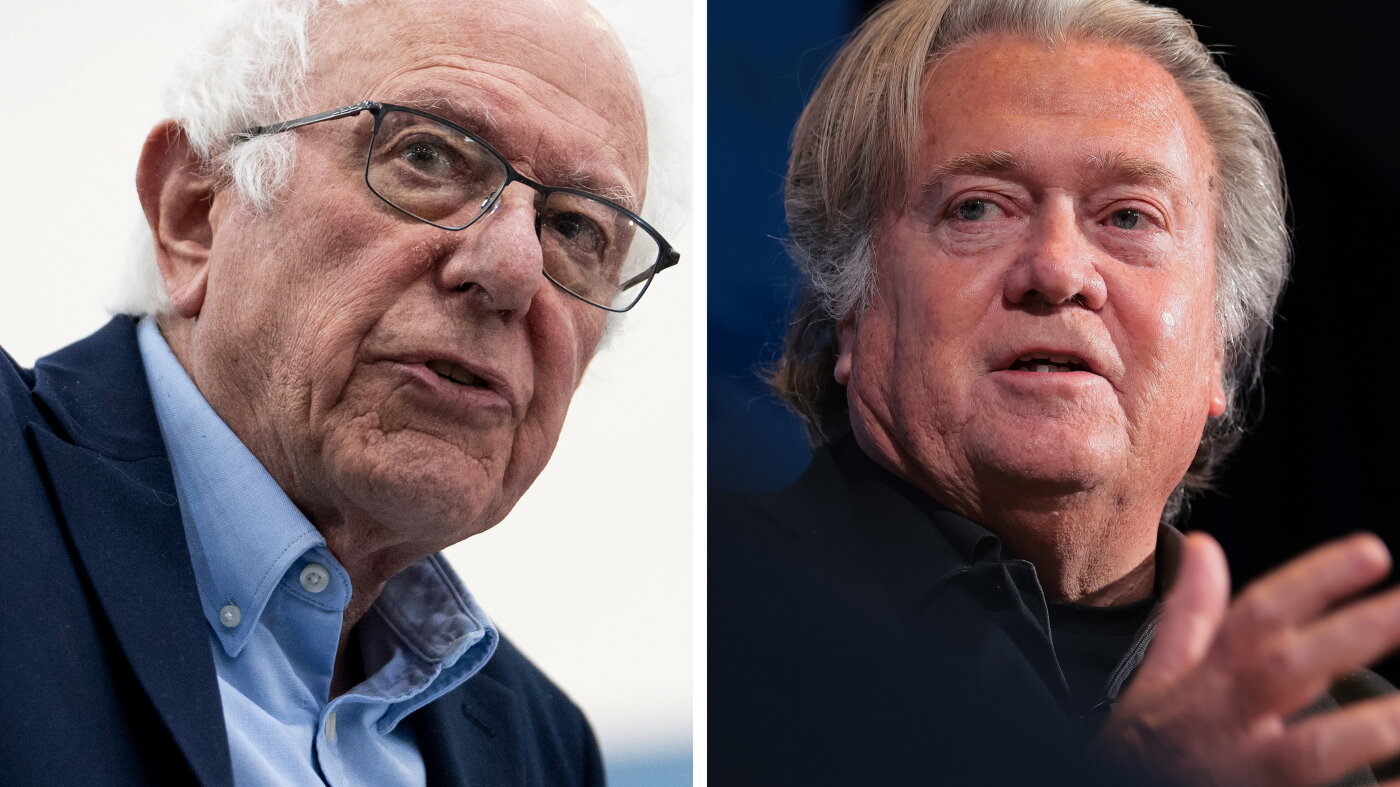
The pairing of progressive Sen. Bernie Sanders, on the left, and former Trump strategist Steve Bannon, on the right, is a sign of how concerns about the rapid advancement of AI are upsetting political alliances. But their political proposals are very far apart. Sanders Credit: Sarah Rice/Getty Images and Bannon Credit: Kayla Bartkowski/Getty Images hide caption toggle caption Sanders Credit: Sarah Rice/Getty Images and Bannon Credit: Kayla Bartkowski/Getty Images Left-wing socialist Bernie Sanders and MAGA strategist Steve Bannon took the same stage Tuesday to criticize the artificial intelligence industry and its leadership, in a sign of how growing concerns about the technology’s rapid advancement are upsetting political alliances. Still, the two showed few signs of agreement on how the technology should be regulated. Sanders, the independent senator from Vermont, and Bannon, Trump’s former White House adviser, appeared at the “Pro-Human Caucus” on Tuesday, alongside a diverse group of speakers who called for curbing the development of AI. Speaking to nearly 300 people packed into a Washington, D.C., ballroom, Sanders expressed concern about AI surpassing human intelligence and escaping human control. He said he will introduce legislation to permanently ban the development of “superintelligent” AI, along with Rep. Greg Casar, D-Texas, next week. “Despite living in a so-called democracy, the public has been virtually unengaged in the AI revolution that is transforming the world,” Sanders said. “Congress, under both Democratic and Republican control, has been asleep at the wheel, and we now have a president whose ignorance on this issue is truly shameful.” Sanders said decisions about AI are made by profit-motivated tech leaders, adding that society should not allow AI developers to continue improving their products if company leaders admit they are losing control of the technology. He said he hopes President Trump and Chinese President Xi Jinping will negotiate a treaty to halt advanced development of AI when they meet at the White House next week. Bannon, who took the stage immediately after Sanders, called AI the defining issue of our time and laid out a nationalist approach to the technology. He said tech leaders have money and power, but they don’t have the public’s trust. “We are not fatalists,” he said. “But we’re not going to give these guys carte blanche. Their arrogance is overwhelming.” He said the United States should put limits on any exchange of chips, technology or knowledge between the United States and China. “Throw them out,” he said. “Remove all Chinese citizens from the laboratories and return them to mainland China.” The assembly, an all-day event, was organized by the Future of Life Institute, a nonprofit advocacy group that issued 33 principles in March to guide its “pro-human” movement. Those principles include that humans must remain in charge of AI, people must retain agency and freedom, and AI companies must be held accountable for the impact of their technology. The event comes at a time when concerns about the expansion of data centers, the growing influence of AI and warnings from AI experts led leaders at Anthropic and OpenAI to call for a slowdown in AI development to keep the technology under human control. At the same time, lawmakers have been urging House Speaker Mike Johnson, R-La., to pass safeguards against AI. Johnson has said he supports guardrails for AI, but that companies should be responsible for ensuring safety, not Congress. “We can’t put a moratorium on this because China will overlap with us, and that’s the challenge,” Johnson told CNN over the weekend. “If Congress rushes in and holds some kind of emergency session to try to regulate AI, we will lose the race to China, and that is a threat to all Americans.” But in a nod to voters’ angst over AI, the House is scheduled to vote on legislation Tuesday that addresses one part of the problem: the proliferation of data centers. The bill, known as the Taxpayer Protection Act, is designed to protect Americans from increases in energy costs related to the construction of data centers. Even though the Trump administration has consistently defended AI and data centers, lawmakers and candidates on both sides of the aisle have been speaking out to voters’ concerns about AI’s risks to society. But after AI companies called for a slowdown this weekend, President Trump quickly responded that the industry’s warnings were overblown. “AI taking over the world, destroying humanity, and all the other bad things is a hoax,” Trump wrote in a Truth Social post on Monday. He added that the only barrier necessary to AI “is a STRONG, INTELLIGENT PRESIDENT (high IQ!).” His administration has rejected calls for regulation, saying the United States must win the AI race with China. Tuesday’s event also attracted Hollywood stars Ashley Judd and Joseph Gordon-Levitt, who have advocated for stricter controls on AI, as well as religious leaders from various denominations and child safety advocates, including parents of children who committed suicide after talking to AI chatbots. “By centering our common humanity, we maintain a space built on trust and collaborative problem-solving to chart a pro-human future with AI,” organizers wrote on the event page.