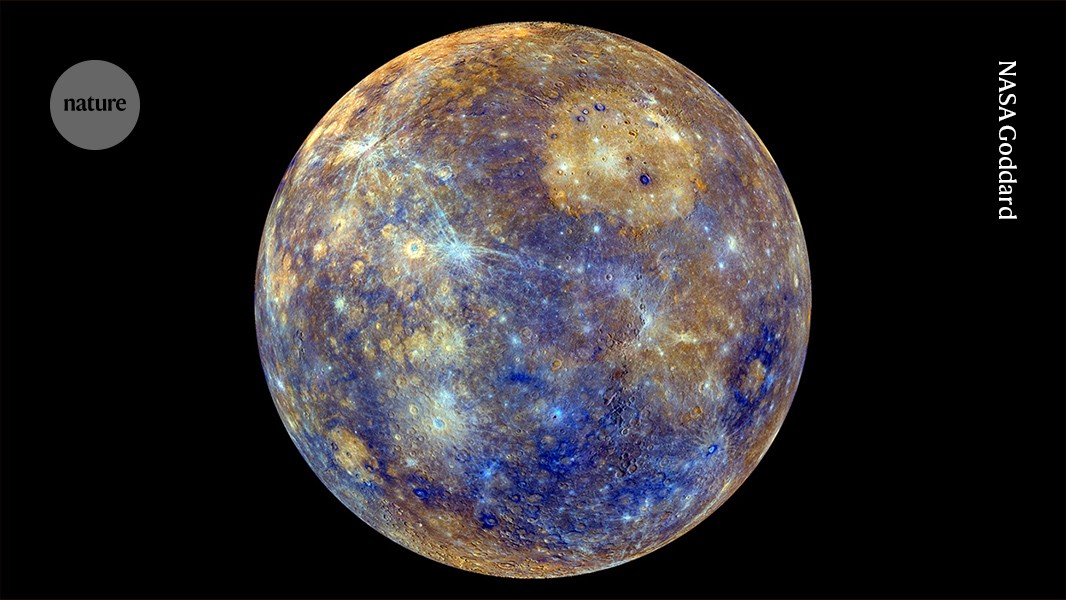
False color view of Mercury produced with data from MESSENGER. Credit: NASA Goddard After an epic eight-year journey, the European and Japanese spacecraft BepiColombo arrived at Mercury. It is only the second mission (after NASA’s MESSENGER in 2011-2015) to enter orbit around the innermost planet in the Solar System. On November 21, the European Space Agency (ESA) announced that a European-built module had been inserted into Mercury’s orbit, beginning a series of maneuvers that would last months. In the coming weeks, its two scientific probes, one built by ESA and the other by the Japan Aerospace Exploration Agency (JAXA), will separate, allowing each to follow its own orbit at a different altitude. En route to Mercury, the spacecraft was able to test some of its onboard instruments. Mission scientists pointed the onboard X-ray camera, the Mercury Imaging X-ray Spectrometer (MIXS), toward the Crab Nebula, the remains of a supernova witnessed on Earth in 1054. MIXS is the first BepiColombo. One mission, two orbiters For now, the two probes will remain linked until they reach the prescribed orbit for the JAXA probe, called MIO, on December 9. It will trace ellipses at altitudes between 500 km and 11,000 km, sampling the planet’s magnetic field and how it interacts with the solar wind. The probe built by ESA, called Mercury Planetary Orbiter (MPO) and carrying MIXS, among other instruments, will gradually descend until March 2027, when it will reach its orbit at between 400 and 1,500 km. From there, its instruments will continually study the planet’s surface. The BepiColumbo spacecraft (illustration). Credit: ESA – P. Carril Traveling to the innermost regions of the Solar System is a “prolonged affair,” says Bunce. “Energy-wise, it takes more energy to go to Mercury than it does to go to the outer Solar System,” Bunce says. BepiColombo launched in October 2018 and needed to gradually descend closer to the Sun without gaining speed or overtaking Mercury.