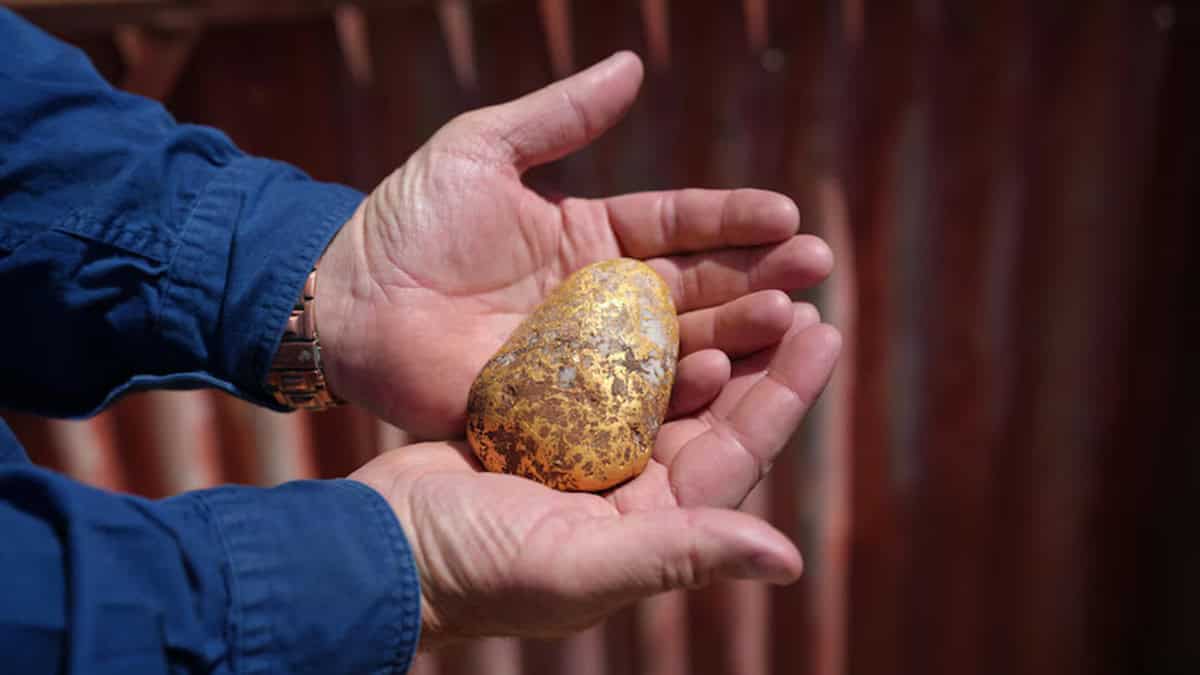
According to tests, the 1,218 gram nugget contains approximately 940 grams of pure gold. Credit: ABC Broken Hill / Kristina Rosengren. The Australian gold prospector was about to call it a day when his metal detector detected a faint signal. After a few scratches on the red dirt, he caught a flash of yellow. What he pulled out was a potato-sized gold nugget valued at about A$150,000 ($100,000). The amateur treasure hunter, who wishes to remain anonymous, spent several days searching at Mount Stuart Station near Tibooburra, a remote town in north-west New South Wales, in October 2026. After unearthing countless pieces of scrap metal over the years, he finally found gold. Literally! And a spectacular amount. The nugget weighed 1,218 kilograms (2.69 lb), including approximately 940 grams of pure gold. His lucky owner affectionately called him “Tibooburra Spud.” But how is it possible for nature to concentrate so much of a relatively rare metal in a single mass? A recent scientific review published in Earth-Science Reviews examines how exceptionally rich gold deposits form. The answer involves everything from underground earthquakes and electrically charged crystals to microscopic gold particles floating in hot water. A Life-Changing Discovery The seeker was nearing the end of a day of searching when his metal detector detected a weak signal. As he went deeper, the signal became more and more intense. “It might have been on the first or second scrape that I saw this bright yellow dot in the center of the hole,” he told ABC News. ×Thank you! One more thing… Please check your inbox and confirm your subscription. Credit: ABC Broken Hill / Kristina Rosengren. Although the gold alone is worth about A$150,000, the rarity and appearance of the nugget could raise its value to A$200,000 if sold to a collector, its finder estimates. Rising gold prices have encouraged more Australians to take up prospecting. Modern gold detectors allow hobbyists to locate buried nuggets without having to excavate large areas of land. Still, most exits yield little more than rusty nails, discarded bullets, and other metal debris. Greg Spangler holding the gold nugget (not the prospector who found the nugget). Credit: ABC Broken Hill / Kristina Rosengren. Greg Spangler, who has sold prospecting equipment in Broken Hill for more than two decades, has only found one other nugget weighing more than a kilogram in that time. These discoveries are rare for good geological reasons. Credit: ABC Broken Hill / Kristina Rosengren. How the Earth Produces Gold Nuggets Gold is found scattered throughout the Earth’s crust, but usually in extremely small quantities. Some rocks that feed underground gold deposits contain only three or four grams of gold per thousand tons of rock. So how does nature gather such tiny traces of gold into a single, huge nugget? In the new review, Rory McNab of Monash University and colleagues explore the mechanisms behind exceptionally rich gold deposits, particularly those associated with tectonic activity and mountain building. Deep underground, intense heat and pressure cause rocks to release water and other substances. These hot fluids extract gold from surrounding rocks, and sulfur compounds help keep the metal dissolved. Faults and fractures act like an underground plumbing system, channeling enormous volumes of gold-bearing fluid into relatively small spaces. Changes in pressure, temperature, and chemical composition can cause gold to come out of solution. Earthquakes can repeatedly open fractures, allowing new supplies of gold-bearing fluid to enter. But this doesn’t quite explain why gold sometimes accumulates into giant nuggets instead of forming countless microscopic grains. One particularly intriguing explanation has to do with electricity. Quartz, the white mineral commonly found next to gold, has an unusual property called piezoelectricity. When subjected to mechanical stress, it generates an electrical voltage. The same phenomenon helps quartz watches keep time. In a 2024 study published in Nature Geoscience, Australian researchers immersed quartz crystals in gold-containing solutions and repeatedly subjected them to mechanical stress, mimicking the effects of earthquakes. Gold accumulated on quartz. More importantly, existing gold particles became preferred sites for further gold deposition because gold conducts electricity exceptionally well. Successive earthquakes could effectively gild existing grains of gold, gradually forming larger and larger nuggets. From nanoparticles to nuggets Gold can also travel through underground fluids as extraordinarily small solid particles rather than dissolved atoms bound to other chemical species. These nanoparticles allow fluids to transport much more gold than would otherwise be chemically possible. In a 2021 study, researchers investigating an exceptionally rich gold deposit in British Columbia, Canada, found evidence that microscopic gold particles had clumped together, which could explain the deposit’s extraordinary richness. Other processes can concentrate gold that has already accumulated underground. For example, tiny droplets of bismuth-rich molten metals can extract gold from passing fluids. Geological deformation can also fracture minerals, releasing previously trapped gold and allowing it to accumulate elsewhere. Even microscopic imperfections within mineral crystals can provide pathways through which gold migrates. The authors of the new review argue that several of these mechanisms likely work together. Repeated episodes of geological activity can progressively transform an otherwise unremarkable gold deposit into an extraordinarily rich one. Once erosion exposes these deposits, the breakdown of surrounding rocks can release nuggets of gold into soils and river sediments. Gold is highly resistant to chemical weathering, allowing it to survive long after much of its original host rock has disappeared. Exactly what processes created the Tibooburra Spud is unknown, as researchers did not examine this particular nugget. But while its lucky discoverer spent several days searching for his fortune, nature may have spent millions of years collecting it.