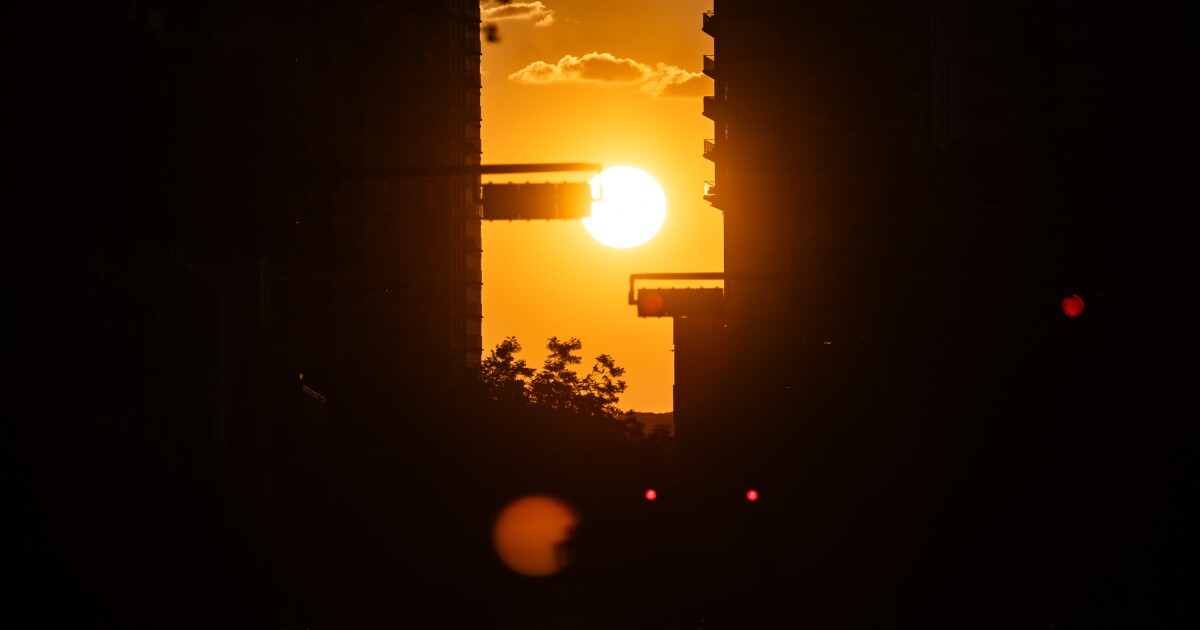
Certain times of year you may notice the sun’s position in the sky around sunset makes driving in Austin trickier. On these evenings, it will shine directly down some streets, creating a light tunnel of blinding intensity.The effect is disorienting but also magical. When the light lines up perfectly with the street, it can almost feel like you’re driving straight into our galaxy’s fiery center.“Austinhenge” is the word many use to describe this twice annual phenomenon that occurs along the downtown street grid.Our city is not unique in celebrating the astronomical alignment. Many places with east-west street corridors mark their own “henge” days. There’s Manhattanhenge in New York, and California Henge in San Francisco and Chicagohenge in, well, Chicago.They are all named after England’s megalithic Stonehenge, a structure built to align perfectly with the sun at the summer and winter solstice.Sunday is when downtown Austin streets will be most perfectly aligned with sunset this year, though the effect will be virtually identical from Saturday through Monday, said Will Best, an astronomy researcher and lecturer at the University of Texas at Austin.Austinhenge occurs downtown twice a year in early August and early May. Best said it misses the fall and spring Equinox because our downtown east-west streets tilt slightly northwest to southeast.“It’s six months apart if the grid is exactly east-west,” he said. “The tilt-off changes that. The thing that is the same is that you’re equal numbers of days before and after the summer solstice.”
Michael Minasi
/
KUT NewsThe sun sets in line with Austin’s downtown east-west streets on Thursday.
Because Austin has multiple neighborhood street grids, all aligned at slightly different angles, it also has multiple different “henge days” depending on where you are in town.For example, the numbered streets just east of downtown appear to align best with sunset a couple days earlier, — this year around Aug. 7 — while some streets just south of UT’s campus experience their most perfect alignment a day after that on Aug. 8, according to the website Hengefinder. Not all streets experience a “henge.” But you can find out when your street might line up, by using a website like Hengefinder or one of many solar planning apps.“I think that people in general are a lot less in touch with astronomical things than they used to be,” Best said. “[But these events] can still poke through sometimes and show us that we’re still part of a larger system.”