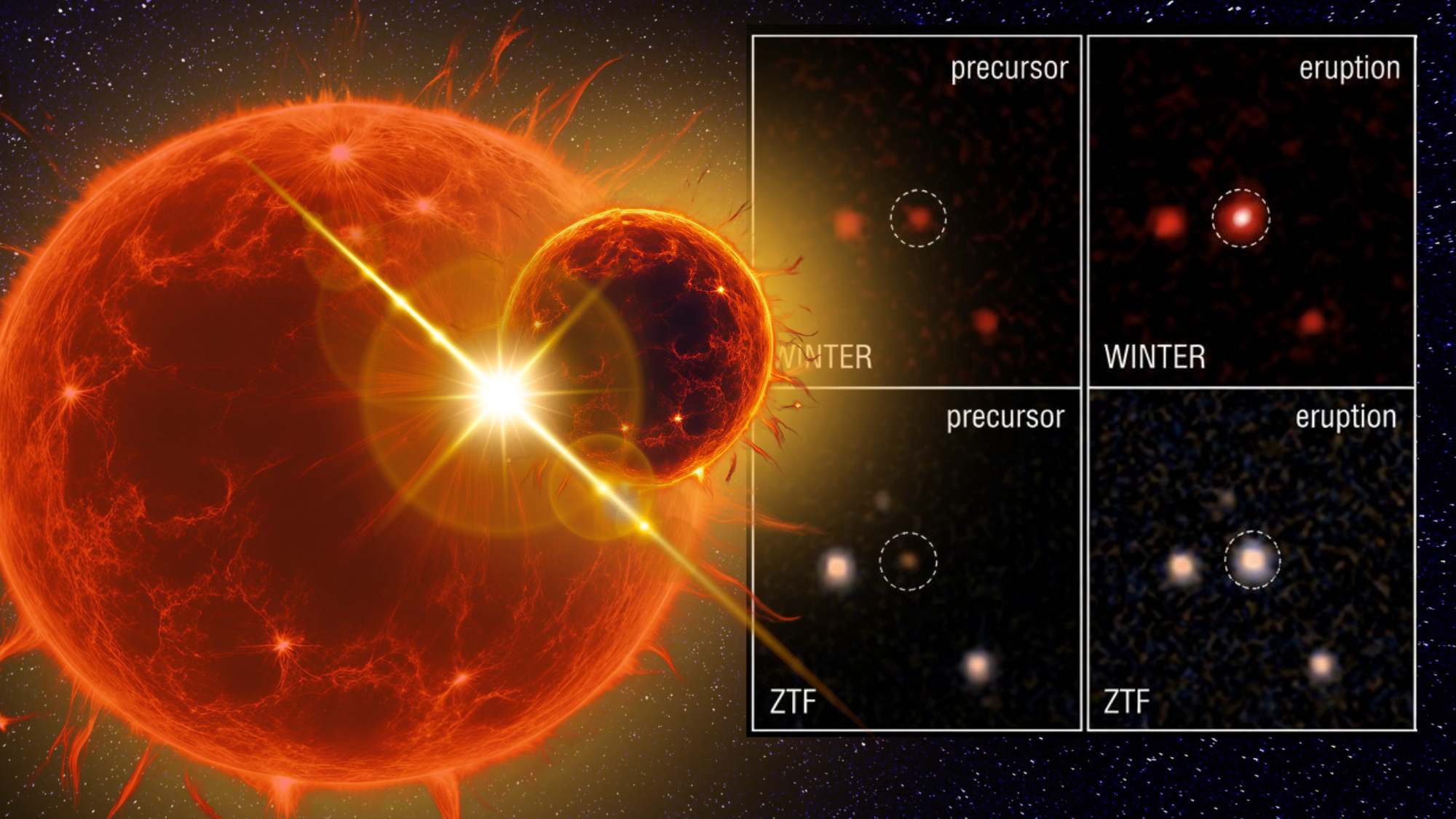
Follow Us Add us as a preferred source on Google Newsletter Subscribe to our newsletter Astronomers witnessed the spectacular cosmic indigestion that resulted from a red giant star devouring a stellar Bao bun in the form of its smaller companion star. That’s not a random comparison. The cannibal star, which is 350 times larger than the sun, is nicknamed “Big Bao,” while its unfortunate companion was nicknamed “Little Bao.” The cute cosmic nicknames come from the fact that this destructive fusion event has been designated AT2025abao. A Bao bun might be a small snack for a human, but this red giant star made a real meal out of Little Bao. This cannibalistic event was tracked by a wide range of ground-based and space-based telescopes, including NASA’s NEOWISE, SPHEREx, and James Webb Space Telescope (JWST) space missions, as well as the WM Keck Observatory in Hawaii. The conclusion of the AT2025abao event was marked by a massive eruption witnessed in October 2025 by two instruments at Caltech’s Palomar Observatory: the Zwicky Transient Facility (ZTF) and the Wide-field INfrared Transient ExplorerR (WINTER). “The excitement was real,” team member Viraj Karambelkar of Columbia University said in a statement emailed to Space.com. “We couldn’t believe our luck. With detailed observations for several years before the merger, we now have for the first time an unprecedented view of the conditions that lead to such cosmic events.” Reconstruction of a violent cosmic collision The story of AT2025abao began when astronomers detected a bright flash in the nearby Andromeda galaxy, a region where scientists did not expect to see a cosmic explosion. You might like In response to this unexpected flash, Karambelkar and his colleagues set out to investigate its cause with a large number of telescopes. This led them to see a slow, steady glow over the course of two years. They determined that the cause of the flash was a rare stellar merger, the luminous red nova now designated AT2025abao. They linked this to a star called WNTR23bzdiq/WTP19aalzlk that had been observed shining steadily since 2019 after remaining stable for the previous 30 years. Thus, the team determined that at the center of the event is a red giant, a star that reaches hundreds of times its original size after running out of hydrogen in its core. The team theorizes that Big Bao, with a mass seven times that of the Sun, expanded so quickly and violently that it engulfed its smaller companion star. The unfortunate star, Little Bao, then spiraled into Big Bao’s core in less than 10 orbits. “A couple of years ago, we discovered a star that was gradually brightening. We took a closer look to discover a red giant, or a star that has begun to expand toward the end of its life, just as our sun will one day do,” Karambelkar said. “A constant brightness was unusual, but even if something moved, no one expected to see an explosion during their lifetime, since these stars remain relatively stable for thousands of years.” The red nova designated AT 2025abao and its location in the Andromeda Galaxy (Image credit: Palomar Observatory/ZTF/WINTER, Viraj Karambelkar) SPHEREx provided an important clue about how this cataclysmic and cannibalistic event unfolded in July 2025, which found that before the eruption, Big Bao was fading in optical light but glowing in the infrared. This indicated that Big Bao was cooling and spewing dense clouds of gas and dust that enveloped the red giant star. When Little Bao slammed into Big Bao’s core, it caused stellar material to be ejected at speeds of around 1.8 million miles per hour. This matter collided with the envelope of gas and dust previously shed by Big Bao, and this caused the flash of light seen on October 17, 2025. What to read next The four main stages in the evolution of AT2025abao. The red giant swells, enveloping its smaller companion star, which is then pulled toward its core, ejecting material that caused a flash of light seen on October 17, 2025. (Image credit: NASA, ESA, CSA, STScI, Leah Hustak (STScI)) One of the latest pieces of this story was provided by JWST on December 24, 2025. The powerful space telescope measured the mass total dust and gas around Big Bao before the eruption from two months earlier. This helped determine that Little Bao had a mass of around 70% the mass of the sun. “It was somewhat symbolic how the year was coming to an end when we managed to put together the puzzle pieces of the story of Big and Little Bao,” Karambelkar said. “But in my opinion, this felt like the closing of just one chapter of a story that is just beginning. We learned a lot about AT2025abao, but we also learned a lot about how to make coordinated, multi-facility, multi-team astronomical discoveries.” The team’s research was published Nov. 18 in the journal Nature.