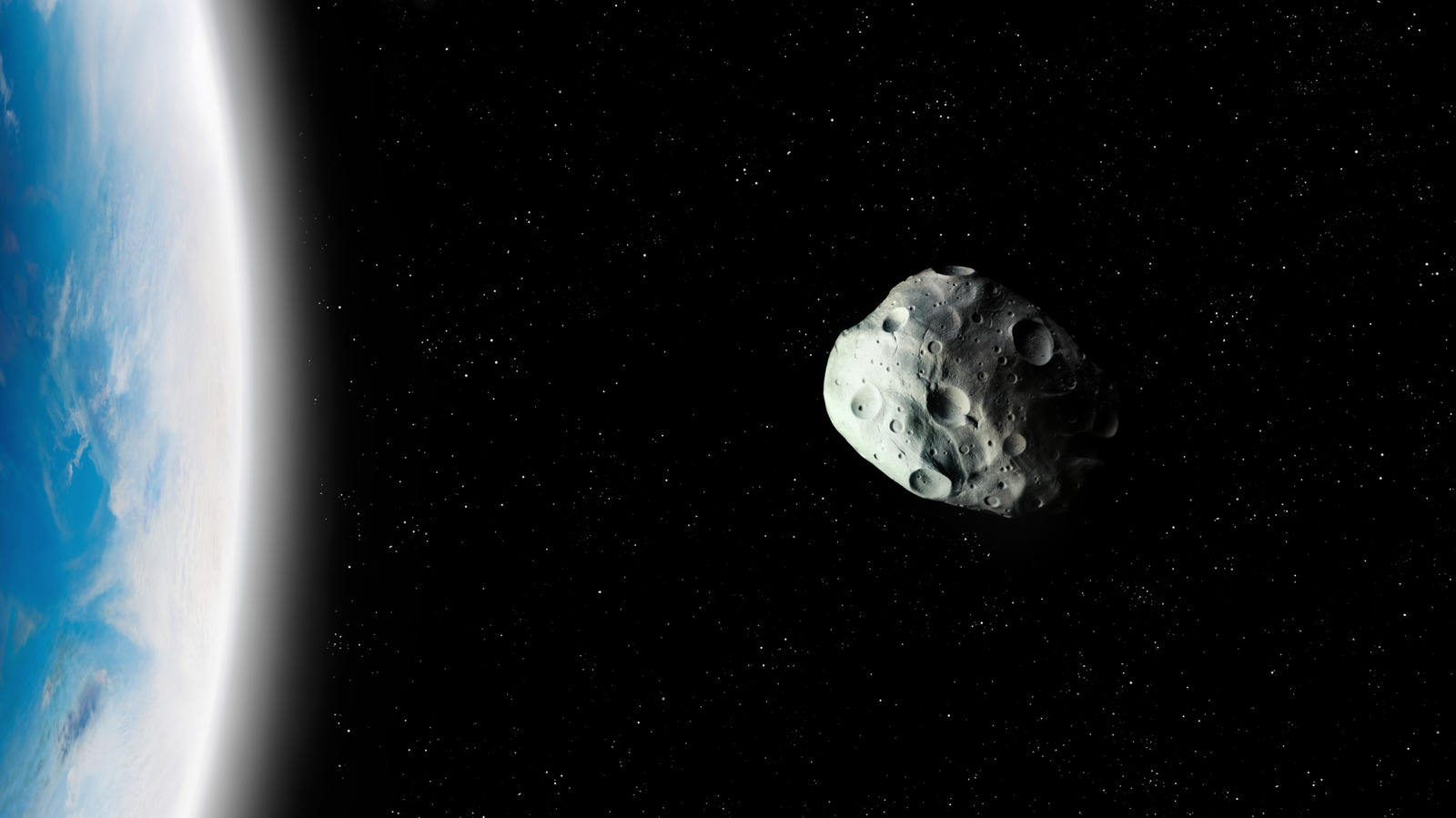
Nazarii_Neshcherenskyi/Shutterstock If you look up at the sky on a clear night, there’s a good chance you’ll see our closest celestial neighbor, the moon. The familiar sphere, which can also be seen during the day depending on its position, has been a faithful companion for billions of years, remaining in Earth’s orbit although slowly moving away as time passes. But it is not the only natural satellite of our planet, as from time to time, smaller space rocks come close enough to become temporarily trapped in the Earth’s gravitational pull, earning them the nickname minimoons. The last minimoon identified is called “2026 QQ8.” It was discovered in August 2026 by Hungarian astronomer Krisztián Sárneczky and is expected to remain in our planet’s orbit until December 2026 or possibly January 2027. But don’t expect to be able to look up at the sky and see it passing by. With an estimated diameter of between 4.6 and 9.8 feet (1.4 meters and 3 meters), 2026 QQ8 is small. On top of that, it is currently at a distance approximately 50% further than the Moon. Even as the minimoon orbits the Earth, it actually continues to orbit the sun. It takes about 359 days to complete a trip around our star, and its stop on our planet temporarily alters its trajectory. Although 2026 QQ8 will leave Earth’s gravitational reach in early 2027, it won’t be the last time it approaches. Its orbit around the Sun will bring it several times closer to Earth in the coming decades. Its next notable approach is forecast for 2058, passing at a distance of about 1.2 million miles (1.9 million kilometers), about five times the average distance between Earth and the Moon. Many mini-moons go unnoticed Buradaki/Getty Images Curiously, the term mini-moon is used quite loosely. Not all objects temporarily captured by Earth’s gravity complete a full orbit around our planet. Some become trapped briefly and escape without even making a full revolution, while others remain long enough to circle the Earth several times. Some astronomers include these brief encounters under the broader term “minimoons,” while others use the label only for objects that make at least one full orbit around Earth. It is not yet clear whether 2026 QQ8 will make a full orbit around Earth. The Earth actually traps many small objects in its gravitational field, so minimoons are not unusual. But due to its small size, many will go unnoticed. Scientific models have suggested that the largest minimoon present at any time is only about 31.5 inches (80 cm) wide, while an asteroid measuring about 10 feet (3 meters) is estimated to be temporarily captured once every 10 to 20 years. A typical minimoon will remain for about nine months and complete about three orbits around the Earth before escaping its gravitational field. While they are often referred to as minimoons, they are not actually a distinct type of celestial body. In fact, most are asteroids, which are rocky or metallic objects that orbit the sun. Meanwhile, comets are less likely to be involved in temporal capture, in part because many fewer of these large bodies of ice, dust and rock are approaching our planet. One of the largest confirmed minimoons was 2024 PT5, which is estimated to be around 33 feet (10 meters) wide. It was captured by Earth’s gravity for a couple of months in 2024, although, like many visiting asteroids, it did not complete a full orbit around our planet before departing.