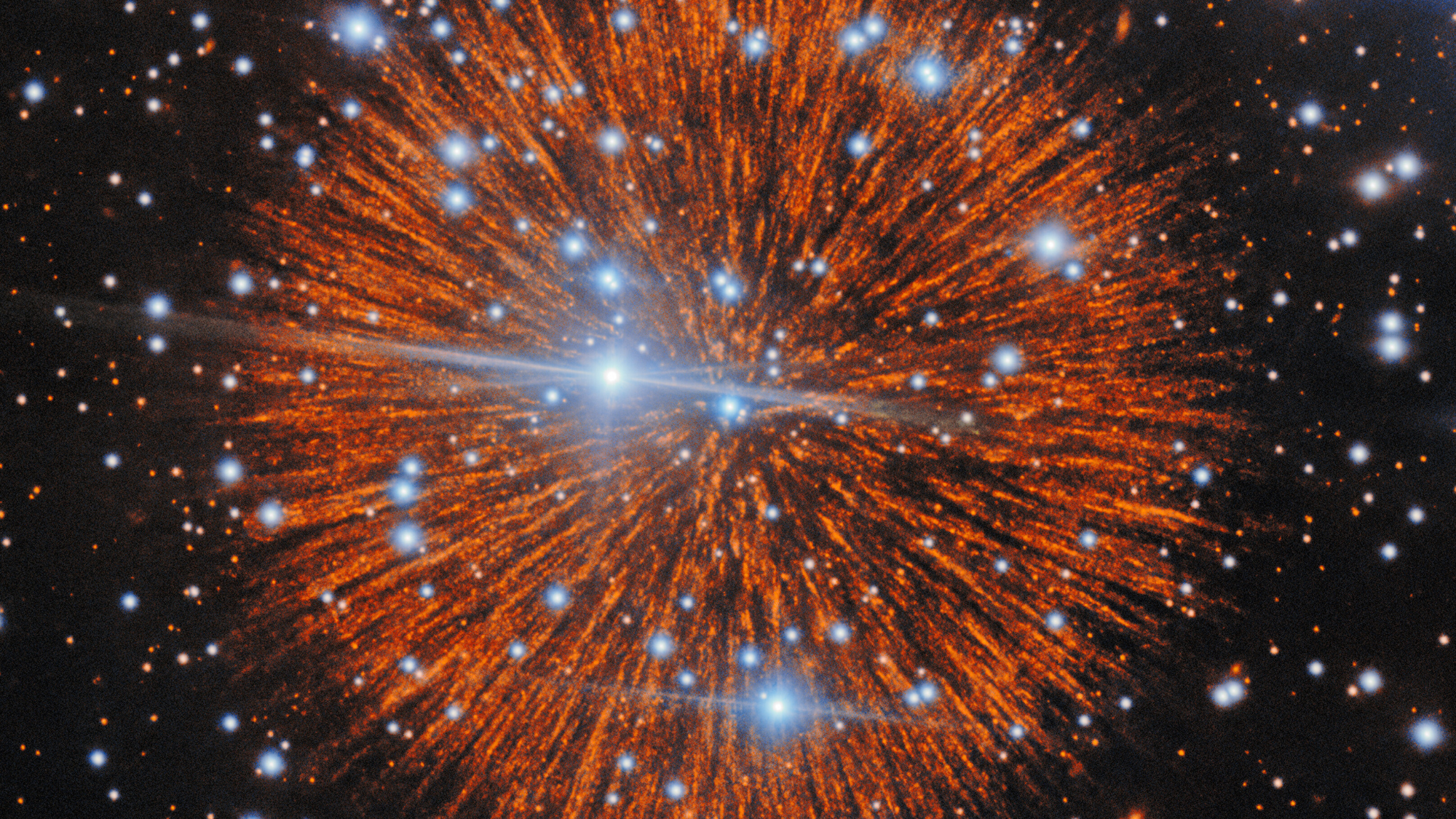
Follow Us Add us as a preferred source on Google Newsletter Subscribe to our newsletter Scientists are still learning about a cosmic “string of pearls,” a unique celestial relic left behind by a supernova explosion that humanity witnessed about 850 years ago. This is thanks to the more detailed observation of the dandelion-shaped chains of gas and supernova remnants that make up Pa 30, the only supernova remnant of its kind observed in the Milky Way. What makes Pa 30 even more unique is that it has a rare “zombie star” at its heart. Supernovae like the one that created Pa 30 are called Type Ia supernovae; They occur when a dead star called a white dwarf supercharges a companion star like a cosmic vampire. This supercharging triggers a runaway nuclear explosion that typically destroys the white dwarf. But in rare cases, the supernova does not completely destroy the star, leaving behind a shattered stellar body, called a zombie star. These events are called type Iax supernovae. Pa 30 was first identified in 2013 by a citizen scientist, but scientists soon linked it to a cosmic explosion independently recorded in the year 1181 in Japanese, Chinese and Arabic historical documentation. This makes it one of only five supernovae seen before the invention of the telescope. “Reliable historical records of stellar explosions go back only about a thousand years. For all we know, there may still be similar remnants lurking in the darkness of our own galaxy,” Ilaria Caiazzo, a team member and assistant professor at the Austrian Institute of Science and Technology (ISTA), said in a statement. You may like “Today we are lucky enough to study an intriguing object that we know was observed by astronomers who made three independent historical records of the event centuries before the invention of the telescope.” Solar System-Sized Pearl Pa 30 is a good laboratory for studying supernovae because, at about 7,500 light-years away, it is relatively close to Earth on cosmic scales. For example, the heart of our galaxy is about 26,000 light years away. “We can see so much detail because of Pa 30’s proximity to Earth,” Caiazzo said. “This proximity makes Pa 30 exceptional value for the study.” It is also an important subject of study because it is the only supernova remnant in which we can see a zombie star. Using the Gemini North telescope, Caiazzo and his colleagues zoomed in on Pa 30, discovering knots along the strands of gas radiating from the site of the cosmic explosion, like pearls on a thread. Each of these pearls is wide enough to span ten times the orbit of Neptune, the most distant planet from the sun. What to read next “The planetary region of our solar system could fit into each node about ten times and there would be room to spare,” Caiazzo said. “The knots are surprisingly uniform. We’re excited to try to model them.” The team also discovered that the zombie star lies almost perfectly at the heart of Pa 30. When these cosmic explosions occur, they should kick out any debris, including the zombie stars. The fact that this “living dead” star is still at the center of this debris suggests that when this explosion occurred, it was approximately symmetrical and the kick was relatively light. “Explosions conserve momentum. If the explosion itself was perfectly symmetrical, the ejecta should also be symmetrical, and the surviving star should not take a substantial kick,” Caiazzo said. “We were able to measure a precise upper limit of the remnant star’s transverse kick velocity, showing that it was surprisingly small. We virtually don’t see the star moving away at all.” An image of the Pa 30 nebula. (Image credit: Robert Fesen) While there are still many mysteries surrounding Pa 30 and its zombie occupant, one of the most interesting prospects emerging from this research is the possibility that it will help identify the remains of other Type Iax supernovae in our galaxy. “While we can see Type Iax supernovae in distant galaxies as point sources of light, resolving the remains of such explosions is only possible in our galaxy and in very few nearby ones,” Caiazzo concluded. “Over time, we plan to use the distinctive properties of Pa 30 to search for similar objects in the Milky Way and nearby galaxies.” The team’s research was published in The Astrophysical Journal.