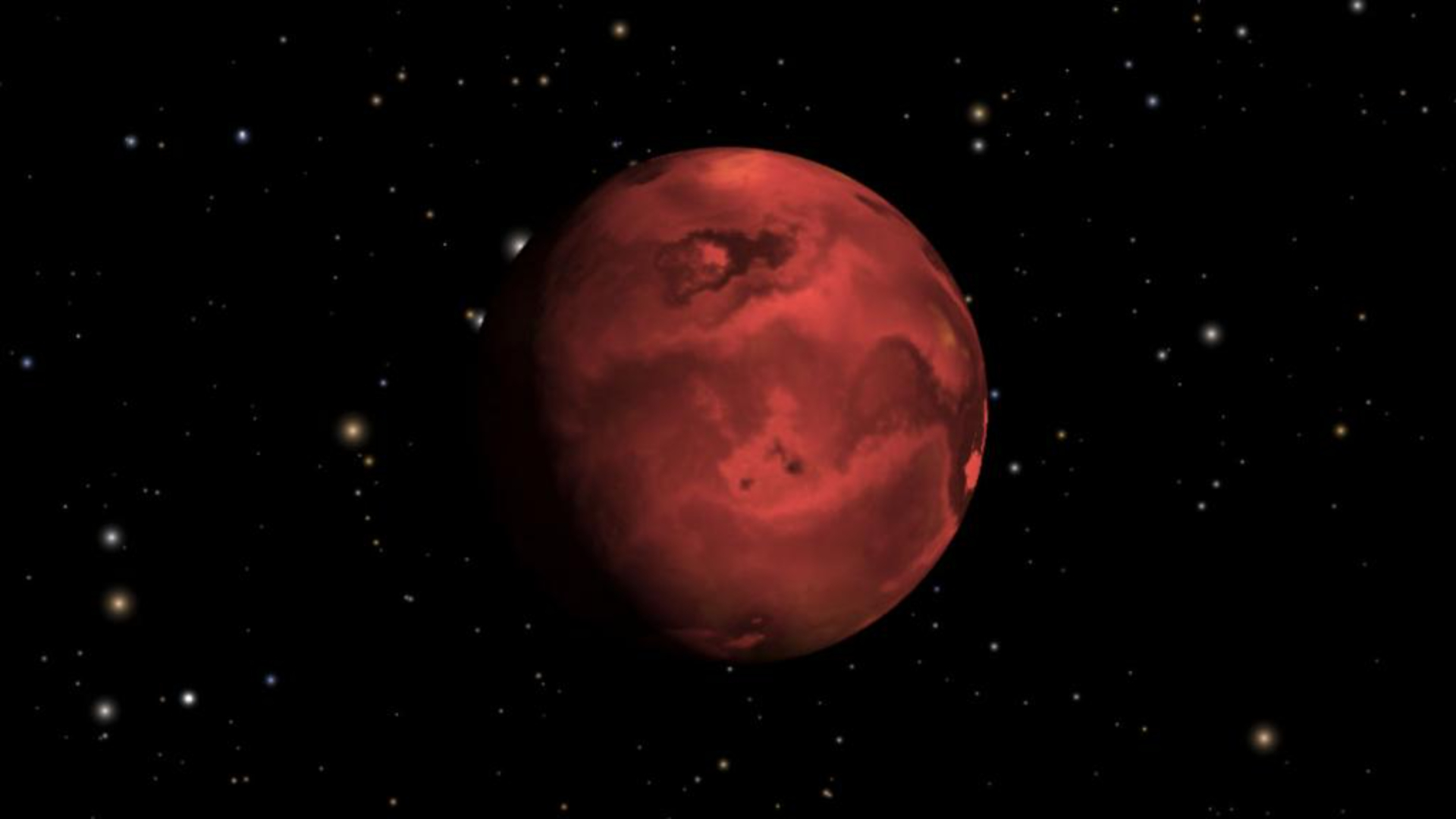
Scientists have discovered a new planet that defies all expectations. It’s a world of lava, but it’s also cold. In fact, it’s the coldest lava world we’ve ever seen with an atmosphere. Researchers detected HD 3167 b, a rocky, lava-covered super-Earth, orbiting a star 154 light-years away. This planet orbits so close to its star that a “world year” (one revolution around its star) takes only one Earth day. But it’s not just a rock covered in lava: it’s the smallest lava world researchers have ever found. And yet, it has managed to hold on to its atmosphere. “What’s so surprising is that the closer a rocky planet orbits around its star, the harder it should be to have an atmosphere, because it is bombarded by the stellar wind and receives more high-energy photons from the star. But it appears that many of these lava worlds do,” co-author Edwin Kite, an associate professor of geophysical sciences at the University of Chicago, said in a statement. Since the first exoplanet (or planet outside our solar system) was confirmed more than 30 years ago, scientists have so far discovered more than 6,300 different exoplanets. From hot gas giants like Jupiter to small worlds like Neptune, an incredible variety of planets have been found. Among them are a handful of “lava worlds,” or rocky worlds that are hot enough for their surfaces to melt into fiery lava. In this new study, the team was able to make observations with the James Webb Space Telescope’s MIRI (mid-infrared instrument), which can view the planet in mid-infrared light, allowing researchers to estimate the planet’s temperatures and see if there are signs of an atmosphere. Using this instrument, they observed the planet during what is called a “secondary eclipse,” meaning they looked for differences in mid-infrared light that occurred when the planet trailed its star. You might like This planet is tidally locked, which is common among lava worlds. This means that it has one side that always faces its star and one side that is perpetually shrouded in darkness. But this newly discovered world is a little different from the rest. If the planet had no atmosphere, its dayside would be “as hot as theoretically possible” being so close to its star, lead author Brandon Park Coy, a graduate student in Kite’s group, said in the same statement. But that’s not what they found. The team found an unusually cold planet with an atmosphere, a planet that “is noticeably colder than its expected maximum,” Coy added. The researchers concluded that the planet appears to have an atmosphere that cools its day side by reflecting light from its star and essentially redirecting that heat toward the night side of the planet. So while it’s hot enough to be a lava world, it’s the coldest atmospheric world ever seen. Interestingly, while this planet’s temperature helped this team conclude that it probably has an atmosphere, scientists have already detected atmospheres on ultra-hot lava worlds. This raises a number of questions about how these planets form their atmospheres and at what temperatures. This discovery is part of a larger program that aims to answer this question. This program, led by University of Maryland astronomer Megan Weiner Mansfield, is examining a group of 10 different lava worlds to see at what temperatures these planets tend to form atmospheres. With these findings, this discovery also supports a growing conclusion among scientists that most lava worlds likely have atmospheres. Scientists are expanding what is possible in the field of exoplanet science by exploring strange, distant worlds that can help us better understand our own planet and how life in the universe might form and survive. “These planets are too hot for life, but by studying them, we can say something about the processes that are important for other rocky worlds,” Kite said. “As inhospitable as they are to life, we’re also interested in studying these types of planets because we think the early Earth might have looked like a lot.” like a lava world,” Coy added. “We think that very early in the history of the solar system, when the terrestrial planets formed, they were extremely hot because of the energy from all the planetesimal collisions. The Earth had what is known as an oceanic magma stage with a completely liquid surface. This result gives us a window to study what conditions may have been like in the first few million years of Earth.” This work is described in a new study published in The Astrophysical Journal Letters.