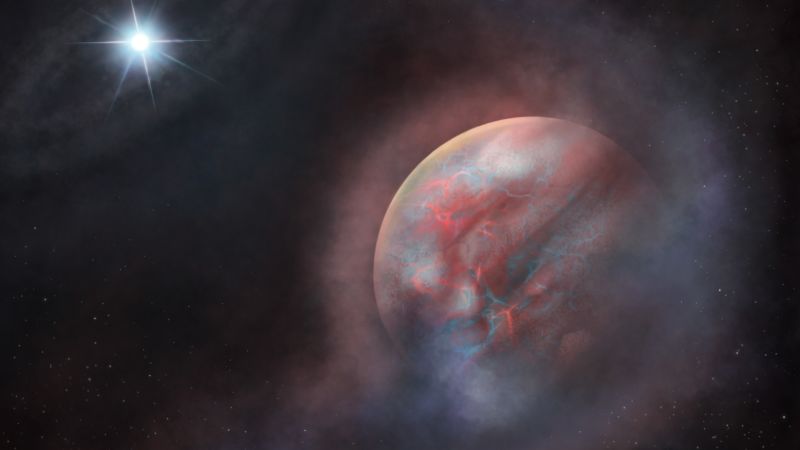
In a world first, scientists say they have detected a planet that may have formed from the burned remains of its dead host star. The planet is likely a gas giant orbiting a white dwarf called HS 0209+0832 located about 270 light years from Earth, according to the authors of a study published Monday in the journal Nature Astronomy. After analyzing observations from NASA’s Hubble Space Telescope and other instruments, the team found chemical evidence suggesting the planet may have condensed from material ejected by the star when it ran out of energy and collapsed into a white dwarf. When a Sun-like star dies, it first expands rapidly into a red giant and then sheds its outer layers, leaving behind a much smaller but dense and hot core, known as a white dwarf. Some of the first-generation planets, those that originally formed at the same time as the star, can survive this catastrophic event if their orbit is wide enough. Astronomers have observed a handful of first-generation survivors orbiting white dwarfs, but they have never before recorded a so-called second-generation planet: an entirely new world formed from the remains of a dead star. The telltale sign that HS 0209+0832 could have given rise to a new planet are the unusual traces of heavy elements on the white dwarf’s surface, which the study’s authors say are planetary material falling onto the leftover core. “This planetary material is very rich in an element called niobium,” said the study’s lead author, Jamie Williams, a doctoral student in the physics department at the University of Warwick in England. “It is the first time that this element has been found in a white dwarf, and this implies that the planetary material is made from the ashes of the dying star.” Closer analysis of observations from NASA’s Transiting Exoplanet Survey Satellite, or TESS, revealed a faint bright signal that repeats every 4.4 days, evidence that researchers say is consistent with a giant planet orbiting the white dwarf. “The interesting thing about planets orbiting near white dwarfs is that because white dwarfs cool over time, their habitable zone is very stable. A second-generation planet could form and then remain in the habitable zone for tens of billions of years,” Williams said. Such a long period of stability could provide more ideal conditions for life, but more work is required to validate the discovery of the second-generation planet, he added. “It’s not a confirmed planet,” Williams said. “For now he is just a candidate.” After the red giant phase, when a dying star swells rapidly, it becomes a nuclear furnace that can produce various elements. However, once the fuel runs out and the star transforms into a white dwarf, the heavy elements (including nobium) quickly sink, leaving only lighter elements like hydrogen and helium on the surface. Therefore, the researchers determined that the niobium detected in HS 0209+0832 must come from the star’s environment. “We think these elements fell on the surface of the white dwarf because the white dwarf is very hot and emits a lot of extreme ultraviolet radiation, which is stripping the atmosphere of a nearby planet,” Williams said. The idea of second-generation planets has been around at least as long as astronomers have known about exoplanets, said study co-author David J. Wilson, a research associate at the Laboratory for Atmospheric and Space Physics at the University of Colorado Boulder. Scientists detected the first exoplanets around a pulsar (a type of rapidly spinning dead star) and because pulsars form as a result of massive explosions called supernovae, these planets are likely second generation, as any original planet would have been destroyed by the immense explosion, Wilson explained. “Although white dwarfs are not formed through a supernova, they are surrounded by debris,” he said by email. “There are the planets that were lucky enough to survive the star’s giant phases, the shattered remains of those that weren’t, and the remnants of gas and dust expelled by the star when it went from giant to white dwarf. So it’s a compelling idea that all of that could coalesce into new planets.” Astronomers still don’t know all the details about how first-generation planets form, which means the potential mechanisms behind this recently reported second-generation planet are even more uncertain. According to Williams, the planet’s formation process could have arisen from a collision between the dying star and a second celestial body. “There could have been another object near the core of the star, perhaps a star about 20% the mass of the Sun, or a brown dwarf,” Williams said, referring to a class of cold objects that are an intermediate between a star and a planet. If a second object fell into the star during its giant phase, it could have prevented all the dust and gas from spreading into a massive cloud, causing part of it to spin into a disk. This disk would have continued to revolve around the white dwarf, giving rise to a planet. “In a normal white dwarf there is no disk, because material from the star will simply be ejected outward during the red giant phase,” Williams added. Researchers plan to use Hubble and NASA’s Chandra X-ray Observatory to observe the system again over the next year, but have also requested time with the more powerful James Webb Space Telescope, which could provide more clues about the planet’s existence or characteristics. If confirmed, this distant world would belong to an entirely new planetary class and would suggest that more second-generation planets could exist around white dwarfs, Williams said. The discovery would also have implications for our own cosmic neighborhood, Wilson said. “The Sun will eventually become a white dwarf, so here we are also looking at the future of the solar system: maybe the Sun will have a new planet one day!” The new discovery of a potential second-generation planet is incredibly exciting, said Sarah Casewell, a professor in the School of Physics and Astronomy at the University of Leicester, England, who was not involved in the study. “We know of a large number of white dwarfs that are contaminated by planetary material that has a composition similar to rocks in our solar system,” he wrote in an email. “However, in this case, the white dwarf is contaminated by an incredibly unusual material and the composition of this material is similar to the atoms we see being created when stars end their lives.” More than 95% of all stars in the universe will eventually become white dwarfs, and astronomers have already cataloged hundreds of thousands of them. Finding a planet that formed after the white dwarf would mean that second-generation planets around other white dwarfs are possible, and that after our sun dies, new planets could arise in our own solar system, Casewell said. Previous observations of white dwarfs have shown that some planetary systems survive a star’s self-destruction, but the recent findings open the possibility of the genesis of new planets, said Amy Bonsor, an associate professor at the University of Cambridge in England, who was also not involved in the work. “This paradigm shift allows us to consider whether in the future we could characterize or investigate the potential habitability of these second-generation planetary systems,” he wrote in an email. This discovery would also add more evidence to research that has shown that planetary systems are varied and complex, even after the host star dies, according to Susan Mullally, a mission scientist at the Space Telescope Science Institute, Hubble’s science operations center. “Some planets may survive the death of the star, others may be thrown into space or eaten by the star. If second-generation planets are possible, then many more white dwarf stars will have planets than we might expect,” Mullally, who was not part of the study, wrote in an email. “This evidence for a second-generation exoplanet indicates that there may be more future exoplanet life than previously expected.” Subscribe to CNN’s Wonder Theory science newsletter. Explore the universe with news about fascinating discoveries, scientific breakthroughs and more.