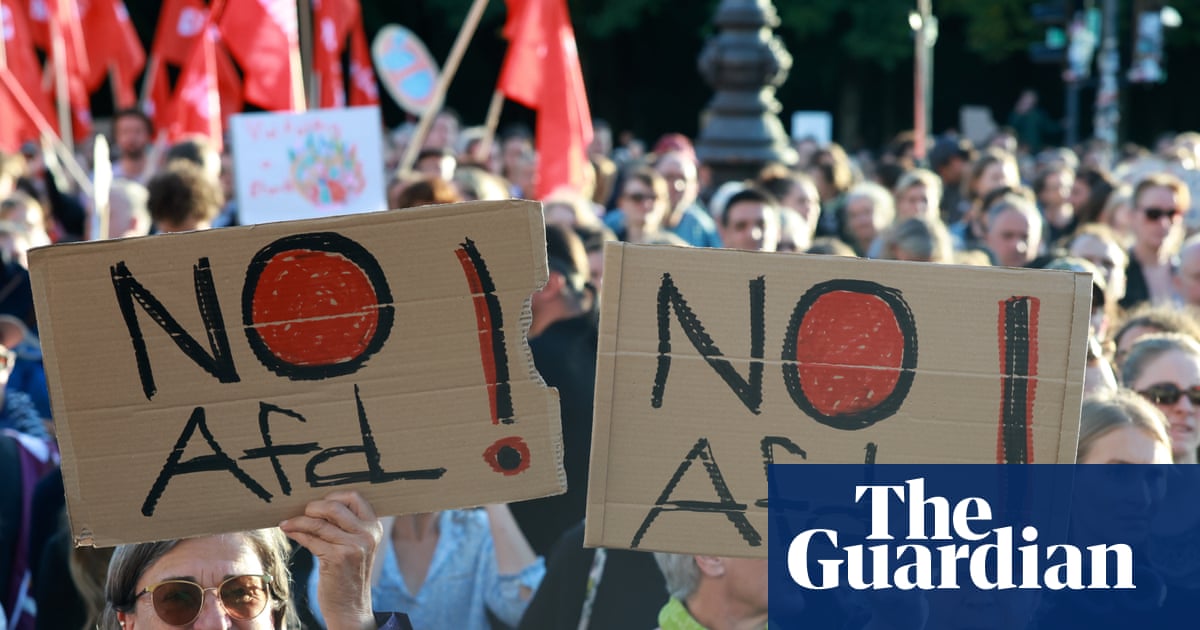
Thousands of Germans have staged protests against the far-right Alternative for Germany (AfD) after the party’s historic victory in a state election, warning it posed a danger in two more elections this month. Protesters at Berlin’s Brandenburg Gate held a peaceful pro-democracy demonstration denouncing the anti-immigrant, pro-Russian AfD, which has called for mass deportations of asylum seekers and a reduction in state support for renewable energy and public broadcasting. The party achieved its best-ever state result in the former eastern communist state of Saxony-Anhalt on Sunday, with clear momentum ahead of regional elections in the capital and in Mecklenburg-Vorpommern, on the Baltic coast, on September 20. Police reported there were 5,000 protesters, while organizers said they attracted more than 14,000 people in a campaign to mobilize voters against the AfD. Signs in the crowd read: “Fascism is not an alternative”, “Stop the Nazi AfD: end racism and cuts to social services” and “History has its eyes on us.” With less than two weeks until election day, protesters at the Berlin rally warned against resignation and cynicism following Sunday’s shocking result. It makes you angry and stunned,” Jens-Christian Wagner, director of the memorial at the former Nazi concentration camp Buchenwald, said from the stage. Protesters crowd the streets around the Brandenburg Gate in Berlin on Monday after the AfD victory. Photograph: Dpa Picture Alliance/AlamyWagner sounded the alarm that the AfD, although falling short of an absolute majority, was on the verge of taking power in Saxony-Anhalt, a first for the far right since World War II. That “should not be accepted quietly,” he said. Max Schneller, 17, a member of the far-left Linke party from Saxony-Anhalt, said activists in the state would fight any attempt by an AfD government to attack minorities. “We will not start categorizing our neighbors according to their origin, religion or skin color; “We are too human to hate each other,” he said to loud applause. The AfD is three votes away from the support needed to form a government under its candidate, media firebrand Ulrich Siegmund, who hopes to eliminate remaining party dissidents willing to play kingmaker. Since 2023, Germany’s domestic intelligence agency has labeled the party’s state chapter as right-wing extremists, saying it represents a threat to democratic norms. Hundreds of protesters anti-AfD also gathered in Potsdam, near Berlin, and demonstrations were also organized in Münster, Göttingen, Dresden, Aachen, Bamberg, Darmstadt and Halberstadt in Saxony-Anhalt, where the AfD won almost half of the votes, local media reported a protester in Berlin Photograph: Maryam Majd/Reuters In Halle, the region’s second largest city, left-wing groups and organizations. civil society have been organizing a protest camp since election day. The AfD leads voting intention polls in Mecklenburg-Western Pomerania, with around 35%. However, the center-left Social Democratic party (SPD) of the state’s prime minister, Manuela Schwesig, achieved a notable comeback during the summer and now scores above 30%. heterogeneous, with several parties competing for first place. It is governed by a coalition of conservative Christian Democrats (CDU) and the SPD. Close on its heels is Linke, who has focused on rising housing costs in his campaign, and the. AfD, followed by the SPD and the Greens, both polled in the mid-teens, have vowed to stay in office and fight for a flagship package of painful reforms, arguing that the only way to defeat the AfD is to get Europe’s main economy moving again and repair its weakened social welfare system. However, the SPD, its junior coalition partner, has indicated its willingness to backtrack on some of the most unpopular measures to shore up support for the embattled party. government. destabilize the unstable coalition.