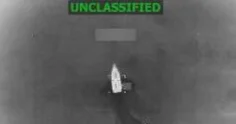
The US military said it attacked a ship suspected of being used to smuggle drugs in the Caribbean Sea on Sunday, killing four people, as the Trump administration continues its year-long campaign against suspected traffickers in Latin America. The latest attack brings the number of people killed in attacks on ships by the U.S. military to at least 235 in 70 strikes since the administration began targeting what it calls “narcoterrorists” in September 2025. As with most of the military’s statements about attacks in the eastern Pacific Ocean and Caribbean Sea, U.S. Southern Command said it targeted suspected drug traffickers along known smuggling routes. The military provided no evidence that the ship was carrying drugs. A video posted on X showed what appeared to be an explosion destroying a moving ship, which the military said was a fast ship. On October 4, under the direction of #SOUTHCOM, the Western Hemisphere Joint Task Force executed a lethal, kinetic attack against a fast vessel operating along established drug trafficking routes in the Caribbean. Confirmed intelligence revealed the ship’s active involvement in… pic.twitter.com/aK0jCTl74o — US Southern Command (@Southcom) October 5, 2026 The Trump administration is seeking agreements with allied nations to extend its land offensive in several Latin American countries. Defense Secretary Pete Hegseth said during a visit to Panama in August that Colombia, Guatemala and Honduras had agreed to allow the United States to carry out joint military operations against criminal groups on their territory. Guatemala denied having reached such an agreement. Ecuador launched similar missions with the United States in March. President Trump has said the United States is in “armed conflict” with Latin American cartels and justified the attacks as a necessary escalation to stop the flow of drugs into the United States and the fatal overdoses that claim American lives. But his government has offered little evidence to back up its claims of killing smugglers. More from CBS News Go deeper with The Free Press