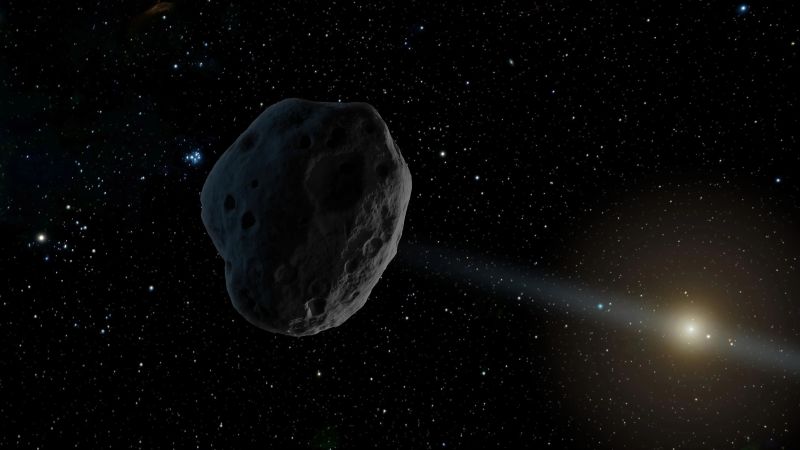
Currently, Earth is home to a second moon. Our planet’s gravity captured the small asteroid in April. This temporary “minimoon,” about 2 meters (6 feet) in diameter, will remain until early December, when it is expected to leave Earth’s sphere of influence and continue its path around the sun. The object is so small and faint in observations that it took astronomers several weeks to confirm that it was not a missing satellite or a fragment of one. The International Astronomical Union’s Minor Planet Center, which tracks asteroids, comets and other small bodies in the solar system, named the newcomer 2026 QQ8 in late October. While minimoon is not an official designation, astronomers have previously used the nickname to characterize a handful of natural objects, including 2006 RH120, which spent about a year in Earth orbit, and 2020 CD3, which orbited our planet for about three years. However, it is not unusual for Earth to have one of these transient companions. “On average, there’s probably one there at any given time,” said Matthew Payne, director of the Minor Planet Center. “They stay for a few weeks or months. Sometimes it’s neither, sometimes it’s a couple.” The catalog of these visitors is relatively short because they normally go unnoticed. “Most of them are really small,” Payne added. “A lot of times they’re too far away and, from our point of view, they’re also circling pretty quickly, and both of those things make it really difficult for current polls to see them.” There is currently no concern that 2026 QQ8 could impact our planet; The good thing about the small size of the object is that even if it entered the atmosphere, it would fragment harmlessly. “Best-case scenario, we would get a bright meteor in the sky and a small explosion,” Payne said. Astronomer Krisztián Sárneczky detected the object in August and provisionally named it Sar2901. “I was looking for near-Earth asteroids, as I have done every clear night since 2020,” Sárneczky, research coordinator at Hungary’s Konkoly Observatory, said in an email. “At the time of its discovery, it resembled the nearly four hundred other near-Earth asteroids that had been found. Its unique nature only became apparent later, following precise orbital calculations.” Near-Earth asteroids are those whose orbits bring them relatively close to our planet. These space rocks belong to a larger group of objects called near-Earth objects or NEOs, which also includes comets. Immediately after the discovery of the new minimoon, the community was divided between a natural and an artificial origin. Only by observing how solar radiation influenced the object’s motion over several weeks could astronomers confirm its nature, Sárneczky explained. With the help of the Lowell Discovery Telescope in Arizona and the University of Hawaii’s 88-inch (2.2-meter) telescope on Mauna Kea, 2026 QQ8 was finally confirmed to be natural. The exact origin of the space rock is “an active area of research,” Payne said, but most OCTs originate in the asteroid belt, a region between the orbits of Mars and Jupiter that contains millions of rocky objects of different sizes orbiting the sun. Over millions of years, gravitational forces can shift the orbits of some of these objects further into the solar system. “If one of these OCTs orbiting relatively close to Earth approaches with a speed that is not great enough to fly past us, it can sometimes gently encounter Earth,” Payne said. “The object moves along with the Earth, then gets closer and closer, and then it may begin to feel more and more of the gravitational forces of the Earth and also some of the Moon’s. That may perturb it slightly away from its initial orbit, and it may begin to rotate around the Earth.” Astronomers have identified about 40,000 OCTs and about 1.5 million total objects in the solar system, according to Payne, but that number is about to grow substantially. The Vera C. Rubin Observatory in Chile, which uses a telescope that houses the world’s largest digital camera, is currently conducting a 10-year study called the Legacy Survey of Space and Time or LSST. The study is expected to identify and catalog asteroids, comets and distant galaxies at an unprecedented rate. “When the LSST survey becomes fully operational, it is expected to uncover a tremendous amount,” Payne said. “The expectation is that we will go from knowing 1.5 million objects to knowing 5 million.” Subscribe to CNN’s Wonder Theory science newsletter. Explore the universe with news about fascinating discoveries, scientific breakthroughs and more.