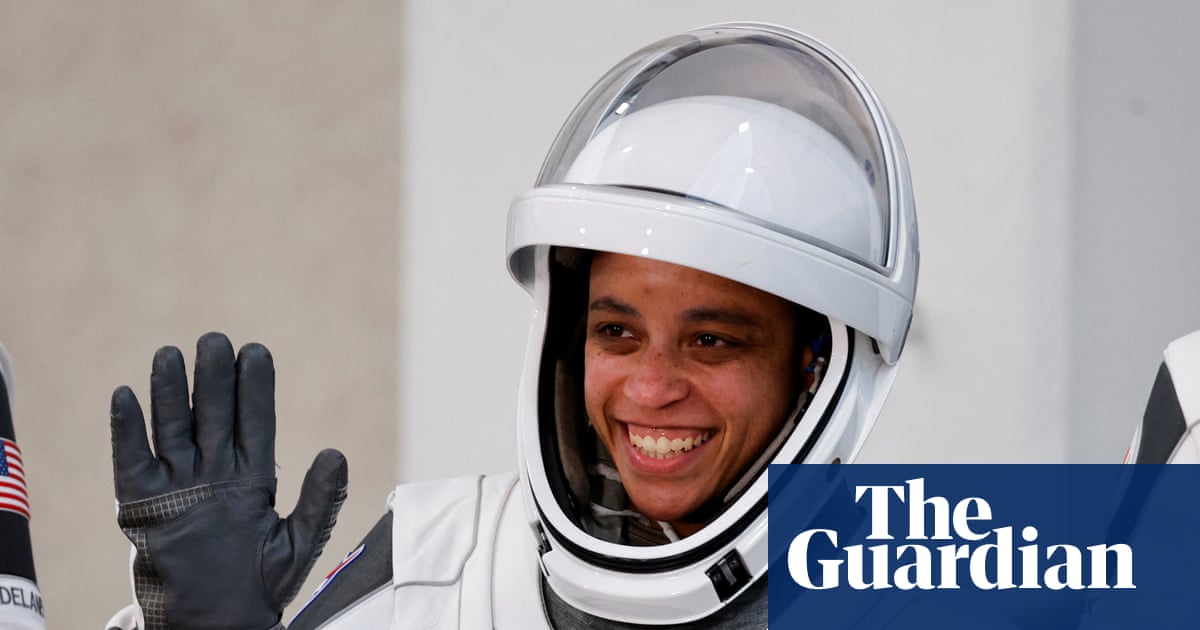
Four astronauts arrived at the International Space Station (ISS) on Thursday after launch on an eight-hour express that set a US speed record and created more history with the first black woman to lead a crew into orbit. SpaceX commander Jessica Watkins and her crew were sent to NASA after a three-week delay to repair their Dragon capsule’s leaking fuel system. Heavy clouds threatened throughout the morning to stop the countdown, but the skies cleared enough to allow a safe takeoff from Cape Canaveral at 11:10 a.m. (3:10 p.m. GMT). Seven hours and 55 minutes later, SpaceX’s Dragon “Grace” capsule docked at an ISS port, setting a record for the fastest trip by a U.S. spacecraft to the outpost. Photograph: NASA/AP In a live broadcast on Nasa TV, the capsule appeared to glide gently toward a stationary ISS as they both moved through space at approximately 17,500 mph (28,100 km/h). The newcomers – Americans Watkins and Luke Delaney, Canadian Joshua Kutryk and Russian Sergey Teteryatnikov – floated to the space station through a pressurized vestibule and headed to their colleagues on Earth on Thursday night. “We are very excited to be here. This is truly a special place,” Watkins said on NASA’s livestream. “It’s surprising and somewhat ironic to think that it’s such a short trip to get here because the trip to get here has been a long one.” NASA astronaut Jessica Watkins waves as she departs for the launch pad at Kennedy Space Center in Cape Canaveral, Florida. Photograph: Joe Skipper/Reuters Canadian Kutryk, whose wife is due to give birth while he is away, said it “feels really good” to represent his country in space, adding that he was “looking forward to a good mission after getting some sleep. That’s what I’m going to do next.” The duration of the trip depends largely on the distance between the ISS and the spacecraft at the time of launch. The last crew to launch from US soil took more than 30 hours to reach the station. With the late morning launch, Watkins became the first Black woman to lead a crew into orbit. Watkins, a geologist who worked with NASA’s Curiosity rover on Mars a decade ago, will make her second trip to the space station after a long stay in 2022. “Thank you for an incredible trip,” Watkins radioed after liftoff. Although his stay on the ISS will last six months, the flight there was the fastest so far not only for Elon Musk’s company, but for any American entity, including NASA. From left, Joshua Kutryk, Luke Delaney, Jessica Watkins and Sergey Teteryatnikov at Cape Canaveral Space Force Station in Florida on Thursday. Photograph: Jennifer Briggs/Zuma Press Wire/ShutterstockApart from Watkins, the other astronauts are newcomers to space: Delaney is a retired Marine; Kutryk is a colonel in the Royal Canadian Air Force; and Teteryatnikov, a former submariner. They will replace four astronauts who have lived in the orbital laboratory since February. This was the 13th crew launched by SpaceX for NASA, not counting the 2020 test flight. The designation Crew-13 on its mission patch pays tribute to Apollo 13, the harrowing 1970 trip to the moon that ended with the safe return of the astronauts. The SpaceX Falcon 9 rocket topped with the Dragon capsule lifts off from Cape Canaveral, Florida. Photograph: Chandan Khanna/AFP/Getty Images References to the number 13 were rife on Thursday. Watkins and his crew traveled to the launch pad in black Teslas with license plates that read “Lucky 13”. They also wore a small crocheted golden dragon named Lucky with a four-leaf clover around its neck. “We thought it wouldn’t hurt to bring a little of our own luck just in case, but we clearly don’t need it,” Watkins said from orbit, noting that they were “four of the luckiest humans on or off planet Earth.” Heather Kutryk will give birth while her husband is orbiting Earth, making him the fourth man to become a father while doing so. Heather will give birth to her third child at the end of November. “A lot of life-changing things can happen in six months,” NASA Director Dana Weigel said on the eve of liftoff, noting that the space agency would do everything it could to keep Kutryk connected to his family. The Canadian Space Agency also promised to support the family. In 2004, NASA provided a radio link between space station astronaut Mike Fincke and his wife’s delivery room during the birth of their daughter. Five years later, Randy Bresnik, commander of next year’s Artemis III mission, called his wife’s hospital from orbit. The happy news traveled more slowly for Austrian astronaut Franz Viehböck. His daughter was born a few hours after his launch to the Soviet Union’s Mir space station in 1991. He was not informed until the next day. Three hours after Crew-13 lifted off, SpaceX launched a Falcon rocket from California with more than 100 mini satellites. Another Falcon was scheduled to take off Thursday night from Florida, carrying a satellite classified for the national reconnaissance office. All of this comes the same week that the company’s massive Starship spacecraft reached orbit for the first time.