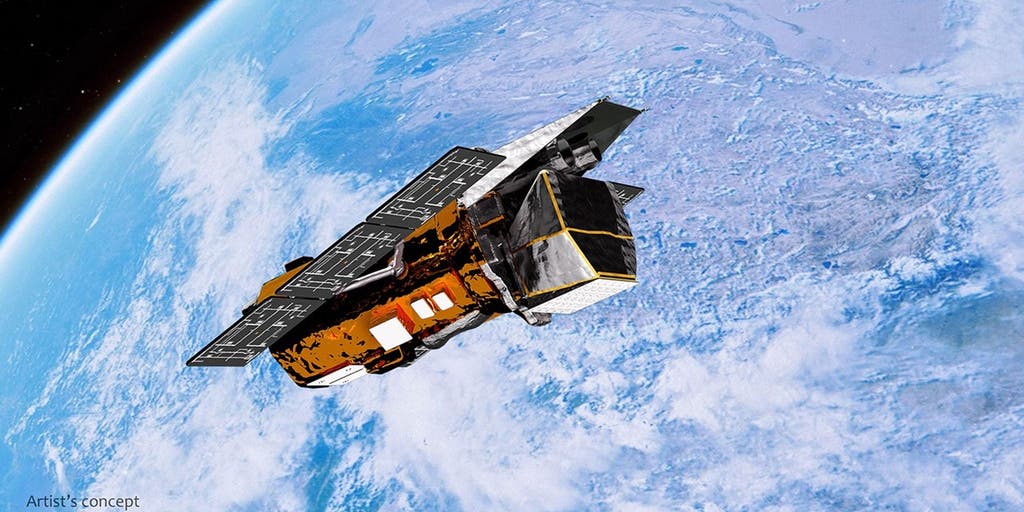
The Nancy Grace Roman Space Telescope is a NASA observatory designed to solve essential questions in the areas of dark energy, exoplanets, and infrared astrophysics. CONCLUSION The final observation of the Neil Gehrels Swift Observatory was on October 20. The telescope is currently orbiting less than 171 miles above the Earth’s surface. The telescope was launched in 2004. NASA has officially ended its effort to save the Neil Gehrels Swift Observatory after the agency failed to adjust the telescope’s altitude above Earth. NASA’S HUBBLE SPACE TELESCOPE REVEALS A GIANT ATMOSPHERIC WAVE AROUND SATURN’S SOUTH POLE Wift made its final observation on October 20 and is expected to re-enter Earth’s atmosphere in the coming weeks. The telescope is currently in orbit less than 171 miles above the Earth’s surface. Photo from NASA’s Swift satellite. (NASA) “Swift provided an incredible and long-lasting return on investment for the nation, designed for a two-year primary mission but productive for more than 10 times longer,” said Shawn Domagal-Goldman, director of the Astrophysics Division at NASA Headquarters in Washington. “At that time, Swift played an important role in advancing our understanding of the changing universe and was part of a revolution in astrophysics that showed how critical fast-response observations are to the entire community.” torn apart by black holes, monitored active galaxies and conducted an all-sky X-ray survey. The telescope also studied numerous asteroids and comets, advancing NASA’s research. NASA’s Neil Gehrels Swift Observatory orbits Earth in this artist’s concept. (NASA Goddard Space Flight Center Conceptual Imaging Laboratory/NASA) Swift data has contributed to approximately 7,000 published scientific papers. “Swift leaves us with an extraordinary archive of multi-wavelength observations that will drive new discoveries for decades to come,” Domagal-Goldman said. on November 20, 2004. The completed Swift spacecraft is seen in a clean room at NASA Goddard on September 9, 2003. (NASA / NASA) Swift was designed as a multi-wavelength observatory equipped with aligned optical/ultraviolet and X-ray telescopes. MARS ROVER REACHES MAJOR MILESTONE WITH RECORD JOURNEY “Swift needed to detect and locate gamma-ray bursts, communicate their position to other observatories, and then rotate its telescopes to image the bursts’ locations before their glows faded,” said S. Bradley Cenko, principal investigator for the mission at NASA’s Goddard Space Flight Center in Greenbelt, Maryland. “It usually took Swift about a minute to do this.” This image shows regions captured by a telescope aboard the Swift satellite from a region 200,000 light years wide. (NASA/Swift/Stefan Immler (GSFC) and Erin Grand (UMCP)) Before Swift’s launch, astronomers had limited ability to identify these bursts quickly and accurately enough to observe their fading afterglows. NASA ANNOUNCES ARTEMIS III ASTRONAUTS IN NEXT PHASE OF MISSION TO RETURN HUMANS TO THE MOON Gamma ray burst that lasted approximately 0.03 seconds. The observatory rotated toward the burst fast enough to detect 11 X-ray photons, marking the first detection of a glow from a brief gamma-ray burst. Over time, Swift evolved into an astronomical multi-tool. Neil Gehrels’ Swift Observatory is optimized to quickly locate and study gamma-ray bursts from the creation of black holes at multiple wavelengths. (NASA / NASA) Its systems allowed NASA to request “target of opportunity” observations that could be made from the ground in just a few minutes. The telescope could also program up to 75 independent targets per day. Since then, Swift has collected nearly 22 years of cosmic burst brightness measurements, multi-wavelength spectra, and more than 1.5 million images from its ultraviolet/optical telescope. “The Swift Flight and Science Operations teams placed Swift at the crossroads of burgeoning research areas,” said John Nousek, director of mission operations and professor of astronomy and astrophysics at Penn State’s Eberly College of Science in University Park, Pennsylvania.