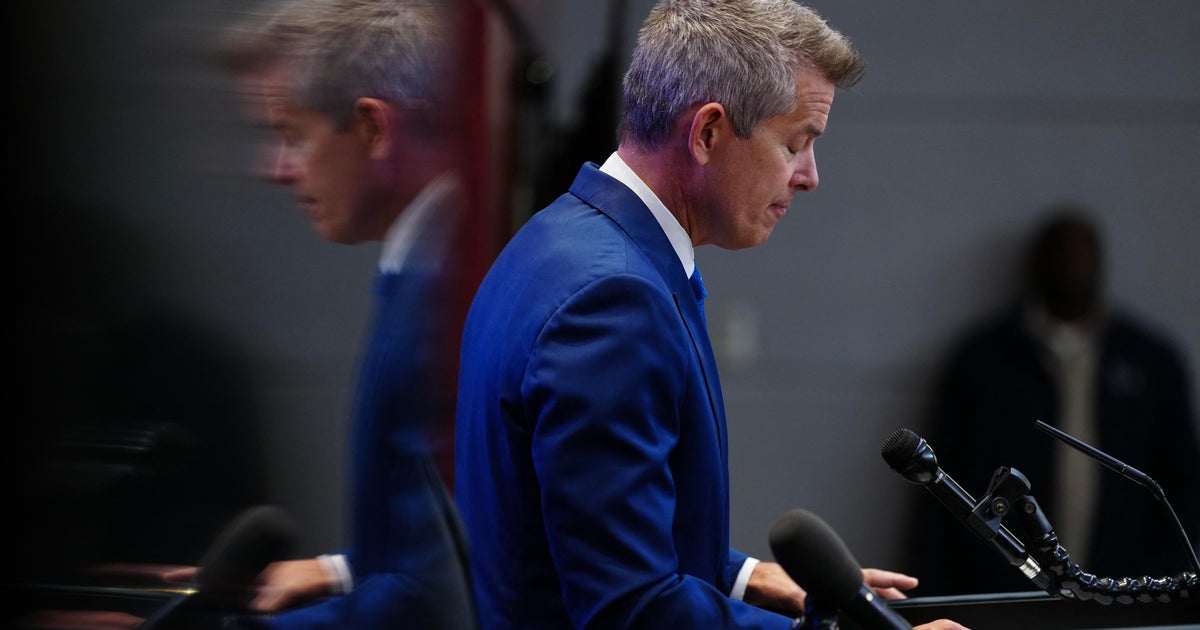
President Trump was briefed 30 minutes after the Federal Aviation Administration imposed a nationwide grounding shutdown Friday afternoon, according to U.S. officials. The grounding resulted in thousands of canceled flights and stranded travelers across the United States. The FAA announced that all planes would remain grounded at 3:36 p.m. ET, while there were 3,500 flights in the air. Within minutes, the FBI, the director of national intelligence, the Department of Homeland Security, the Department of Transportation, the Department of Justice, the Department of Defense, the Joint Chiefs of Staff, the US Cyber Command, the FAA and the Federal Emergency Management Agency began communicating with each other. Transportation Secretary Sean Duffy said in a statement at 4:16 p.m. ET that the ground stop was necessary due to “a communication issue affecting all air route traffic control centers” and that FAA technicians were investigating. Within minutes, the White House led a call with agencies to determine what had happened. A game plan was put into action. The intelligence community soon preliminarily ruled out the likelihood of nefarious activity after searching for conversations or pings on its various channels. Nothing came up. Senior officials briefed Trump, who was at an economic policy meeting, a U.S. official said. The staff relayed their directives to other participants in the multi-team call, led by White House Chief of Staff Stephen Miller. Trump later met with Duffy and DHS Secretary Markwayne Mullin. Secretary of Transportation Sean Duffy, left, and Secretary of Homeland Security Markwayne Mullin during a press conference in the James S. Brady Briefing Room of the White House in Washington, DC, Friday, Nov. 13, 2026. Shawn Thew/EPA/Bloomberg via Getty Images Mr. Trump began calling on congressional leaders on Friday to work on more funding for the FAA. The White House congressional team called on key members of Congress to work with them to modernize air traffic controllers. The National Security Council invited key members of the government and some outside stakeholders to a meeting on Monday to discuss next steps and what needs to be done to avoid a repeat as modernization efforts continue. The council is an interagency government body responsible for coordinating national national security policy. Established by President George W. Bush in 2001, under the current White House structure, the Council operates through the framework of the National Security Council and can draw on senior officials from agencies such as the Department of Transportation, the FAA, DHS and the Department of Defense. But not all planes were grounded during the four-hour stoppage: Medical flights were given the green light to proceed to their planned destinations. By the fourth hour, the problem in the system had been identified and the suspension was lifted. About 9,159 flights were canceled Friday and 7,190 were delayed, according to FlightAware. At a news conference Saturday, Duffy said the problem apparently began when FAA telecommunications contractor L3Harris Technologies performed maintenance upgrades at a remote facility, replacing aging copper communications lines with fiber optic connections. During that work, one router began generating more than 1,000 connection attempts every four to five seconds, overwhelming routers throughout the FAA network. Mullin and Duffy were more than 30 minutes late for a 7:45 p.m. ET news conference at the ground stop on Friday because they were close to having the suspension lifted and did not want to disrupt the effort to sustain the press, U.S. officials said. While federal officials have identified a likely sequence of events behind Friday’s outage, key questions remain about the underlying cause of the system-wide outage. Zak Hudak contributed to this report. More from CBS News Go deeper with The Free Press in: