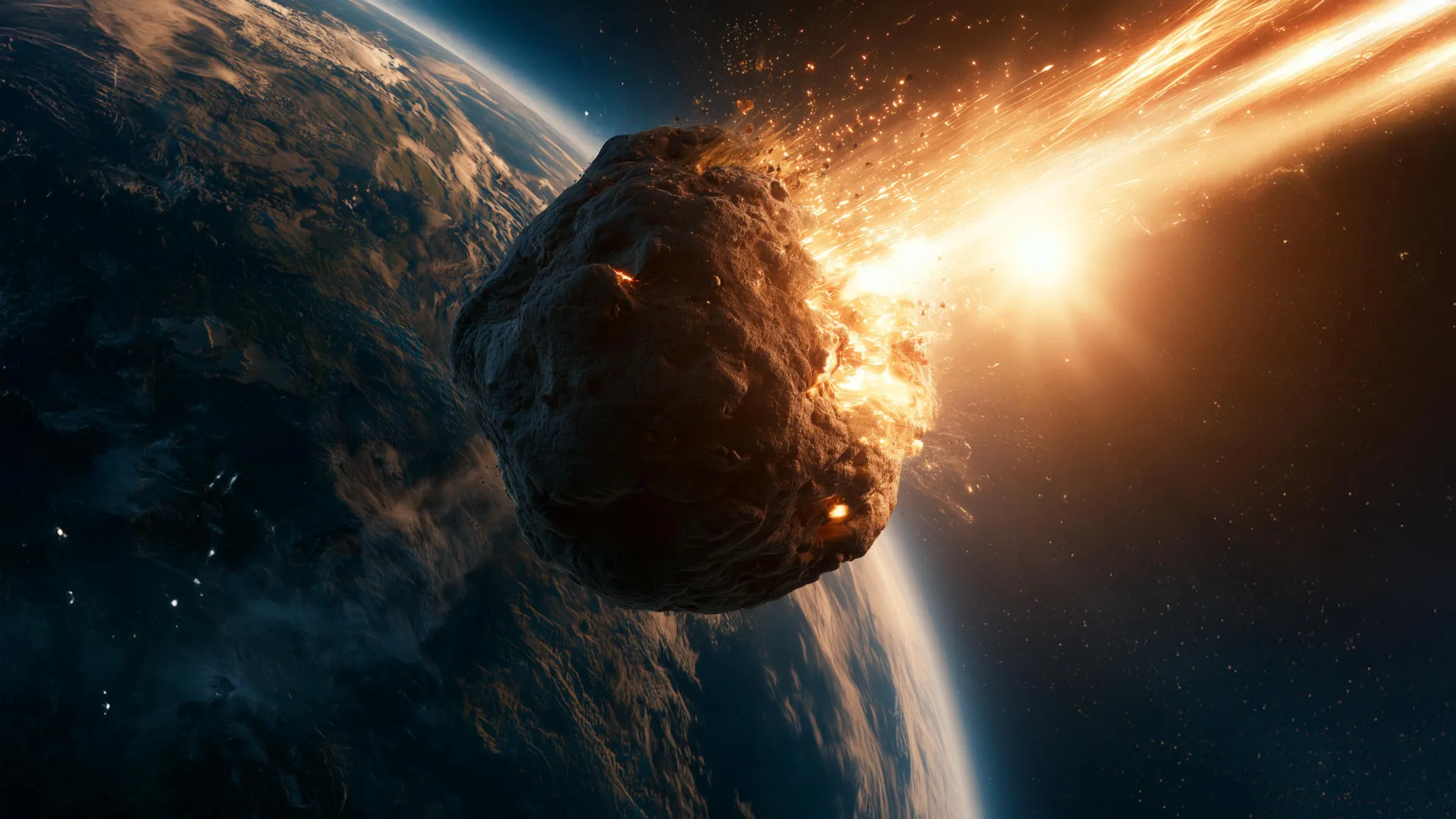
A nuclear explosion could potentially protect Earth from an incoming asteroid by releasing powerful X-rays that heat its surface and push it toward a safer trajectory. However, new research suggests that the success of such a mission could largely depend on which side of the asteroid receives the blast. Unlike the smooth, round objects typically used in computer simulations, real asteroids have uneven surfaces and irregular shapes. Those differences can dramatically influence how an asteroid moves when exposed to intense radiation. A new study published in Icarus found that changing the direction of an X-ray burst could produce very different results, even when aimed at the same asteroid. In one simulation, the asteroid’s speed changed by 3.9 millimeters per second as it radiated from one direction, compared to just 0.8 millimeters per second from another. That represents a nearly five-fold difference in deflection velocity, the change in the asteroid’s forward speed caused by the explosion. “We were hoping the target would matter,” said Nathan Moore, a physicist at Sandia National Laboratories who led the research. “What surprised us was how much.” The effects on an asteroid’s rotation could be even more dramatic. On another simulated asteroid, the change in rotation speed varied by a factor of 17 depending on the direction of the X-rays. These findings suggest that understanding the shape of an asteroid and carefully selecting where to direct a nuclear explosion could be essential to protecting Earth from a future impact. The research received funding through Sandia’s Laboratory Directed Research and Development program. A new way to simulate asteroid drift To investigate how different shapes of asteroids respond to nuclear explosions, Moore and his colleagues developed what they describe as the most accurate asteroid drift model yet. Early computer models faced a major limitation. Typically, researchers had to choose between representing the complex shape of an asteroid and performing very detailed calculations of the physical forces involved. Combining both approaches required more computing power from the practice. The new system overcomes that hurdle, allowing scientists to study realistic shapes of asteroids while maintaining the precision needed to calculate their response to an X-ray burst. The result is the most detailed simulation of an asteroid’s deflection yet produced. “Our new algorithm is 1,600 times faster, which was critical to this breakthrough,” Moore said. “With the older models, the computers just couldn’t handle it.” Why Lumpy Asteroids Change Everything Moore’s interest in improving these calculations arose from an earlier experiment using Sandia’s Z machine. That experiment provided the first demonstration that X-rays could deflect a small piece of material from an asteroid. The next challenge was determining how the same physical process could affect an entire asteroid. “I began to wonder how to scale up the calculation to more accurately predict the deflection of an asteroid on a large scale.” A major problem was the widespread practice of treating asteroids as spheres. Although this simplifies the math, it ignores the irregular shapes of real asteroids, which can have ridges, depressions, and irregular surfaces. “You can make estimates that way, but asteroids have all kinds of weird, lumpy shapes,” he said. “That’s when I became aware of some work one of my colleagues was doing related to outgassing objects in space. I think we had an aha moment where we realized we could do this. No more spheres. We could model the deflection of any asteroid.” The solution involved bringing together two sophisticated simulation systems already in use at Sandia for very different types of physics problems. “The ALEGRA code is typically used to model fast, high-energy experiments, such as magnetically imploding cables in the Z machine, while SPARTA, a direct simulation Monte Carlo code, is typically used to model comparatively weak and slow-evolving forces, such as drag on a satellite by the solar wind,” Moore explained. “The key innovation here was figuring out how to combine the two simulation approaches.” Predicting what happens after a nuclear explosion The new computer model allows researchers to reconstruct an asteroid using detailed 3D images captured during spacecraft flybys. They can then simulate a nuclear X-ray explosion while adjusting the strength of the explosion, its distance from the asteroid, and the direction from which the radiation arrives. The software calculates how much material would vaporize in different parts of the asteroid’s surface and displays the results as a heat map. Using that information, it estimates the resulting thrust, changes in the asteroid’s rotation, and the magnitude of surface damage. These calculations are important because a successful planetary defense mission would ideally change the trajectory of an asteroid without breaking it into multiple dangerous fragments. Redirecting one large object might be preferable to creating several pieces that could still threaten Earth. However, simulations cannot yet predict all the possible consequences of a nuclear explosion. “Right now, our computer model only considers the disintegration of rocks on the surface. We cannot yet accurately predict the disintegration of the entire body of the asteroid,” Moore said. Developing that capability will require research, investment, and more advanced computational tools. An intense burst of X-rays can cause numerous physical effects, some of which influence each other. Taking all of those interactions into account makes it exceptionally difficult to predict exactly how an asteroid would behave during an actual deflection attempt. Choosing the right explosion could save Earth Despite the remaining challenges, the findings offer valuable guidance for future planetary defense efforts. Research shows that the direction of a nuclear explosion is not just a minor detail. It can substantially change how effectively an asteroid is redirected. “Our study shows how important it is to aim carefully,” Moore said. “Choose the right side and you’ll win. If you guess wrong, it could be a bad day.” New simulation tools could eventually help mission planners identify the most effective way to deflect a threatening asteroid. In principle, researchers could input detailed information about its shape and then calculate the ideal explosive force, distance and direction needed to push it away from Earth. Turning those calculations into a real mission would still be extremely difficult. For one thing, the software requires reasonably accurate information about the asteroid’s shape from all directions. If an asteroid were discovered on a collision course with Earth, there might not be enough time to collect the necessary observations. Another challenge would be to deliver and position a nuclear device in precisely the right place relative to a space-traveling asteroid. Even if scientists could identify the ideal explosion configuration, executing it would require extraordinary precision. However, improved simulations could eliminate much of the uncertainty surrounding a potential asteroid defense method. By better understanding how nuclear X-rays interact with the complex surfaces of real asteroids, scientists are getting closer to predicting which strategies would work best. For Moore, that progress is an encouraging step toward ensuring humanity has a better chance of preventing a catastrophic asteroid impact.