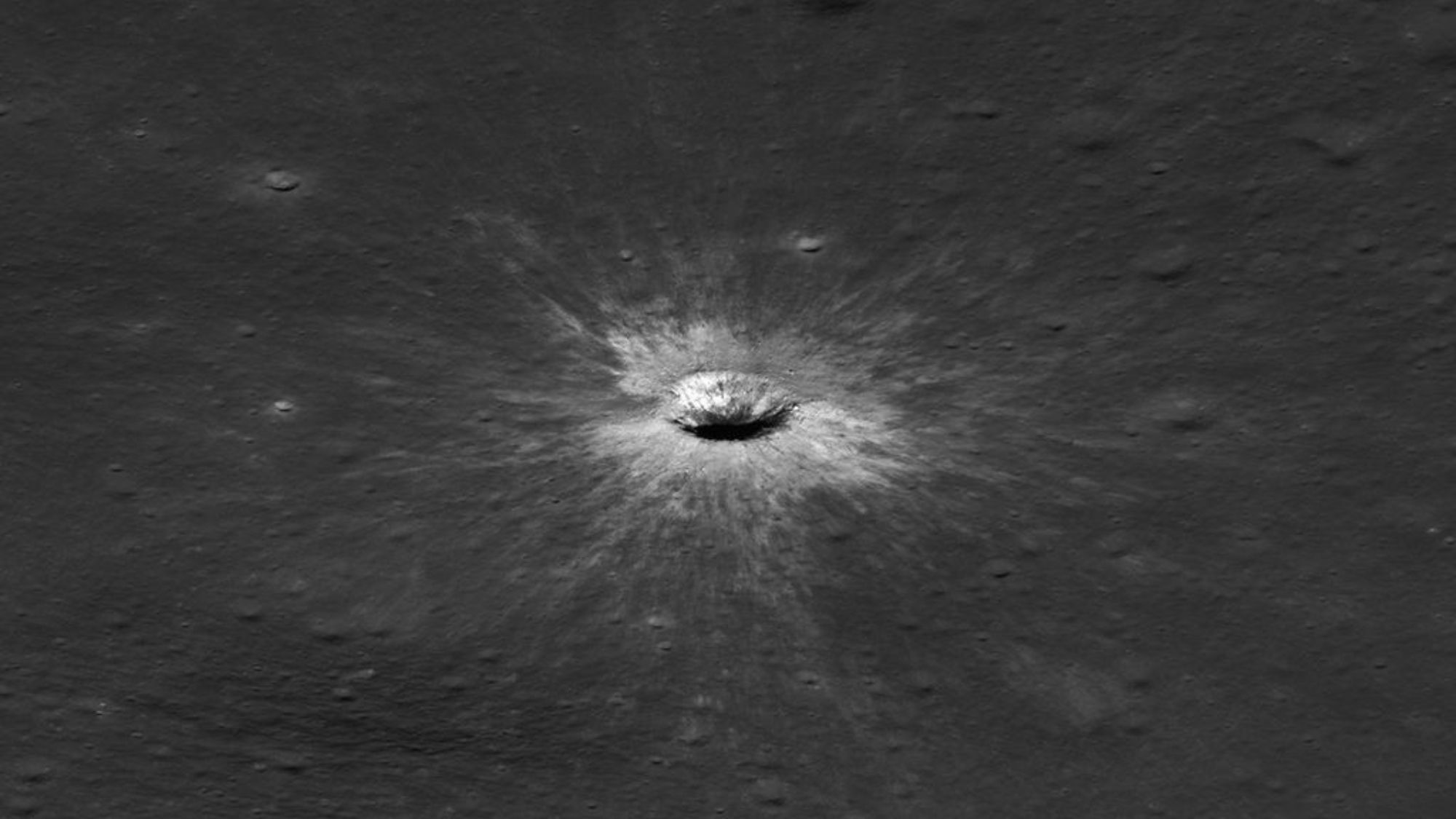
A newly discovered crater on the Moon is giving scientists a rare glimpse into the immediate aftermath of a lunar impact. Called McGetchin Crater, the feature formed sometime between April 11 and May 22, 2024, when an asteroid or comet fragment collided with the Moon. McGetchin, measuring about 728 feet (222 meters) wide and about 141 feet (43 meters) deep, is the largest newly formed impact crater identified by NASA’s Lunar Reconnaissance Orbiter (LRO). In fact, it is the largest newly formed crater ever found in the solar system, according to the agency. An impact capable of producing a crater of this size is expected to occur on the Moon only once every century, making McGetchin an exceptionally rare real-time discovery. The findings are detailed in two new studies published September 16 in the journal Science Advances. One study, led by Mark Robinson of Intuitive Machines, describes the crater itself and the enormous amount of material thrown onto the lunar surface due to the impact that caused the feature. The second study, led by researchers studying data from LRO’s Diviner instrument, examines a much larger region around the crater that was physically altered by the impact. Together, the studies offer scientists something they rarely get: a pristine impact site with observations before and after the event. More importantly, this site is seen before other processes begin to degrade it. An aerial view of the crater taken on December 5, 2025. (Image credit: NASA Goddard/Intuitive Machines) “McGechin Crater is exceptional because it is the largest newly formed impact crater identified to date,” Tyler Powell, lead author of one of the studies, told Space.com. “A crater of this size is expected to form on the Moon only once a century, so we are very fortunate that it formed during the life of the LRO mission and that we can observe the region before and after the impact.” NASA’s LRO mission has been observing the Moon for more than 17 years, providing researchers with images and measurements of the area before and after impact. That long-term record allowed scientists to identify subtle changes that would otherwise be difficult to detect. You may like The crater was first discovered in 2025 by researchers comparing LRO images of the lunar surface. But then follow-up observations from LRO’s Lunar Reconnaissance Orbiter Camera (LROC) revealed the fresh crater and material ejected during the impact. The two studies reveal that McGetchin’s effects extend far beyond the sizable crater. LROC observations show an extensive ejecta blanket surrounding the crater, while data from LRO’s Lunar Diviner Radiometer revealed an even broader thermal anomaly. Diviner detected a “cold spot” about 4.3 miles wide (7 kilometers wide) around the crater that is about 14 to 16 degrees Fahrenheit (8 to 9 kelvin) cooler than the surrounding surface during the lunar night. Scientists believe the temperature difference is caused by changes in the upper layers of lunar soil when the impact disturbed and decompacted the regolith, creating a “spongier” layer that is less able to retain heat, Powell explained. “Impact crater formation is one of the most common and important processes in the solar system. Understanding how impacts modify the surface and its surroundings is important for interpreting lunar geology and history,” Powell said. “In addition, understanding how impacts influence surface properties is relevant to lunar exploration and future lunar landing missions.” A zoomed-in view of McGetchin Crater, circled on the left, along with a “before” image on the right. The left panel is made from images captured in the summer of 2025; The right panel was made from images taken in the spring of 2011. The white spot is not the crater itself, but rather material thrown out of the crater, which formed when a rock, possibly the size of a three- to six-story building, slammed into the moon (Image credit: NASA Goddard/Intuitive Machines/Robert Wagner) The moon is covered in impact craters, but most are old and have been altered by subsequent impacts and the effects of spatial erosion. Therefore, the fact that McGetchin is a large, pristine crater provides a valuable reference point for understanding how craters form and evolve. What to read next The pristine state of the crater could also make it an intriguing target for future lunar exploration. Its location along a boundary between the Moon’s darker, basalt-covered mare and the brighter mountainous terrain offers scientists the opportunity to study how an impact affects two distinct geological environments. A rover or manned mission could take that research a step further by examining features that cannot be fully resolved from orbit. in detail from the surface,” Powell said. “This would improve our understanding of many aspects of the impact crater formation process.” Those observations could also have practical implications for future lunar exploration. As NASA and other space agencies plan increasingly ambitious missions to the Moon, understanding how impacts alter the physical properties of regolith could help scientists better anticipate how future rovers, landers and other equipment will interact with the lunar surface. In that sense, McGetchin is More than a newly formed crater: it is a natural laboratory that could help scientists understand both the Moon’s past and the challenges that await future explorers.