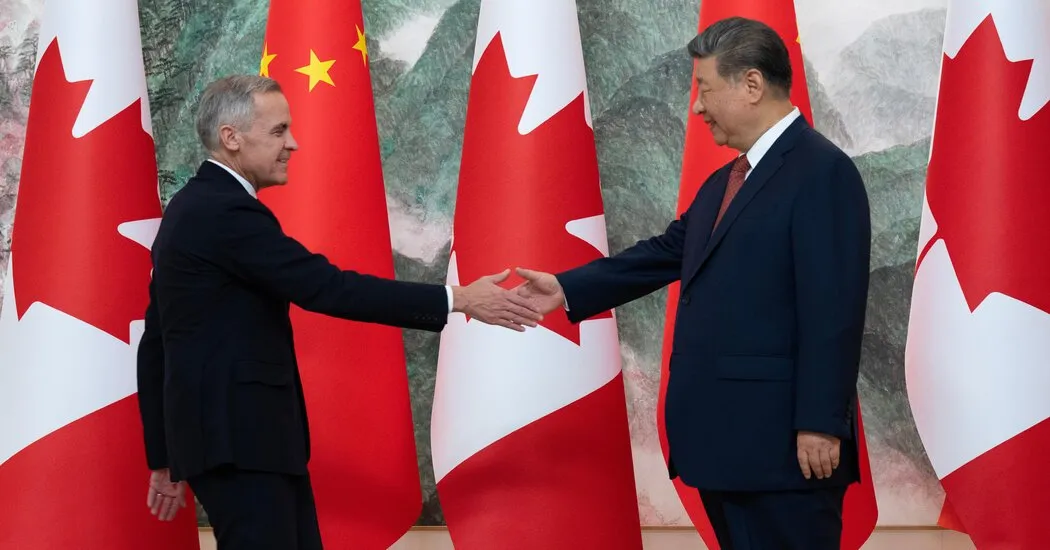
Shenzhen, the Chinese megacity where Prime Minister Mark Carney concluded an eight-day tour that began last week in Dublin, is touted as a place to see the future. Some of what is visible, such as the obvious constant electronic surveillance, seems dystopian. But among the many impressive things in the city of 18 million people is what is missing: the noise of traffic and exhaust fumes. Shenzhen is China’s tech hub, but its streets offer a preview of what Canadians can expect when Chinese electric vehicles hit the Canadian market next year with low tariffs, under a trade deal Carney and China’s leader Xi Jinping reached earlier this year. Carney’s second private meeting with Xi, ahead of the Asia-Pacific Economic Cooperation summit in Shenzhen, produced no new progress on Canada’s opening to Chinese cars. Carney also met with President Trump at the summit. But he returned home with a deal under which China will reduce some tariffs on Canadian agricultural and seafood products in exchange for Canadian concessions on some steel and aluminum products from China. And in Manila, where Carney attended the Association of Southeast Asian Nations summit, Canada reached the outlines of a free trade agreement with the Philippines. However, automobiles did emerge in China. Twice during the trip, Carney – who revealed during the New York Times DealBook Summit this week that he is a former Tesla owner – said Canada would turn to Chinese, Japanese and European automakers to build factories in Canada if the Detroit-based automakers left. The trip came as the government tries to persuade Stellantis to reverse plans to sell its factory in Brampton, Ont., after moving production of a Jeep model from there to Illinois. In a background document on Mr. Carney’s visit, the government said 16,211 electric vehicles from China had been shipped to Canada since March under the lowest tariff. Their arrival ended a trade war in which China had imposed high tariffs on Canadian canola. The government did not say which brands were involved; Most of the first arrivals are believed to be Chinese-made Teslas. Elon Musk’s car company said last month it had already exhausted its Canadian import quota for this year. But the government added that Transport Canada had completed crash testing and certified the safety of vehicles from two China-based companies. The newcomers won’t immediately bring to Canada the eerie near-silence that electric vehicles have brought to Shenzhen’s busy streets, nor will they make food the predominant smell on downtown sidewalks. Initially only 49,000 cars will be allowed entry with reduced tariffs, less than 3 percent of the Canadian market. Several Chinese automakers have said they plan to sell in Canada, but little is known about what they will offer. (Polestar, a luxury brand owned by Geely, has had a presence in a handful of Canadian cities since 2020.) The government wants to encourage affordable cars and is linking the expansion of the quota to lower prices. This week it said all cars from one of the certified companies would cost less than C$35,000, its definition of affordable. On Thursday, I toured several car showrooms in shopping malls near my hotel in Shenzhen’s financial district to get a sense of what might be coming. BYD, a local company, dominates taxis in Shenzhen. In a corner of its cramped showroom, I found the Seagull, an SUV slightly roomier than the Honda Fit hatchback once sold in Canada. Although it was the cheapest car on display, it was no bleak economy box. The interior featured a large flat screen and a stylish open center console like those in many Volvos. The floor model had a battery range of 420 kilometers and a price of 17,700 Canadian dollars. Some features would need to be added for Canada. The car lacks a rear window defroster and the seller wasn’t sure if it had a heat pump to prevent the battery from draining quickly in winter. Most likely, the price here will be much higher. Many of the Chinese cars I saw were innovative, although perhaps not in a way suitable for Canada. Opposite BYD was Arcfox, a brand whose cars are made by a joint venture between China’s BAIC and Canadian auto parts maker Magna International. Their trick is swapping batteries. When the battery of the S3 model, which costs 20,000 Canadian dollars, approaches its range of 500 kilometers, the driver enters a special garage where a robot exchanges it for a fully charged one. No one has to get out of the car and in the videos they showed me, the process seemed to take as long as filling a tank of gas. With Canada struggling to build charger networks, bringing the idea here seems outlandish. Style can also be a problem. For a large SUV that costs around $100,000 Canadian, Voyah has opted for a massive chrome grille and equally gigantic wheels. The result resembles a Rolls-Royce caricature. Next door, in the showroom of Zeekr, another Geely luxury brand, I found a Chinese electric vehicle that may prove popular here even though it’s above the government’s affordability threshold. The Zeekr 007 offers an unusually high range of 688 kilometers in its base model, which costs 44,000 Canadian dollars. Telsa’s popular Model Y, on the other hand, costs about $50,000 for a version with a range of 463 kilometers. The Zeekr has no shortage of obvious luxury elements. When the doors are opened, the seats automatically slide rearward for easy exit. Any car that arrives from China will come with many qualifications. Some models may not handle well. Their long-term reliability is unknown, as is how they will cope with Canadian winters. And Chinese brands are unlikely to have a network of parts warehouses in Canada that established automakers depend on to ensure timely repairs. But the streets and showrooms of Shenzhen suggest that, at the very least, its arrival will not go unnoticed. Ian Austen reports from Canada for The Times. Originally from Windsor, Ontario, based in Ottawa, he has reported on the country for two decades. He can be reached at austen@nytimes.com. The ‘boss’ of all bears Around 75 grizzly bears roam the 6,641 square kilometers of Banff National Park, but there is one bear that stands out. To scientists and park guardians, he is grizzly bear 122. To everyone who visits or lives in or near Canada’s oldest national park, he is the Boss. Despite the Chief’s fearsome behavior, few bear experts consider him a threat to humans. Rather, they fear that their celebrity could endanger their lives and their dominion. Ian Austen traveled to Banff National Park, Canmore and Dead Man’s Flats, Alberta, to report on the legend and longevity of the Chief. Read the full article. Trans Canada After an appearance last year, a float representing Krampus, St. Nicholas’ evil accomplice, will not be allowed in the Santa Claus parade in Strathroy, Ont., on Saturday, Mark Colley reports. From Opinion: For many Canadians and citizens of other democracies, even this month’s Democratic tsunami in the midterm elections will not be enough to immediately change minds about the reliability of the United States, writes Chrystia Freeland. How are we? We look forward to hearing from you about this newsletter and developments in Canada in general. Send them to nytcanada@nytimes.com. Do you like this email? Forward it to your friends and let them know they can sign up here.