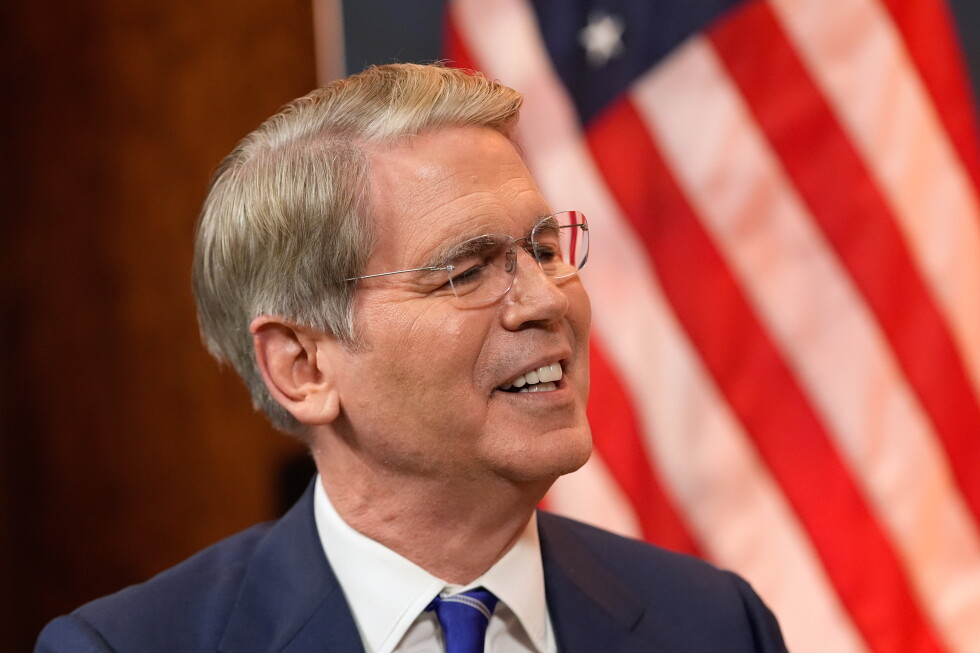
ASHEVILLE, N.C. (AP) — President Donald Trump’s administration plans to impose sanctions on another bank this week as it steps up efforts to economically isolate Iran, U.S. Treasury Secretary Scott Bessent told The Associated Press on Sunday. “This will be financial violence if necessary,” Bessent said in the interview. “We’re showing people that we know who you are, that you know who you are, and this has to stop.” Bessent spoke to the AP ahead of Group of 20 meetings in Asheville, North Carolina, where he will meet individually with his counterparts from the world’s major and developing economies to encourage cooperation against Iran. He said he plans to focus on encouraging economic growth at his meetings, which come as he faces scrutiny over an unusual bond buyback program and his focus on $40 trillion in U.S. debt, and defended the Treasury’s decision to exclude certain journalists from covering the event. Bessent did not name the bank that would face sanctions this week. His comments come after the Trump administration signaled it would shift from military strikes to economic pressure during a war that recently hit the six-month mark, promising what it called an “economic D-Day” against a country that has already withstood decades of sanctions. The United States is trying to squeeze Iran. However, hostilities between the United States and Iran broke out on Sunday. US forces attacked Iranian rocket launchers in the Strait of Hormuz in their first military action in a month, breaking a lull in fighting. Iran vowed to retaliate for what it called a deadly attack. Furthermore, the administration has relied primarily on warnings rather than new sanctions against Iran’s trading partners. There is also the question of how Trump will handle China, which is Iran’s largest trading partner and the largest buyer of its oil. Bessent told the AP that he would speak to his Chinese counterparts at the G20 meeting and that “all options are on the table” in terms of sanctioning Beijing for its continued purchases. But he rejected the idea that the administration was reluctant to confront China, calling it “a completely false narrative that the media picked up on.” He insisted that China and the US agree on the need to reopen the Strait of Hormuz and prevent Iran from developing a nuclear weapon. Sign up for the Ground Game newsletter: your guide to the biggest stories in American politics, policy and elections. The Treasury’s first official action in this economic pressure campaign was a proposed regulation on Friday that, if finalized, would prevent Emirati branches of Banque Misr, Egypt’s second-largest bank, from accessing the US financial system. By stopping short of imposing sanctions on the Egyptian bank, the Republican administration appeared to be signaling its reluctance to penalize major trading partners that do business with Iran, including China and India. Treasury restricted media access to G20 meeting Treasury banned certain journalists from The New York Times, The Wall Street Journal and Bloomberg News from covering the G20 meetings. The Times said it was “not just another disturbing government effort to undermine independent journalism, but a blatant attempt to evade public scrutiny.” Treasury officials have not explained their decision. Bessent defended the exclusion, telling the AP that it “has nothing to do with point of view.” Bessent faces scrutiny in the bond market. Bessent said he wanted to focus on growth at the summit with his counterparts. “The world has this mountain of debt, and we have to grow out of it because we know that there are many countries that have very large budget deficits, but they also have zero growth,” he said. Bessent surprised financial markets earlier. This month with an unusual intervention in the bond market that sparked criticism that the administration has not done enough to address fiscal problems. The move, which came on the same day U.S. debt surpassed $40 trillion, was seen as a way to try to put a lid on rising bond yields, which have raised borrowing costs for consumers. Some of the harshest criticism came from Stan Druckenmiller, CEO of Duquesne Family Office LLC, a former boss of Bessent’s in the 1990s, who wrote in The Wall Street Journal that the Treasury Department was on “the wrong side of that trade” and needed to do more to address the deficit. Bessent promises measures on debt and deficit. When asked about the criticism, Bessent acknowledged that “we’ve been in touch” and said, “Stan is a great money manager. He changes his mind a lot.” said. Druckenmiller in a 2011 interview said that a technical debt default “would be horrible” but not “the end of the world” if it led to measures that reined in spending on U.S. government programs. Bessent told the AP that he was working with Russ Vought, the director of the Office of Management and Budget, on a fiscal package to reduce the debt and deficit that would be unveiled in the coming weeks. noise” and said rising yields were “a global phenomenon.” Bessent blamed tariff refunds for the rising deficit. The government was forced to refund some tariffs paid by companies after the U.S. Supreme Court said Trump had exceeded his authority by imposing sweeping tariffs on imports from most countries.