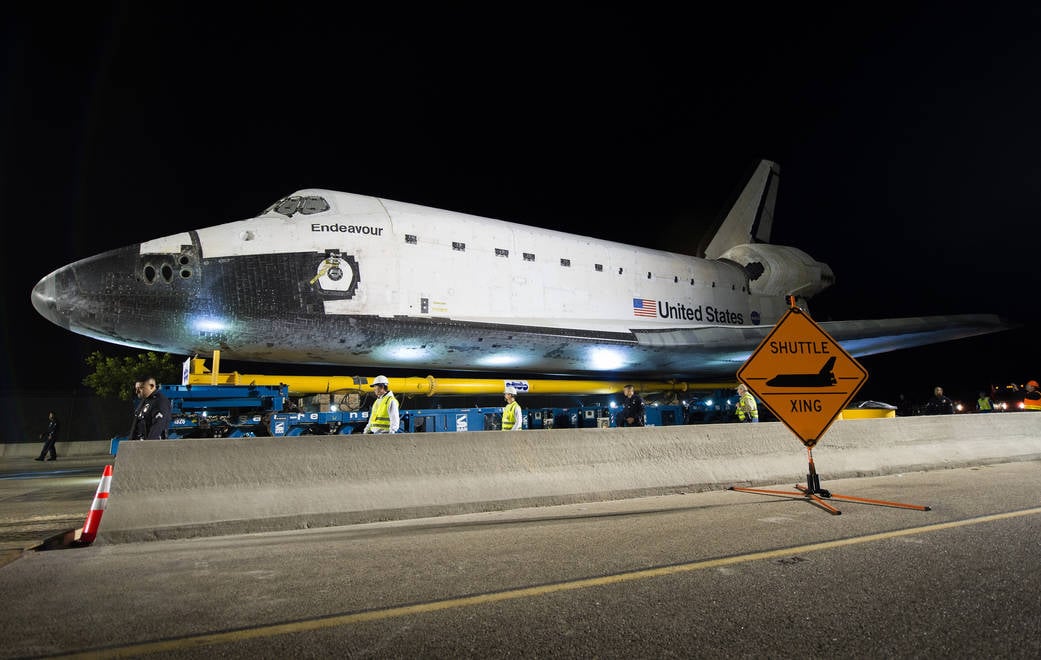
The space shuttle Endeavor had crossed the United States aboard a modified Boeing 747. The last 20 kilometers were slower. From October 12 to 14, 2012, the retired orbiter glided from Los Angeles International Airport through Inglewood and Los Angeles to the California Science Center. The trip lasted about 68 hours. The Endeavor moved no faster than about 2 mph and often came to a complete stop as crews dealt with utility lines, traffic equipment, buildings and trees. At several points, its 78-foot wingspan overcame obstacles with only inches available. Calling this a 12-mile drive understates the problem. It was a carefully sequenced transport operation for an irreplaceable, airplane-shaped spacecraft whose body was wider than many of the streets intended to transport it. Sixty-eight hours does not mean sixty-eight hours of movement. The headline figures should be read together. Twelve miles divided by 68 hours gives an average of about 0.176 mph, about the pace of covering a city block in one hour. That doesn’t conflict with a maximum movement speed of close to 2 mph. The watch included long pauses. Workers stopped the Endeavor for tree and utility work, inspections, route adjustments, ceremonies and delays. Sometimes the transporter would move forward just enough to create the next clearance problem and then wait while specialists resolved it. The move was expected to be completed by Saturday evening, October 13. It was extended until Sunday and Endeavor arrived at the science center on October 14. A contemporary SpaceDaily dispatch recorded how the planned two-day trip turned into a three-day event as the orbiter passed between power lines, trees and buildings. The orbiter was heavy, but its geometry was harder. Endeavor weighed approximately 170,000 pounds in the configuration carried through Los Angeles. Published orbiter weights vary depending on mission equipment, booster, and time in the vehicle’s operational life, so the rounded figure should not be confused with the shuttle’s launch weight or full stack weight. The carrier added more. Endeavor sat on a steel support structure and a specialized ground transporter, making the load presented to the road substantially greater than that of the orbiter alone. The weight could be distributed among many wheels. The shape couldn’t be made smaller. NASA lists an orbiter length of 122 feet, a wingspan of 78 feet, and a runway height of 57 feet in the space shuttle’s reference dimensions. On the transportation system, the queue was even higher. A road vehicle is usually long and narrow. Endeavor was long, extremely wide, and tapering in several directions. Turning the nose changed where both wingtips were swept. Lowering or moving a portion of the conveyor could fix a gap at one point while tightening another. A conveyor built for movements measured in inches. The orbiter was traveling on the Over Land Transporter, or OLT. Its strong support structure had for the first time transported orbital shuttles on a 37-mile land route from its assembly facility in Palmdale to what was then NASA’s Dryden Flight Research Center at Edwards Air Force Base. After 27 years in storage, the frame was restored for Endeavor’s voyage to the museum. Unlike a typical tractor-trailer, the multi-axle transport arrangement allowed operators to steer and position cargo with exceptional control. Observers could call a stop, reevaluate various clearances, and order a small correction before movement resumed. The team didn’t just keep the tires between the painted lines. It had to monitor the orbiter’s nose, belly, tail and two widely separated wingtips as the width of the street, crown and roadside obstacles changed. A fraction of a degree on the protractor could move the tip of a wing noticeably when that angle reached the end of the wing. NASA’s photo of Endeavor leaving LAX shows the visual contrast: a vehicle that once flew at orbital speed resting on workers, concrete barriers and an orange sign that says “Shuttle Xing.” The scale of the orbiter makes the transporter below appear deceptively small. Los Angeles had to be edited around the shuttle. Route planners didn’t simply choose the shortest line from LAX to Exposition Park. They examined curves, street widths, bridges, overhead utilities, traffic hardware, trees and underground infrastructure. The selected 12-mile route was the path that could be made viable, not an ordinary response from a navigation app. A later NASA story on the Endeavor display project says crews removed about 220 traffic signs and more than 400 trees to clear the way. The distinction matters: Many moves occurred before Endeavor arrived, while arborists continued pruning branches and resolving conflicts during the move. The cutting of trees was controversial. The plans included replacement plantings, but a mature canopy cannot be immediately recreated. The operation demonstrated a true compromise between preserving urban vegetation and moving a national artifact whose dimensions the streets had never been designed to accommodate. Utility crews lifted, disconnected or worked around overhead lines. Traffic lights and streetlights were temporarily removed. Steel plates and other protective measures distribute loads or protect vulnerable surfaces. Police closed roads and separated the moving spacecraft from crowds that gathered along the route. The NASA report says approximately 1,000 police officers lined the route. This was part engineering convoy, part civic procession, and part rolling workplace. The repeated stops were not failures of the plan. They were included in a plan that considered a collision unacceptable. The tightest clearances came near the end As the Endeavor entered denser streets near its destination, progress slowed. Contemporary observers reported wingtips passing within inches of apartment buildings, poles, and other obstructions. Workers pruned more foliage and checked clearances as the conveyor made small, deliberate inroads. “Inches to spare” does not mean that the route was improvised blindly. Surveys and digital models had identified the difficult places. Real streets, however, contain flexible branches, cables, parked infrastructure, and surfaces that do not behave as perfectly as a model. The final authority was still the people who observed the physical gap. The movement also depended on time. An extensive public celebration was planned around the ferry, but public access could not be allowed to interfere with the work environment. The breaks gave the crews space to complete the next task and gave the transporter team time to confirm that all groups were ready. The Endeavor crossed the country for the first time by plane. The road trip was the final stage of a much longer move. NASA had awarded Endeavor to the California Science Center after the shuttle program ended. The orbiter was prepared at the Kennedy Space Center, mounted on NASA’s modified Shuttle Carrier Aircraft 747, and flown westward in September 2012. NASA’s final ferry announcement planned low passes over NASA landmarks and centers before landing at LAX. SpaceDaily followed that journey as the 747 and Endeavor stopped at Houston’s Ellington Field on their way to California. At LAX, teams removed Endeavor from the transport plane and prepared it for display. The aerodynamic tail cone used during the ferry’s flight became detached. Museum configuration hardware took its place. Only then could the orbiter begin what the science center called Mission 26. Mission 26 followed twenty-five flights to orbit. The name was ceremonial but appropriate. Endeavor completed 25 space missions from STS-49 in 1992 to STS-134 in 2011. According to NASA’s final mission history, it spent 299 days in space, circled the Earth 4,671 times and traveled 122,883,151 miles. His assignments included the first servicing mission that corrected the Hubble Space Telescope’s blurry vision, the STS-88 mission that linked the first American and Russian elements of the International Space Station, and the delivery of the Alpha Magnetic Spectrometer during its final flight. Mission 26 had no astronauts, no launch stack, and no orbital speed. It still required route analysis, hardware preparation, rehearsals, operating rules, contingency planning, and a large team. Their criterion for success was simple to state and difficult to achieve: place Endeavor in the museum without harming the orbiter, the transporter, the city, or the public. The museum tour was not the end of the engineering that the Endeavor initially presented horizontally. The California Science Center’s long-term plan was to present the orbiter vertically with an actual external tank and authentic solid rocket propulsion components, recreating a launch-ready stack. SpaceDaily later reported donating airworthy shuttle booster hardware for that display. Moving and supporting an entire vertical stack in a seismic zone created another set of structural problems, very different from street routing but governed by the same principle: a familiar-looking spacecraft becomes an extraordinary civil engineering burden when it leaves the runway. Contrast is what makes a trip to Los Angeles memorable. The Endeavor had traveled nearly 123 million miles, survived atmospheric re-entry and landed as an unpowered glider. Its final 12 miles required nearly three days, hundreds of temporary shifts in the city, and human observers guarding gaps that sometimes shrank to inches. Speed was never the measure of success. The slow pace was evidence that the operation was doing what it was designed to do: turning an orbiter built for open skies into a safe object on an urban street, one carefully controlled movement at a time. About this articleThis article is for general information and reflection. It is not professional advice. For your specific situation, consult a qualified professional.