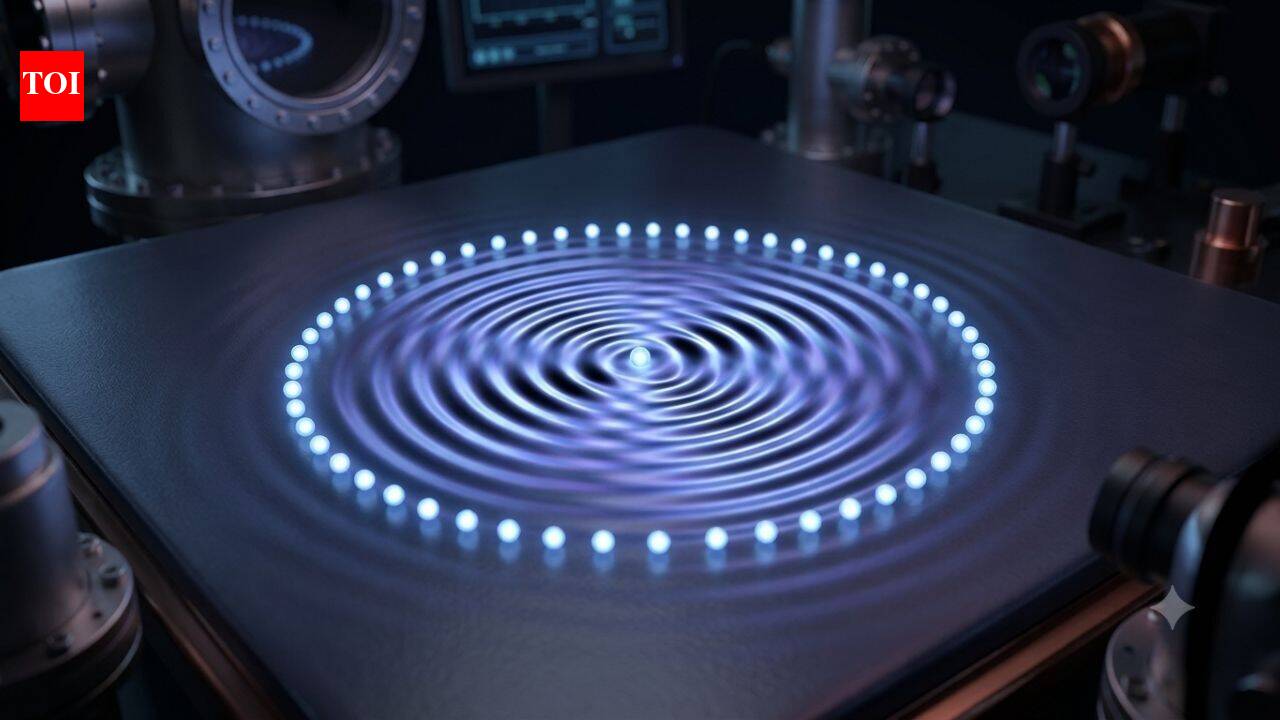
Representational image of quantum images showing waves of electrons around an atom. (AI Photo) Dirk Morr, a physics professor at the University of Illinois at Chicago (UIC), has developed a quantum imaging strategy that uses superconductors as small projectors. The research, published in Nature Physics, provides experimental support for an idea Morr first proposed two decades ago. Morr had been waiting for years to see if his theoretical work could be demonstrated in an experiment. The recent findings showed quantum images similar to what their calculations had predicted. “I don’t know if ‘blessed’ is the right word, but it’s a cool accomplishment,” Morr said. “It’s gratifying to have theorized something two decades ago and finally see it come true. That’s what science is all about,” UIC Today said. Morr joined the UIC faculty in 2001. As a theoretical physicist, he works with mathematical models to explain how nature behaves. He became interested in the possibility of quantum imaging after following an experiment at IBM that year. The IBM researchers used a scanning scanning microscope to arrange cobalt atoms into a small elliptical structure called a quantum corral on a thin copper disk. The pen was about 20 nanometers long, making it thousands of times narrower than a strand of hair. Electrons behave like waves Inside the corral, the electrons in the copper behaved in an unusual way. Instead of acting just as individual particles, they formed waves. Morr compared the behavior to the ripples that spread across a pond after a rock hits the water. Waves can move in different directions and have different intensities. Similarly, the electrons inside the pen produced wave patterns. The observation was important because quantum mechanics shows that individual particles can exhibit wave-like behavior under certain conditions. Morr realized that these electron waves could be used to create images, much like light waves can be used to form an image. “But copper wasn’t good enough to create high-resolution images, so we set out to investigate other materials,” Morr said. His work focused on superconductors. They are materials that can conduct energy without losing it. Morr’s calculations showed that superconductors could potentially function as a lens, focusing quantum waves and producing high-resolution images. The idea could offer a way to study atoms without directly disturbing the original object being examined. In the quantum world, observing an object can change its properties, making direct observation difficult. “In the quantum world of atoms, if you look at an object, you actually change its properties,” Morr said. “Imagine that every time you look at a book on a table, the book falls off the table. But if I can create an image of the atom, then I can study the image without altering the original.” Morr’s calculations showed that superconductors could potentially function as lenses, focusing quantum waves and producing high-resolution images. The required experimental setup was not possible at the time because scientists could not make a quantum corral on a superconducting surface. The surface had to be extremely smooth and defect-free for the experiment to work. According to Morr, that level of surface quality could not be achieved two decades ago. “Back then, you couldn’t build a quantum corral on top of a superconducting surface. The superconducting surface would have to be completely smooth and flawless, which simply wasn’t possible,” he said. The situation changed years later, when researchers in Germany developed a facility that could test the idea. In 2023, Morr’s colleagues at the University of Hamburg built a rectangular atomic pen on top of a superconductor. They then placed an iron atom inside the pen to generate a quantum projected image. The experiment produced results that could be compared with Morr’s theoretical prediction. Hamburg’s configuration was more complicated than the system Morr had originally envisioned. To understand what the researchers were seeing, Chang Xu, a graduate student in Morr’s group at UIC, created a multilayer theoretical model that replicated the experimental setup. The model matched the quantum picture. The model included several layers. The base was niobium, a superconductor. A silver island was placed in the middle, while an elliptical corral made of silver atoms was placed on top. Xu’s calculations showed quantum images that closely matched the effect observed by the Hamburg researchers. The result confirmed Morr’s prediction from 20 years earlier. The work also brought together theoretical and experimental research carried out by scientists from different countries. Morr said the result showed how collaboration between researchers can help advance scientific ideas. “This study is a classic example of how scientists from around the world collaborate and make progress,” Morr said. For Morr, the result also reflects two different reasons why he finds science interesting. Sometimes, he said, his interest comes from the possible practical uses of a discovery. At other times, it arises from a desire to understand how nature works. “There are many reasons why I am intrigued by science. Sometimes I focus on the practical applications of a discovery; other times I am motivated by intellectual curiosity and a sense of wonder at how beautiful and complex nature is,” he said. “In this case, I’m both.”