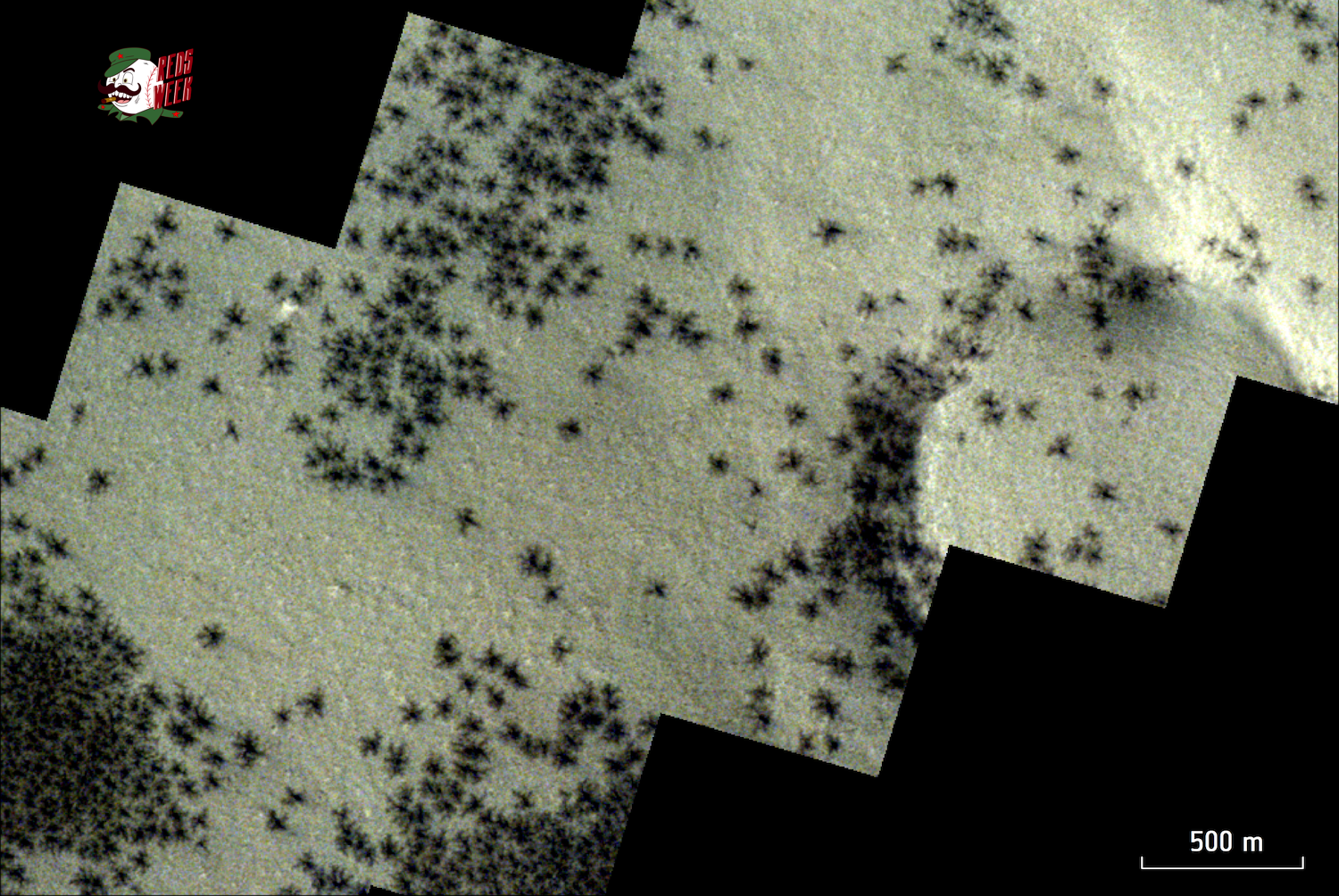
Is there life on Mars? That’s the wrong question. Every time scientists from NASA, the European Space Agency or any other terrestrial organization bring news from Mars about new discoveries in the search for evidence of life on the fourth planet, I feel a little annoyed that the attention of the general population is focused exclusively on the quest to find the slightest microresidue of exobiota. It is a narrow angle, which highlights everything in the background and makes the search possible or worthwhile. Mars is fascinating because of its broader planetary-scale dynamics. It is both Earth-like (the two planets rotate at about the same speed, their inner shells and elemental compositions are roughly equivalent, and both have moons) and extraterrestrial (Mars is relatively small and light, has no atmosphere, and orbits the Sun very slowly) in some important ways. Furthermore, higher-order mysteries about the state of life on Mars are mostly solved. Everything that lived there has been dead and gone for billions of years, unless one generously expands the parameters of “lived.” The better question is something like: Why would there have been life on Mars? Is this question even more tempting? We have to be honest: no, of course not. Nothing on that path is as great as life. But there are still interesting things. I am referring, of course, to the glacial spiders of Mars. The most significant difference between the blue and red planets is that only we have a thick atmosphere that protects us from solar radiation, warms our surface and creates the conditions for liquid water to exist. Mars used to have a real atmosphere, but producing one depends on constant churning at the center of the planet. Mars is smaller and made up of different elements than Earth, so they all died out billions of years ago. Without a magnetic field, this process let the solar wind strip Mars of its atmosphere in a process called sputtering. The atmosphere of Mars is a thin, cold, and shrinking layer of carbon. But it wasn’t always like this. Billions of years ago there were rivers and lakes, and research suggests there probably was life, though only in the simplest sense. The Martian atmosphere did not last long, cosmically speaking. There almost certainly weren’t little things running around, but rather microbes. But! Water still exists on the surface of Mars, encased in the form of ice. Like Earth, both poles of Mars are covered by polar caps. That’s not where all the things happen, but it’s where the most interesting things happen. There is ample evidence of past glaciation throughout the Martian tropics; Even under different gravitational and atmospheric conditions, glacial geomorphology (or, in this case, areomorphology) is extremely different, and there are plenty of glaciers in the mid-latitudes today. However, those glaciers aren’t actually doing anything. They just sit there, neither growing nor shrinking. On Earth, glaciers are the most dynamic forces of erosion, cutting the highest mountains that plate tectonics (another thing Mars no longer has) can produce. But that requires them to melt. It’s too cold on Mars for that to happen, and the pressure is so low that any increase in temperature would make solid ice sublime. Sublimation, in the scientific and non-Freudian sense, refers to the process by which a solid becomes a gas without passing through the liquid state. So mid-latitude glaciers are hunkering down, covered in rock and dust, and will probably stay that way for a few more billion years. The polar glaciers on Mars are active, although not in the erosive sense. Its north pole is relatively less interesting, simply because it is at a lower elevation and the winter in the north is shorter, although it is larger than its southern counterpart. Like Earth, Mars’ orbit is inclined, so it has pronounced hemispheric seasons. In the polar winter, a thin layer of carbon dioxide ice forms on top of water ice glaciers. In the polar summer, it sublimates. When I was studying this topic, there were many popular theories that glaciers were largely composed of carbon dioxide ice (more popularly known as dry ice), although recent studies have established the surprising purity of Martian glaciers. This was as deep and specialized as I ever got in my study of the geological arts. The physics of glacial fluids is fascinating, mainly because they occupy an intermediate rung on the time scale between tectonics (slow) and water erosion (rapid), and because they tear at the Earth’s surface, rather than adapting to its preferred structures and arrangements. You can always recognize a glacial valley: they are U-shaped, the traces of the glaciers of yesteryear. What I liked the most was the study of glaciers in extreme environments, such as the tropics, New Zealand or Mars. Whether fading traces of a colder era or the last refuge of water on a dry world, glaciers are the atmosphere’s most important tool for shaping the planet. I wanted to see the very edge of the tool. What makes the south pole of Mars so interesting are the spiders. The longer winter and more unusual areological composition mean that carbon dioxide ice forms directly on the ground, not on frozen water glaciers. In the southern spring temperatures increase. Due to the relative difference in albedo, the ground warms faster than the upper layers of carbon dioxide ice, causing the lower layers to sublime. But that gas is trapped by the rest of the still-frozen ice above it and has nowhere to go. Then the pressure increases until it reaches a breaking point and, bang, geyser. The geysers’ composition is primarily underlying gas and dust, giving them their distinctive spider-like appearance. They look like spiders. David Bowie was right! European Space Agency Spiders suggest a simple truth: something doesn’t have to be alive to be active. The Martian atmosphere has disappeared, but there is still something dynamic happening on the planet’s surface. There may be no life on Mars, but Mars is alive anyway.Recommended