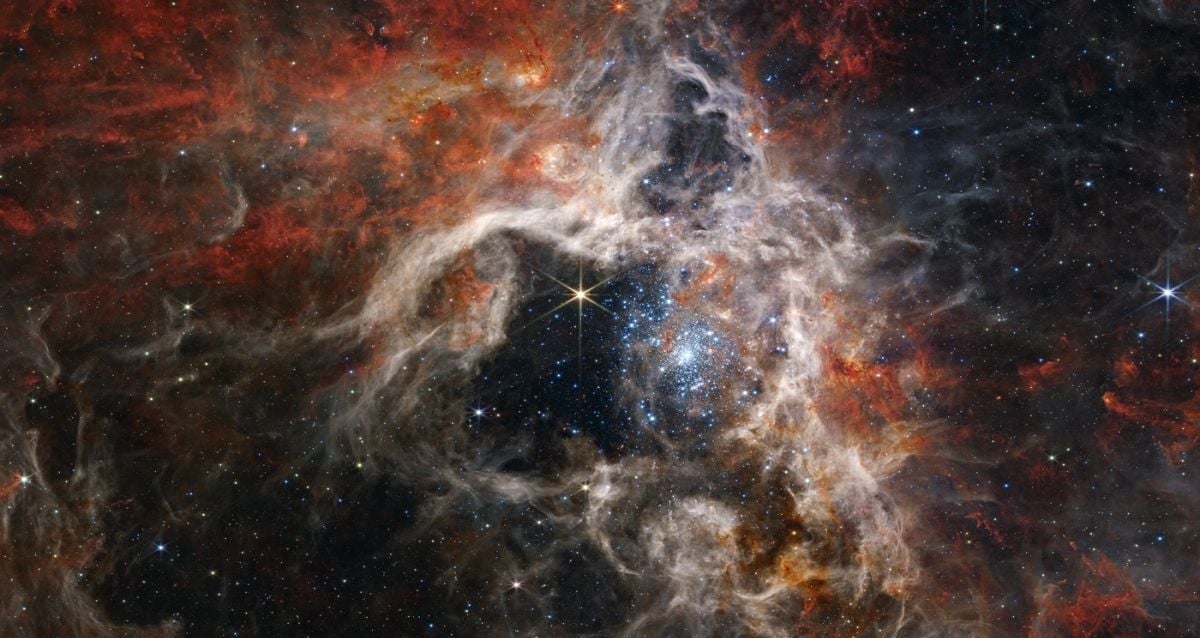
For decades, scientists have used two different measurements to analyze the behavior of the universe. Now, one of its pioneers is questioning the meaning of these models. NASA The Tarantula Nebula, a section of the universe where new stars are forming. Historically, experts have used two different approaches to measure how the universe is expanding. Although the measurements have produced two different results, both were generally thought to be reliable, with the variation explained by the imprecision that comes with analyzing such a complicated issue. It was thought that over time the instruments would become more precise and this discrepancy would disappear. However, this has not been the case. Instead, increasingly precise measurements have continued to land near the same incompatible values, making the discrepancy harder to rule out as error. Now, some of the scientists involved in these pioneering measurements are sounding the alarm. But what was the incident that caused this chaos? The answer lies in the changing state of dark energy itself. How fast is the universe really expanding? In the late 1990s, a team led by astrophysicist Adam Riess and another led by Saul Perlmutter studied distant exploding stars called type Ia supernovae. Models at the time predicted that the gravitational pull of all the matter in the universe would slow the expansion of the universe, which would be reflected in their measurements of exploding stars. But these teams noticed that, strangely, the opposite was happening. Instead of slowing down, the expansion of the universe seemed to accelerate. This discovery earned Riess, Perlmutter, and another researcher named Brian Schmidt the 2011 Nobel Prize in Physics. Their research would eventually be incorporated into calculations through the “Lambda cold dark matter” model, or ΛCDM, where Λ represented the cosmological constant of the dark energy that was somehow accelerating the expansion of the universe. National Optical-Infrared Astronomy Research Laboratory Dark energy is a mysterious force driving the expansion of the universe. The problem was that scientists couldn’t agree on exactly how fast the universe is expanding. The Planck satellite used ΛCDM and cosmic microwave background radiation (remnant light from the early history of the universe) to estimate the expansion rate at 67 kilometers per second per megaparsec. Riess’ SH0ES team, by contrast, measured distances between nearby galaxies to determine that the expansion was closer to 73 kilometers per second per megaparsec. This discrepancy became known as the “Hubble tension.” While it was believed that these numbers would one day align as measurements became more accurate, the opposite has happened. There is also another problem: the findings of the Dark Energy Spectroscopic Instrument. Is dark energy changing? The Dark Energy Spectroscopic Instrument, or DESI, maps millions of galaxies and quasars to reconstruct how the universe has expanded over billions of years. Taken on their own, the DESI measurements appeared to be compatible with ΛCDM. But in March 2025, researchers announced that when combined with observations of the cosmic microwave background and supernovae, they determined that dark energy might not be as constant as they thought. Instead, the very nature of dark energy may be evolving over time. NOIRLab/KPNO/NSF/AURA/P. Marenfeld The dark energy spectroscopic instrument at the Kitt Peak National Observatory near Tucson, Arizona. This is surprising because, in the old ΛCDM model, “Λ” had to be treated as a constant. By showing that this might not be the case, the researchers revealed that the simplest version of the standard cosmological model may not tell the whole story. Riess himself has noted the remarkable nature of this discovery. In a paper published in August 2025, he and fellow astronomer Alexie Leauthaud wrote: “Widening cracks are appearing in the cold dark matter (ΛCDM) Λ model.” “It is increasingly clear that the standard cosmological model has difficulty describing the full history of the expansion of the Universe as revealed by the cosmic microwave background, baryon acoustic oscillation measurements, and locally calibrated type Ia supernovae,” the paper reads. What does this mean? Once this news became public, the Internet was flooded with theories about what this meant for our understanding of the universe. A video on the topic posted by Dr. Alyssa Sokol (@alyssa.sokol.phd), which currently has more than 266,000 views, stated: “It is quite possible that we are about to throw out the standard model of cosmology.” NASAThe “Pillars of Creation”, enormous trunks of interstellar gas and dust almost 7,000 light years from Earth. This is a real possibility, but researchers are still unsure of the true consequences of these findings. For example, in July 2026, DESI researchers published a new analysis using the “Lyman-alpha forest.” This generates measurements by looking at the patterns produced when light from ancient quasars passes through hydrogen clouds across the universe. They found that this measurement was more accurate and its central value moved towards ΛCDM. This could further complicate the idea that dark energy is changing. In short, astronomers aren’t entirely sure about the current state of our universe or how fast it’s expanding, but it’s certainly an exciting time in the field, and the nature of our understanding of the universe may change dramatically again soon. @alyssa.sokol.phd What a time to be alive and curious 😀🤯 amirite? “Hubble tension” refers to the fact that we have two independent estimates for the expansion rate of the universe that largely DISAGREE! So which one is it? What is the truth? And what does it mean for physics? Well, it has to do with dark energy. Dark Energy is the name we give to everything that is causing the universe to expand and accelerate. We say that spacetime itself is spreading and that dark energy is the driving force (not a force, but words are difficult; who knows lol). That said! Dark energy, and specifically the extent to which it *dominates* the energy density of the matter of the universe, is MAINLY RESPONSIBLE for the fate of the universe. That is, does the expansion continue to accelerate and separate everything forever? Or will this dark energy eventually tire or become less dominant in some way, causing matter to dominate? Well, what happens then? Maybe the Big Crunch? A sort of inversion where the universe becomes too heavy and falls in on itself is pretty much what it is 🤔 It’s all very exciting and really goes over my biggest and favorite open question in the universe: What is empty space? What is space-time? Why does it stretch? What else is he doing? What happens below the Planck scales and beyond the event horizons of black holes 👀 ♬ original sound – Dr. Alyssa Sokol For more space oddities, learn how black holes may be the source of dark energy. After that, explore a detailed 3D map of our galaxy.