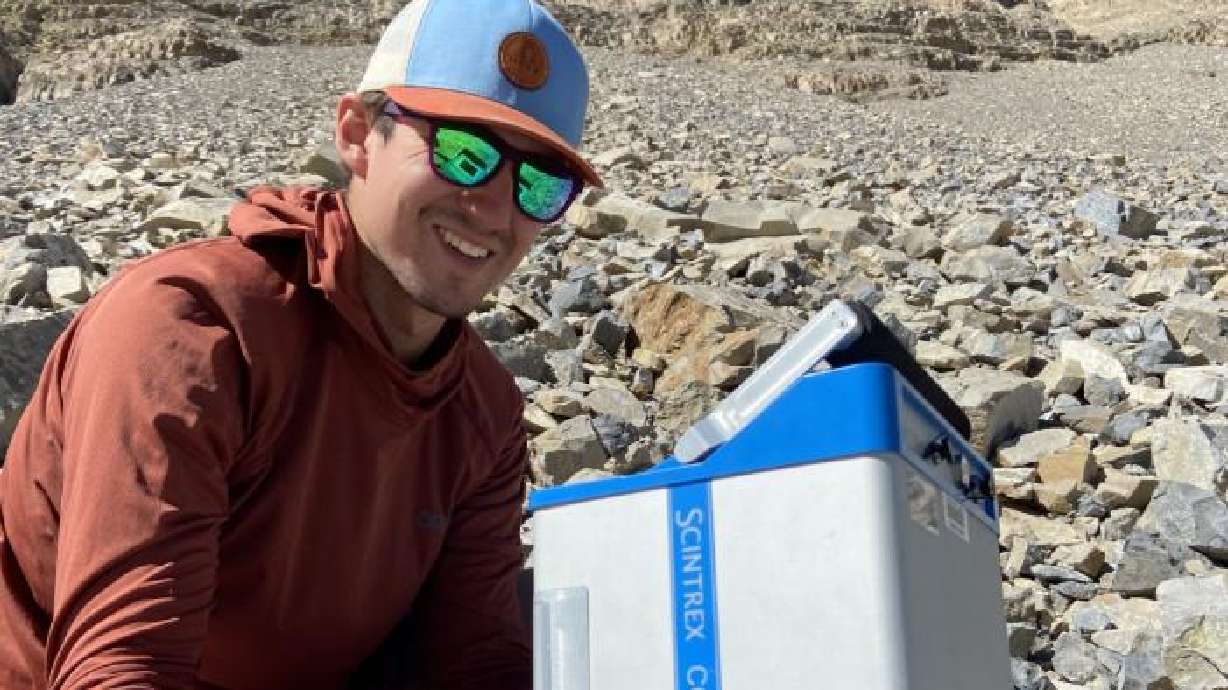
SALT LAKE CITY — New research methods are revealing how much water may be found buried in Utah’s mountains, leading to an updated understanding of our water supply and knowledge of future dangers. There is enough water in the Timpanogos Rock Glacier to fill 600 Olympic-size swimming pools, according to new research by geologists at the University of Utah. How could this be? Geophysicist Michael Thorne says the Timpanogos hikers probably wouldn’t have known they were on a glacier, because it is covered in rocks, gravel and debris. “We suspect there is ice under many of them,” Thorne said. “And when you look from the surface, you can see these features, you can measure how big they are on the surface. But what we can’t do is say how much ice, how thick the ice is underneath them.” In many cases, rock glaciers are just that: just rocks, and the ice has melted, leaving only a rock-filled slope. A photograph is documented in the archives of the University of Utah and BYU on Mount Timpanogos during a ski season. (Photo: U. and BYU Archives) How They Did It Only since Thorne and glaciologist Lief Anderson teamed up, we now know that there is a mass of ice up to 150 feet thick located just above Emerald Lake. Thorne and former graduate student Bronson Cvijanovich worked for a semester on the mountain, testing different devices and measurement methods before finding one that worked. Using “really precise” gravitational acceleration, they created a three-dimensional image of the ice body. “If you go from measuring gravitational acceleration on a rock, like on the rock that makes up Mount Timpanogos, it has higher mass, higher density. But then if I walk on an area that has thicker ice, that ice has less density than the rock. So the gravitational acceleration that we measure is actually lower. And then we can do this modeling,” Anderson said. “That’s part of what we did in this study, develop a new way of doing the modeling to determine from these measurements of gravitational acceleration: This is the thickness of the ice beneath us.” The ice is covered by rocks and debris, and each year, Anderson says snow falls, which is then covered in debris and rock slides, leading to slow but steady growth of the glacier over time. Anderson says the presence of these ice-filled rock glaciers may be good news for Utah. A side-by-side photograph shows the internal view of the Mount Timpanogos rock glacier as mapped by researchers at the University of Utah. (Photo: University of Utah) First, because the glacier can be good for dry, arid climates like Utah, where ice from a rock glacier melts more slowly than an exposed glacier. “That melting occurs in the summer after all or most of the snow, for example, in the Wasatch or Uinta has melted,” Anderson said. “The rock glaciers are providing a kind of sustained flow in late summer into the streams and then also into the groundwater. And that can be an important contribution to the watershed.” Second, because the ice is covered, its meltwater is much colder and can provide important ecological benefits to cold-water species. However, events such as the catastrophic floods in Nepal highlight the danger of these hidden dangers. “It is a horrible tragedy what has happened in Nepal,” Anderson said. “And I know there are a lot of people who have been researching the hazards in highly tectonic places, like the Himalayas or the Wasatch, and how they relate to earthquakes and glaciers and also debris and rocks.” As climates warm, Anderson says geologists are seeing more glaciers retreating, retreating and being covered by debris. “We’re also seeing an increase in these really large catastrophic events related to glacial collapse,” Anderson said. He doesn’t expect these types of events to decrease anytime soon. “The shapes of glaciers are changing with climate change,” he said. “They are shrinking, they are becoming, and that will tend to lead to more unstable situations.” 400,000 Olympic swimming pools. It is estimated that there are about 836 rock glaciers in the state, with enough ice to fill 400,000 Olympic-size swimming pools. “Ice also has the potential to store hidden water. So you can have lakes under glaciers,” Anderson said, adding that work is continuing to identify more ice-filled rocks. State glaciers. “Right now, it looks like the most likely ones are around Mount Timpanogos. And then also in Little Cottonwood Canyon.” The Wasatch Fault adds another layer. “There’s no doubt, right, that on the Wasatch Front, the big danger is the Wasatch Fault and magnitude 7 earthquakes. And so every time you shake mountains, things can fall. And another big danger here.” Anderson pointed out one at Snowbird Ski Resort. “There is a huge rock avalanche deposit that is 1,000 years old,” he said. “Further up, there is one that is about 14,000 years old.” Anderson said the work the team has been doing may help them identify more of these ice-filled rock glaciers, most of which are believed to be around Mount Timpanogos and Little Cottonwood Canyon, where huge amounts of snow accumulate in the rugged mountains. Key findings in this article were generated with the help of large language models and reviewed by our editorial team. The article itself is written solely by humans.