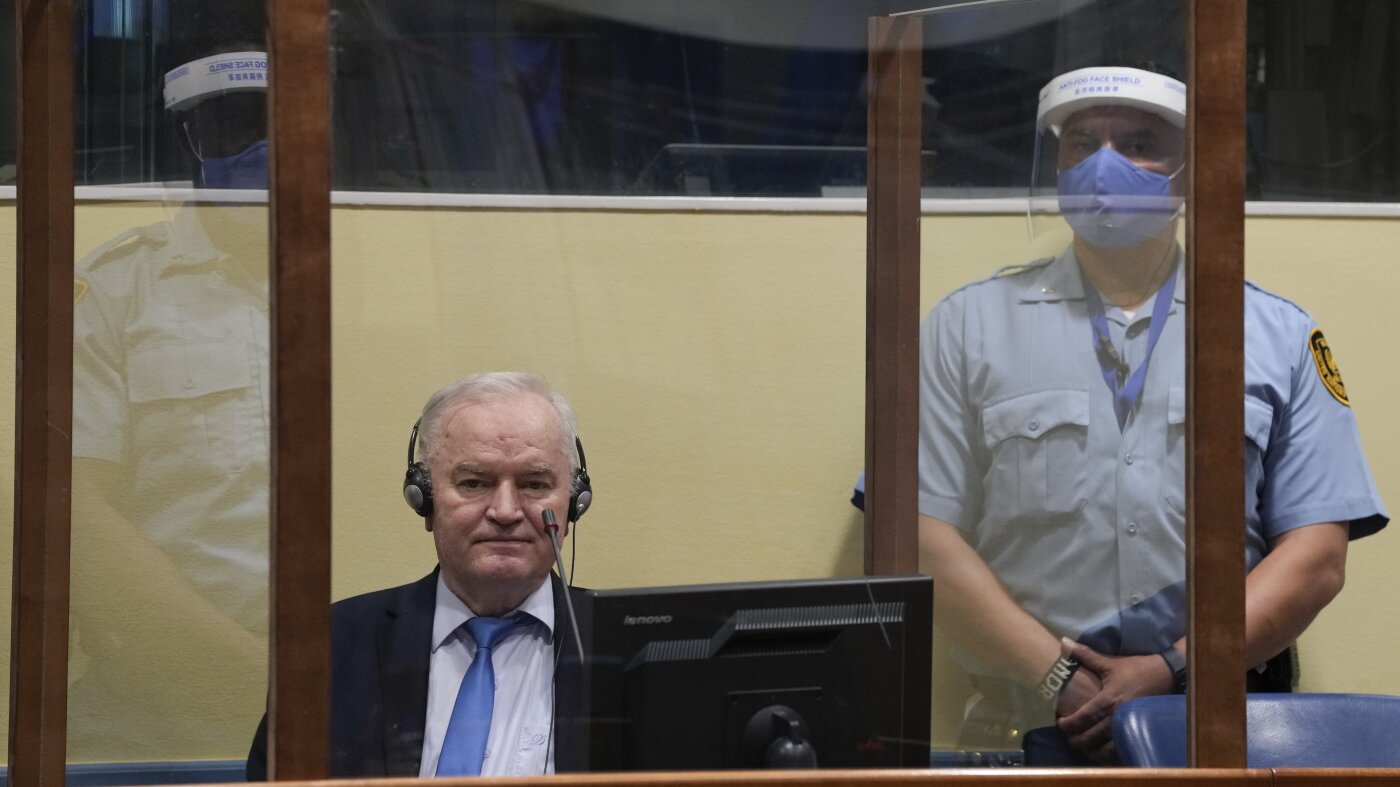
Former Bosnian Serb military chief Ratko Mladic sits in the courtroom in The Hague, Netherlands, June 8, 2021, where the United Nations court delivers its verdict in Mladic’s appeal against his convictions for genocide and other crimes and his life sentence for plotting atrocities during the Bosnian war. Peter Dejong/AP hide caption toggle caption Peter Dejong/AP BELGRADE, Serbia — Ratko Mladic, the optimistic Bosnian Serb general whose forces besieged the Bosnian capital for several years in the 1990s and carried out the worst massacre in Europe since World War II, died Thursday while serving a life sentence for his crimes, U.N. officials said. He was 84 years old. Mladic died in a hospital in The Hague, Netherlands, U.N. court officials said. A relative of Mladic who spoke to The Associated Press on condition of anonymity due to the sensitivity of the situation confirmed the reports and said Mladic’s son, Darko Mladic, was on his way to the Dutch city. The UN tribunal for war crimes committed during the wars in the former Yugoslavia in the 1990s sentenced Mladic to life in prison in 2017, in what was seen as a key step in bringing justice to the victims. He had been detained since 2011 after many years on the run. The ruthless, blue-eyed former communist officer turned nationalist warlord was one of the most notorious figures in the conflict that left more than 100,000 dead and more than 1 million homeless. He ordered his troops to “burn the brains” of Bosnian Muslims and boasted of being a “Serbian God.” A rise to power When ethnic war began in Bosnia and Herzegovina in 1992, Mladic became commander of Bosnian Serb troops and took control of large swathes of the country to form a Serbian mini-state. Serbs under Mladic’s control besieged the Bosnian capital, Sarajevo, and other cities and towns, established concentration camps for non-Serb civilians and detained enemy soldiers, and systematically murdered prisoners. In Sarajevo, Serbian troops kept the city isolated while killing civilians with snipers and heavy artillery. In 1995, Mladic’s troops massacred more than 8,000 Muslim men and boys in Srebrenica, the first case of genocide in Europe since World War II. A mural of former Bosnian Serb military chief Ratko Mladic vandalized with paint in Belgrade, Serbia, on September 20, 2022. Darko Vojinovic/AP hide caption toggle caption Darko Vojinovic/AP But Mladic and his admirers have never regretted it. Many saw him as a patriot fighting for the first pan-Serbian state. Defiant, Mladic acted optimistically during his trial and shouted at the judges as they sentenced him to life in prison. Munira Subasic of the Mothers of Srebrenica group said she had mixed feelings about Mladic’s death and deplored that many Bosnian Serbs continue to deny Mladic’s crimes. “Today a major war criminal has died, the Balkan criminal,” said Subasic. But while the victims’ mothers “still carry the pain in our souls” 31 years later, “we still hear denials, we still hear how Ratko Mladic was a hero for Serbs,” she said. “I’m sorry that he died and that he didn’t suffer a little longer, that he didn’t wait longer and dream with the eyes of our children,” he said. Bosnian Serb General Ratko Mladic (center) speaks with Bosnian Serb President Radovan Karadzic (right) in the Bosnian city of Banja Luka, 1994. Radivoje Pavicic/AP hide caption toggle caption Radivoje Pavicic/AP Residents of Pale, a Bosnian Serb stronghold on the outskirts of Sarajevo, mourned Mladic. “He was killed there, in those dungeons,” said Janko Seslija, a former Bosnian Serb soldier. “I feel sorry for General Mladic. He was an honorable man, an honorable soldier and a commander.” Raised on nationalism, Mladic was born on March 12, 1942, in the small Bosnian village of Bozinovici, in the hills 40 kilometers (25 miles) south of Sarajevo. Like other protagonists of the Yugoslav conflict, he absorbed nationalism from his family’s fate in World War II: his own father was murdered by the Croats. Mladic, a communist-era officer, sided with the Serbs as Yugoslavia disintegrated in the war. Mladic first led a Serb insurgency in Croatia before taking charge of the Bosnian Serb army that was backed by Serbia and then-president Slobodan Milosevic, who also died in custody of the Hague tribunal in 2006 while on trial for genocide. Bosnian Serb General Ratko Mladic (right) speaks on the telephone alongside Russian Army General Vladimir Zurbenko (center) during a Russian Army delegation’s visit to the Bosnian city of Banja Luka in October 1995. Radivoje Pavicic/AP hide caption toggle caption Radivoje Pavicic/AP Mladic was known for his obsession with his nation’s history. He saw the Bosnian War as an opportunity for revenge against the former 500-year Ottoman occupation of Serbia. He often referred to Bosnia’s Muslims as Turks and boasted of revenge when his troops invaded the UN-protected enclave of Srebrenica in 1995. Spurred by Serbian dominance in firepower and international ignorance, Mladic was convinced of his ultimate victory. “The time has come… to take revenge on the Turks in these regions,” Mladic said after taking command of Srebrenica. Civilian massacre Srebrenica, a UN “safe haven” for Muslims, was eventually overrun by Serbs who separated men and boys, forced them to strip naked, killed them and turned their bodies into mass graves in a brutal massacre that lasted more than a week. Srebrenica survivors said one image will forever be etched in their minds: Mladic handing out sweets to Muslim children who had been detained in the town square and assuring them that everything would be fine, even patting one child on the head. Convinced of the power of his army, he used to tell his soldiers: “When I give you guarantees, it is as if God gave them.” To clear the way for his helicopter to land, he told air traffic controllers: “Here speaks Ratko Mladic, the Serbian god.” Sarajevo residents still remember his orders to Serb gunmen who bombed the Bosnian capital in early 1992. He gave his orders over a military radio system, without bothering to encrypt the signal, which was picked up and recorded by Sarajevo police. “Go back to Velesici, there are no Serbs there,” Mladic said as he ordered his artillery to bombard the Sarajevo suburb. “Burn your brains,” he told his gunmen. Life on the run Faced with the accusation of genocide by the UN tribunal, Mladic began his years as a fugitive in 1996 in Han Pijesak, a military complex in eastern Bosnia built for the former communist leader of Yugoslavia, Josip Broz Tito, and designed to withstand a nuclear attack. With his wife, Bosa, Mladic adapted to imposed domesticity, spending time tending bees and goats. His 23 goats are said to have been named after foreign dignitaries he despised, such as Madeleine Albright, former US Secretary of State. Surrounded by security guards, he occasionally ventured out of the dense pine forest to commemorate events such as the anniversary of the Bosnian Serb army and St. Vitus’ Day, a religious holiday commemorating the 1389 Serbian defeat by the Turks in Kosovo. When his trail became too intense in Bosnia in the late 1990s, Mladic moved with his family to a villa near the Serbian capital, Belgrade. There, he was seen at his son’s wedding, at soccer games and in elegant restaurants, refusing to give interviews and smiling curiously when he was photographed. When Milosevic was ousted from power in 2000, and Serbia’s new pro-democratic authorities signaled they might hand Mladic over to the tribunal, tabloids reported that he had left Belgrade for Bosnia. But true to form, Mladic countered those rumors and others that he was terminally ill, and before going into hiding in 2002, he was repeatedly seen driving around the Serbian capital in a yoke. Capture and conviction He disappeared completely from public view in 2008 and was finally arrested in May 2011 in a village near Belgrade, where he was hiding in a relative’s house. The frail-looking old man who appeared before the Hague court was a far cry from the robust wartime image Mladic exuded. But his defiance remained intact. “Everything you said is pure lies. What a shame!” he shouted at the UN judges when they handed down the sentence. Already in poor health when he was arrested in 2011, Mladic is believed to have suffered multiple strokes during his years on the run and was hospitalized on several occasions while in custody.