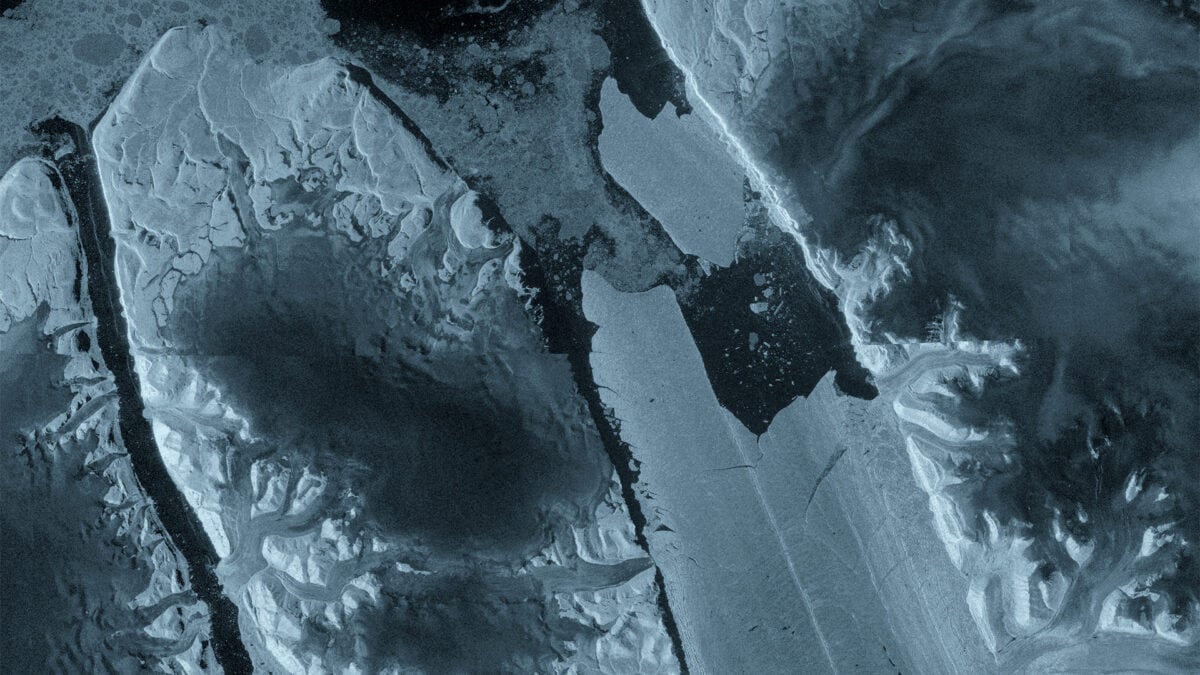
A huge sheet of ice has broken off from one of the largest remaining floating glacier tongues in Greenland, creating an iceberg the size of Manhattan in the Arctic Ocean. The spectacular calving of the Petermann Glacier was captured by satellites in August, giving scientists a stunning view from space of the glacier’s shifting and increasingly fragile ice tongue. The European Space Agency’s (ESA) Copernicus Sentinel-1 mission captured the vast island of ice when it broke off the eastern side of the glacier on August 4. Newly released satellite images revealed fractures within the ice tongue months before the calving event. The 76 square kilometer (29 square mile) section that was released represents the largest loss of floating ice from the Petermann Glacier in more than a decade. And although the rift was years in the making, the sudden separation offers a powerful snapshot of the forces reshaping Greenland’s glaciers. Close monitoring Petermann is one of the largest marine glaciers in Greenland, from which large icebergs frequently break off and dump them into the ocean. Scientists have relied on satellite images to monitor changes in the glacier since 2019. In April, observations revealed deformations and fractures that had begun to develop within the ice tongue. Months later, Sentinel-1 radar images showed pronounced deterioration along the centerline of the ice tongue. The next day, the newly formed ice island had completely broken off. An optical image of the Petermann Glacier from Sentinel-2 (left) and an interferogram from Sentinel-1 (right), revealing deformations and fractures within the ice tongue. Credit: ESA “The changes we observed on Petermann Glacier occurred very rapidly in the run-up to the iceberg calving, so it was incredibly exciting to monitor the crack propagation with interferometry in near real time,” Molly Hammond, a PhD student at the University of Leeds, who processed the Sentinel-1 data, said in a statement. The data allowed for detailed measurements of fracture propagation across the ice shelf in the period before the iceberg calved. Ice loss Several icebergs have calved off the Petermann Glacier in recent years, including a 97-square-mile (251-square-kilometer) iceberg in 2010 and a 50-square-mile (130-square-kilometer) iceberg in 2012. Scientists anticipate at least two more calving events in the near future. As existing cracks continue to propagate across the floating ice tongue, future ice islands are projected to measure around 36.3 square miles (94 square kilometers) and 32.4 square miles (84 square kilometers). Ice islands are a massive subclass of icebergs that generally feature a flat, plateau-shaped top with a large surface area compared to its height. They break off from floating ice shelves or ice tongues in northwest Greenland and northern Ellesmere Island. Arctic ice islands are much rarer than large icebergs and can float for years before deteriorating. According to ESA, researchers will continue to monitor the Petermann Glacier, as well as the newly formed ice island, using satellite images, aerial observations and tracking data to monitor its movement and fragmentation over time. “Satellite missions like Sentinel-1 provide the systematic long-term observations needed to track these changes, helping scientists better understand the processes driving the calving and the broader impacts on the polar environment and ultimately the Earth system as a whole,” ESA’s Martin Wearing said in a statement.