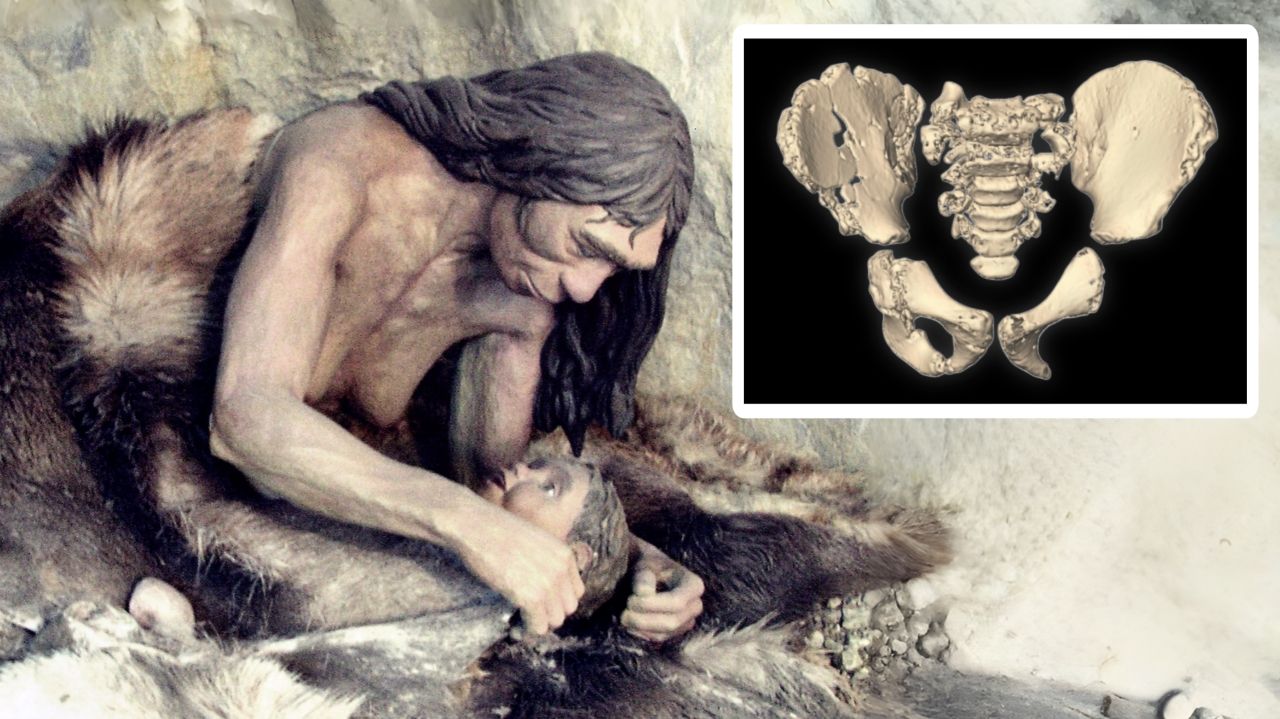
For decades, scientists have used the human pelvis to study a basic question about our evolution: How did our ancestors balance walking upright with giving birth to babies with big brains? Neanderthal pelvises challenge a long-held idea about childbirth and walking. Credit: Jaroslav A. Polák / Zollikofer et al., Proceedings of the National Academy of Sciences (2026) A new study of two unusually well-preserved Neanderthal skeletons challenges the classical answer. The researchers found close similarities between the female pelvises of Neanderthals and modern humans in areas related to childbirth. Characteristics related to walking, by contrast, differed in several key ways. The findings, published in the Proceedings of the National Academy of Sciences, suggest that the main evolutionary trade-off was not between childbirth and efficient walking. Instead, the researchers argue, the pelvic shape was shaped in part by the need to give birth while keeping the pelvic floor stable. The study focused on two rare fossils. One belonged to a one-and-a-half-year-old Neanderthal boy from the Dederiyeh Cave in Syria. The other belonged to a young adult female from Sima de las Palomas in Spain. Both had pelvic bones well enough preserved for detailed study. The team used medical CT scans, digital cleaning methods and 3D reconstruction to study the bones without disturbing the fossils. They compared the new models to other Neanderthal pelvises, including the female Tabun and the male Kebara, as well as scans of modern humans. The Neanderthal child already showed several features typical of adult Neanderthals. The shoulder blades of the hips flared outward, while the pelvis was relatively short from front to back compared to its width. This suggests that the basic pelvic shape of Neanderthals developed early in life. Virtual reconstruction of the pelvis of Neanderthals. (A) Dederiyeh Cave Baby (“Dederiyeh 1”). (B) Young adult female from the Sima de las Palomas del Cabezo Gordo (“Paloma”). (Scale bar, 5 cm.). Credit: Zollikofer et al., Proceedings of the National Academy of Sciences (2026) The results also point to a close link between Neanderthal and modern human birth. Neanderthal women had a wider birth canal than men, just like modern human women. The shape of the regions involved in birth was also very similar between the two groups. These similarities suggest that Neanderthal women and modern human women likely used very similar birth mechanisms. Both groups faced the challenge of delivering babies with relatively large brains through the pelvic canal. Differences appear in other parts of the pelvis. Neanderthals had hip joints and muscle attachment patterns suitable for a different style of standing and walking. Their pelvises also showed reduced pelvic tilt and less lower back curvature than modern humans. These characteristics point to differences in posture and gait rather than a simple trade-off between a wide birth canal and fast, efficient gait. The finding is important because the so-called Obstetric Dilemma Hypothesis has shaped research on the human pelvis for decades. The idea holds that evolution had to balance the need for a wide birth canal with a pelvis suitable for upright walking. Some researchers have already questioned this model. Wider hips do not appear to greatly reduce walking or running performance, raising questions about whether locomotion was the main limit on pelvic fitness. The new Neanderthal evidence adds a different possibility. A wide birth canal may have placed greater demands on the pelvic floor, which supports internal organs and helps maintain stability. The fossil record also offers clues about how these body shapes changed over time. The oldest Australopithecus and early Homo fossils had wide pelvises with a side-to-side shape closer to that of Neanderthals. The narrower front-to-back shape of modern humans appears to be a later evolutionary change. Taken together, the results suggest that Neanderthals and modern humans followed different paths in pelvic configuration. Their anatomy related to childbirth remained strikingly similar, while their anatomy related to movement took different forms. The study therefore shifts attention from walking alone to the broader demands placed on the pelvis. For hundreds of thousands of years, childbirth and pelvic floor stability may have been a more important evolutionary conflict than childbirth and locomotion. Publication: Zollikofer, CPE, Ponce de León, MS, Uriarte, MH, López, MV, Ortega, J., Kondo, O.,… Walker, MJ (2026). Information on the development, birth and locomotion of Neanderthals from the Palomas and Dederiyeh pelves. Proceedings of the National Academy of Sciences of the United States of America, 123(35), e2535303123. doi:10.1073/pnas.2535303123