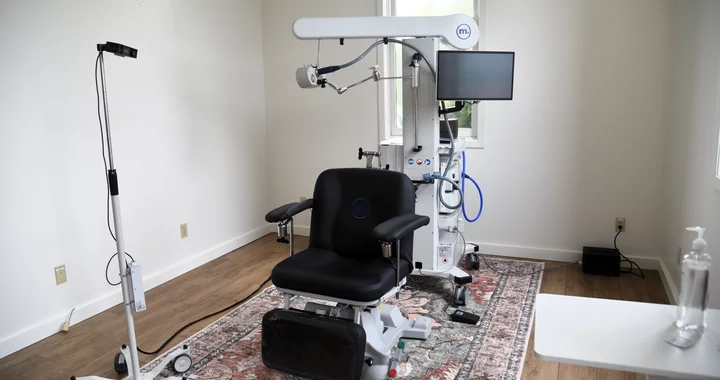
Where patients will sit for Transcranial Magnetic Stimulation (TMS) in Humboldt Counseling Connection’s new Eureka office. Photos by Sage Alexander.An electric coil is attached to the scalp. Magnetic fields are sent into a particular spot on the brain, penetrating the skull and stimulating nerve cells.It involves no surgery, no pain (save, perhaps, a mild headache) and patients stay awake through the short sessions. It’s not entirely understood why it works, but the procedure is approved by the FDA to treat major depressive disorder, anxious depression and obsessive compulsive disorder. Residents of Humboldt County — where statistics reflect troubling mental health trends — will now have the option of receiving Transcranial Magnetic Stimulation (TMS) through two providers in Eureka and Arcata.“I’ve been trying to get several of my patients to get covered for this, out of the area,” said Mariel Bosserman, a psychiatric mental health nurse practitioner at Humboldt Counseling Connection .“It was just impossible because of the logistics,” she said.The regiment typically involves around 30 short sessions over seven weeks, meaning extended time off work and lodging costs for people to stay hundreds of miles away, something insurance wouldn’t cover. Plus, people typically need “maintenance treatments” further down the line.Effectively, this made TMS out of reach for many people living in Humboldt County. Providers there are hopeful now, people will be able to simply drop in for a magnetic session during lunch breaks. The machine in Humboldt Counseling Connection’s office consists of instruments attached to a seat that resembles, at first glance, a dentist’s chair. A science fiction-like device scans and maps the parts of a brain, and the sections that need to be stimulated are highlighted on a monitor. A technician will then carefully tilt a treatment coil to match the precise angle needed, and begin sending waves to the right part of the brain.
Staff at Humboldt Counseling Connection demonstrate the device for the Outpost. Left, Joselyn Legacy, director of operations, and right, Mariel Bosserman, PMHVP. It’s believed the magnetic fields improve neuroplasticity. A TMS device was first invented in 1985 and has since been researched widely for a spread of conditions. Depending on the treatment, the fields stimulate underactive areas or calm overactive areas. Providers were interested in TMS because it offers something for patients who haven’t responded to multiple medications.Bosserman said that research shows generally, about 30% of people respond to their first antidepressant medication. Adding a second antidepressant medication, about half as many people will respond.
“I’ve seen people that have tried like 10 medications in the same class and there’s really no data supporting the efficacy for that. So having another treatment that’s non-invasive is really, really powerful,” she said. While medications work for some, others don’t see improvement or struggle navigating a gauntlet of new side effects, she said. TMS is particularly used in the U.S. to treat major depression in folks whose symptoms didn’t respond to the first couple of medications. In studies, about half of people with depression who didn’t receive benefit from medications have a clinically meaningful response with TMS, and a third of those saw their symptoms go away completely.Joselyn Legacy, director of operations at HCC, said their overall goal is to find what the community needs in mental health care and fill in gaps.With high demand and a broadly under-resourced system, “we want to not just throw resources at something, but think very intentionally about how we’re meeting the needs of our community,” she said.
“Our mental health system is not quite as robust as it is in some other areas. But I think that by adding in certain things, like adding an option for TMS referrals, we’re really kind of bringing our county up to par with [better-resourced areas],” said Bosserman.TMS treatments began August 25, and the office is starting with 16 patients.
From left to right: Mariel Bosserman, Joselyn Legacy, and TMS tech Emily Evans pose beside the new machine.###Almost concurrently, another local mental health provider is adding the treatment to their repertoire. The Arcata office of the Humboldt Center for New Growth is calming. Fabric blocks harsh overhead lighting and fur blankets adorn cozy day beds in therapy rooms. Previously, the Center for New Growth referred patients to providers in the San Francisco Bay Area or Chico for TMS. But, like at HCC, patients struggled with the logistics involved. Mental health providers there said TMS fits in naturally with the Center’s other treatments. “It felt like the right bit of expansion. It gives us another way to work with people’s brains and biology,” said Dr. Carrie Griffin, medical director of the Humboldt Center for New Growth. Kayla Kinsman, a Psychiatric Mental Health Nurse Practitioner DNP who spearheaded bringing TMS to the Center, treats patients using ketamine-assisted psychotherapy and Spravato at the center. But “there’s a few medical contraindications for ketamine,” she said. TMS is helpful to add to the roster, she said, because some patients have conditions that make use of other treatments unsafe — say, they can’t take ketamine due to high blood pressure, or they have a history of psychosis. Or, patients may not have responded to these other treatments and it’s time to try something else.
Ruby the dog sunbathes at Humboldt Center For New Growth’s office in Arcata.In the U.S., TMS treatment is FDA approved — and thus billable through insurance — for a handful of conditions. TMS was approved by the FDA for major depression in 2008, and gradually more symptoms are being studied with the treatment. Even smoking cessation and pain relief for certain migraines are FDA approved.Griffin said other countries are using TMS as the main intervention for substance use disorder, and it is increasingly being used to treat PTSD. (While the treatment hasn’t been approved by the FDA for PTSD, U.S. research is showing very positive results.)Griffin said broadly, much of the work at the Center for New Growth involves addressing symptoms that are an artifact of developmental trauma disorder. “A lot of what we treat, especially at Center for New Growth, is people who, yes, they meet the criteria for major depressive disorder, yes, they meet criteria for general anxiety, but what they also have is an underlying nervous system foundation of dysregulation and attachment disruption, and that’s caused from chronic failures of caregiving in the early years of development,” she said.Adults in Humboldt County have among the highest rates of Adverse Childhood Experiences in the state, with about 30% reporting an ACE score of 4 or higher. Higher ACE scores correlate with adult physical and mental health problems. Humboldt County has roughly double the statewide rate of suicide. Griffin said she’s interested in offering emerging treatments where patients don’t need “endless amounts of willingness or willfulness.” Their overall mission is transforming trauma and suffering into wholeness, she said. “A lot of the people who come here, they’ve already done a lot of things, right? They’ve already been on a lot of medications through their primary care provider, through other psychiatric providers, they’ve been to multiple different kinds of therapists. Typically, if they’re reaching out to the Center for New Growth, maybe it’s for ketamine work, but it might just be for a more integrative, holistic approach to their mental health care or their physical care,” she said. The Center for New Growth is starting by treating about 6 patients at a time with TMS beginning September 1. ### When asked why they worked to bring the service to Humboldt County, providers at both location had similar stories. It was needed in the local network of care, it made sense for their practice and people will benefit from having more options.Humboldt Counseling Connection’s new annex, where the treatment will be offered, is located at 100 H street in Eureka. It accepts Medi-Cal/Partnership and multiple private insurance plans. Visit www.humcounseling.com/tms to learn more.The Center for New Growth will offer TMS at 770 11th street in Arcata, and can be reached at their main office line at 707-267-7931. It accepts Medicare, Partnership and is contracted with the U.S. Department of Veterans Affairs.