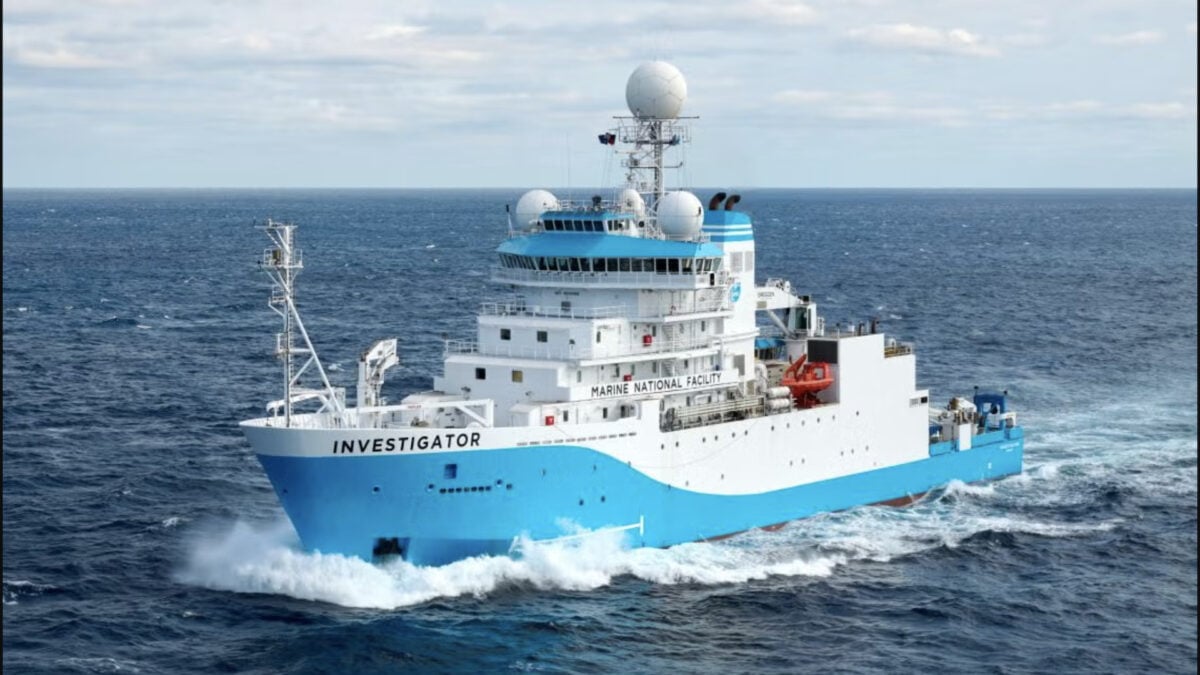
A 24-day journey across the coast of Queensland, Australia, revealed the hidden lives of indigenous people who once occupied an ancient landscape frozen in time. A team of scientists and Aboriginal rangers have discovered a submerged landscape beneath Australia’s Great Barrier Reef, mapping rivers, lakes, estuaries and beaches in great detail. The hidden coastal plain was where First Nations people once lived before sea levels rose about 7,000 years ago and submerged the area under water. “First Nations people arrived in Australia more than 65,000 years ago, when sea level was 80 meters below today,” Helen Bostock, a researcher at the University of Queensland who served as lead scientist on the trip, said in a statement. “At the time, the Great Barrier Reef area was a vast coastal plain bordered by towering forests stretching inland.” A hidden world The research team embarked on a boat called the Investigator, and the resulting voyage was co-designed with the Darumbal traditional owners of Sea Country and the neighboring Woppaburra people. Using high-resolution maps, researchers combined scientific findings with Aboriginal cultural knowledge to reconstruct the history of the ancient landscape. The sonar system aboard the ship mapped a landscape frozen in time. “Our research has revealed submerged rivers, lakes, estuaries and beaches in stunning detail that helps tell the story of the First Nations who lived on this land in times past,” Bostock said. To help reconstruct previous conditions, researchers collected more than 20 sediment cores from the seafloor to examine various types of fossils. The data will help them reconstruct the historical climate, sea level rise, vegetation and evolution of the southern Great Barrier Reef in a process known as paleoenvironmental reconstruction. “Seafloor sediments act as time capsules and allow us to reconstruct the history of the region, from its past as a broad coastal plain to the development of the modern Great Barrier Reef, and connect this with the cultural stories of the Darumbal people and their close neighbors, the Woppaburra people,” Bostock said. Journey through time The research aims to connect indigenous people with their ancient landscape and preserve the history found beneath the ocean. “We hope this journey makes our families, ancestors and the Darumbal people proud, while creating stronger pathways for our younger generations to continue caring for and protecting our land and sea country,” Nataliah Backo, land and sea ranger for the Darumbal people, said in a statement. Oceanographic data will also be used to understand past and present ocean conditions and predict how future changes could affect the reef. “By interweaving modern science and traditional knowledge systems, we have a much greater understanding of the history of the southern Great Barrier Reef, which will help us better protect its incredible natural and cultural values in the future,” Bostock said.